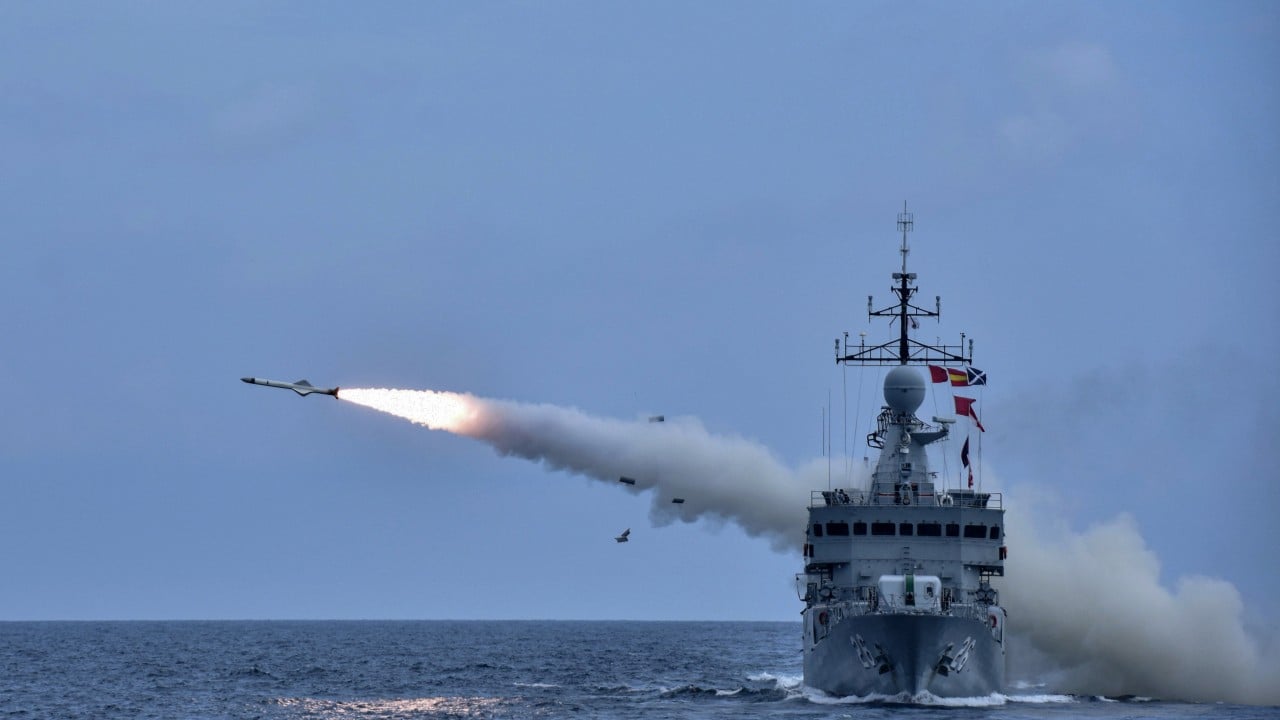
Procurement failures in defense rarely stem from kinetic deficits; they originate in political friction along the supply chain. When Malaysia pivoted from Norwegian anti-ship missiles to Turkish alternatives for its Littoral Combat Ship (LCS) program, the decision was not an isolated hardware swap. It was a structural recalculation of geopolitical risk, industrial offset viability, and lifecycle sustainment. Kuala Lumpur effectively traded a technically mature Western supplier—Kongsberg Defence & Aerospace—for Roketsan, an emerging defense contractor operating under a fundamentally different export regime.
To understand this shift, one must deconstruct the friction between Western end-user compliance frameworks and the operational demands of middle-power navies. The conventional narrative frames this event as a simple vendor replacement following an export freeze. That surface-level reading misses the underlying mechanics of defense industrial base resilience, subsystem integration penalties, and the strategic vulnerability of single-source Western armaments in non-aligned states.
The Anatomy of the Export Freeze
Defense procurement contracts operate on a fragile equilibrium between buyer autonomy and seller sovereignty. When a state acquires a Tier-1 weapon system like the Naval Strike Missile (NSM), it does not merely purchase an airframe, a turbojet engine, and an imaging infrared seeker. It enters a continuous regulatory dependency governed by the exporting nation's foreign policy apparatus.
Norway’s export control architecture is among the most stringent globally. Governed by the Export Control Act of 1987 and enforced by the Ministry of Foreign Affairs, Norwegian defense exports require explicit end-user guarantees and are subject to continuous political review. Unlike major arms exporters that view defense sales primarily through the lens of strategic alignment and industrial scale, Oslo weights human rights assessments, regional conflict volatility, and domestic parliamentary consensus heavily in its licensing matrices.
The Three Failure Modes of Western Defense Dependency
For a recipient nation like Malaysia—which maintains a non-aligned foreign policy and vocal diplomatic stances on Middle Eastern geopolitics—relying on Northern European defense hardware introduces three distinct operational vulnerabilities:
- Retroactive Licensing Revocation: An approved initial sale does not guarantee the uninterrupted delivery of spares, software updates, or mid-life upgrades. Political shifts in the supplier nation can freeze active contracts mid-execution, leaving hulls in the water without primary offensive payloads.
- Third-Party Component Vetoes: Modern anti-ship cruise missiles are complex assemblies of globally sourced subsystems. Even if Oslo approves a transfer, a single American, German, or British gyroscope, microchip, or propulsion component embedded within the missile triggers the International Traffic in Arms Regulations (ITAR) or equivalent European export controls. A veto by any secondary component manufacturer paralyzes the entire system.
- Operational Deployment Restrictions: Western end-user agreements frequently stipulate conditions on how, where, and against whom munitions may be deployed. For a maritime nation managing contested claims in the South China Sea, sovereign command over deterrent assets is non-negotiable.
The freeze on Norwegian missile deliveries exposed Malaysia’s LCS hulls to the worst possible outcome in naval engineering: a "fitted for, but not with" (FFBNW) configuration that degrades a multi-billion-dollar surface combatant into an oversized offshore patrol vessel.
The Structural Logic of the Turkish Alternative
Turkey’s defense industrial base (Savunma Sanayii Başkanlığı) evolved specifically to bypass the exact bottlenecks Malaysia encountered. Subjected to repeated Western arms embargoes—most notably the US CAATSA sanctions following the S-400 acquisition and Canadian restrictions on electro-optical sensors—Ankara systematically engineered out foreign dependencies from its primary munitions programs.
When Malaysia evaluated Roketsan’s Atmaca anti-ship missile to replace the Kongsberg NSM, the decision matrix was governed by supply chain insulation rather than marginal differences in aerodynamic performance.
Deconstructing the Atmaca Value Proposition
The Atmaca is not merely a functional equivalent to the NSM; it represents a different philosophy of defense industrial architecture:
- ITAR-Free Componentry: Following Western export blocks on French-made Safran TR40 turbojet engines, Turkey accelerated the domestic development and integration of the Kale Arge KTJ-3200 turbojet. By localizing propulsion, inertial navigation, and seeker manufacturing, Ankara eliminated third-party veto points. Kuala Lumpur can procure the weapon system without seeking tacit approval from Washington, Brussels, or Berlin.
- Political Alignment on Export Controls: Turkey’s defense export policy is transactional and strategic. Ankara views arms transfers as instruments to build bilateral coalitions with middle powers, particularly within the Organization of Islamic Cooperation (OIC). The probability of Ankara freezing spares or munitions over domestic political disputes in Kuala Lumpur is statistically negligible compared to a Scandinavian parliament.
- Industrial Offset and Technology Transfer (ToT): Western defense primes generally guard intellectual property fiercely, restricting local partners to low-value assembly or basic maintenance, repair, and overhaul (MRO) tasks. Turkish contractors, aggressive in capturing market share from established Western monopolies, routinely bundle deep technology transfers, local manufacturing participation, and source-code access into baseline contracts.
Technical Equivalence vs. Integration Friction
Swapping a primary weapon system mid-construction is never a plug-and-play exercise. Naval architecture is a zero-sum game of weight, space, power, and cooling (SWaP-C), underpinned by complex combat management system (CMS) software integration.
While the Norwegian NSM and the Turkish Atmaca share broad operational profiles—both are subsonic, sea-skimming, long-range anti-ship cruise missiles—their physical and digital interfaces diverge significantly.
Kinematic and Seeker Trade-offs
To assess the operational impact of this pivot, one must compare the underlying engineering philosophies of both systems without relying on unverified marketing claims:
- Propulsion and Range: Both systems utilize high-subsonic turbojet propulsion, achieving operational ranges exceeding 200 kilometers. The NSM relies on a micro-turbojet paired with a solid-propellant booster, optimized for low-observable flight profiles. The Atmaca utilizes a similar booster-sustainer architecture, initially powered by the French TR40 and transitioning to the indigenous KTJ-3200. In pure kinematic terms, coastal defense and surface warfare commanders face nearly identical threat envelopes.
- Guidance and Terminal Homing: Here lies the primary technical divergence. The NSM relies exclusively on a passive Imaging Infrared (IIR) seeker combined with an autonomous target recognition database. Because it emits no radar energy during its terminal phase, the NSM does not trigger standard Radar Warning Receivers (RWR) on target vessels, compressing the defender's reaction window. The Atmaca, conversely, employs an active Radio Frequency (RF) radar seeker supported by a two-way datalink, inertial navigation, and GPS. While an active RF seeker provides superior all-weather performance and the ability to re-task the missile mid-flight via datalink, it emits electromagnetic radiation that modern electronic support measures (ESM) can detect prior to impact.
- Low Observability: The NSM airframe was designed from inception around stealth geometry, utilizing composite materials to minimize its radar cross-section (RCS). The Atmaca incorporates RCS-reduction features, but its conventional cylindrical fuselage is less aggressively faceted than the Norwegian design.
The Combat Management System Bottleneck
The true cost of Malaysia’s pivot is not measured in unit missile price, but in systems integration labor. Malaysia’s Maharaja Lela-class frigates (the LCS program) are built around the Naval Group SETIS combat management system.
Integrating a missile into a warship requires deep software harmonization between the ship’s fire-control radar, the CMS, the vertical launch system or deck-mounted canister launchers, and the missile’s own mission planning computer. The NSM had already undergone extensive architectural mapping for the LCS design. Replacing it with the Atmaca forces naval engineers to execute a costly re-engineering loop:
- Structural Recalibration: Deck-mounted launchers must be redesigned to accommodate the Atmaca’s specific canister dimensions, blast deflection profiles, and weight distribution, altering the ship's center of gravity calculations.
- Software Interface Rewriting: Engineers must build new data bridges between the French SETIS CMS and the Turkish fire-control consoles. Because European defense primes are notoriously protective of CMS source codes, getting Naval Group to integrate a non-NATO, non-Western missile onto a French software backbone introduces severe contractual friction and intellectual property disputes.
- Testing and Certification: Every modification to the weapon-ship interface invalidates prior safety and electromagnetic compatibility (EMC) certifications, requiring new live-fire trials and shock-testing protocols that extend delivery timelines by years.
The Cost Function of Geopolitical Hedging
Malaysia’s LCS program is already a case study in procurement mismanagement, plagued by cost overruns, design changes, and construction delays spanning over a decade. Adding a major subsystem substitution mid-stream appears, on the surface, to violate basic project management discipline.
However, applying standard corporate project management metrics to state-level defense procurement produces a distorted conclusion. A corporation optimizes for capital efficiency and time-to-market; a sovereign state optimizes for strategic autonomy and operational continuity under crisis conditions.
Calculating the True Risk-Adjusted Cost
If Kuala Lumpur had attempted to wait out the Norwegian export freeze or negotiate diplomatic exemptions, the cost function would have included an unquantifiable strategic liability: an indefinite operational blackout. A warship without missiles is a sunk cost yielding zero deterrence value.
By accepting the immediate financial and schedule penalties of integrating the Atmaca, Malaysia internalized a known, bounded cost (re-engineering and integration fees) to eliminate an unbounded existential risk (permanent loss of strike capability).
This decision reflects a broader structural shift across Southeast Asia and the Global South. Middle powers are increasingly unwilling to accept the binary geopolitical alignment demanded by Western defense ecosystems. As the United States and European nations weaponize export controls, financial networks, and supply chains to enforce foreign policy norms, buyer nations are executing defensive diversification strategies.
The Rise of the "Non-Aligned Defense Tier"
Turkey, alongside South Korea, India, and Brazil, has successfully positioned itself in a newly formed tier of global arms suppliers. These nations offer high-end kinetic capabilities—supersonic missiles, fourth-generation fighter upgrades, armed unmanned aerial vehicles, and modern surface combatants—without the ideological strings attached to Washington or Brussels.
For Malaysia, acquiring the Atmaca establishes a vital industrial beachhead. It creates institutional familiarity between the Royal Malaysian Navy (RMN) and Turkish defense engineers, paving the way for future acquisitions in unmanned surface vessels (USVs), electronic warfare suites, and corvette-class hulls—such as the Littoral Mission Ship (LMS) Batch 2 program, where Turkish designs have already secured prime consideration.
Operational Limitations and Strategic Vulnerabilities
While the pivot to Turkey solves the immediate problem of Western export freezes, it does not eliminate supply chain risk; it merely shifts the vector of vulnerability. Strategic consultants must account for the second-order consequences of adopting an emerging defense ecosystem.
The Maturity Deficit
Kongsberg’s NSM is operational across the US Navy, the Royal Norwegian Navy, and multiple NATO fleets. It possesses thousands of hours of flight-test data, proven resilience against advanced electronic countermeasures (ECM), and an established global logistics network.
The Atmaca is a capable system, but it is comparatively young. Its operational track record is largely confined to the Turkish Naval Forces. Malaysia is effectively acting as an early-adopter export customer, which carries inherent technical risks:
- Unproven Counter-Countermeasure Resilience: Modern naval warfare is an electronic duel. How the Atmaca’s active RF seeker performs against advanced Western or Chinese Digital Radio Frequency Memory (DRFM) jammers and chaff dispensers remains largely theoretical outside classified Turkish test ranges.
- Logistics and Sustainment Scalability: Roketsan does not yet possess the global forward-deployed spare parts infrastructure of a Raytheon or MBDA. Maintaining high readiness rates for the Atmaca will require Malaysia to invest heavily in domestic stockpiling and local maintenance facilities, transferring inventory carrying costs directly onto the RMN’s balance sheet.
The Secondary Sanctions Horizon
Turkey’s defense industry operates in a complex geopolitical gray zone. While Ankara is a NATO member, its independent foreign policy frequently triggers friction with the US Congress and European parliaments.
If Turkey experiences a renewed wave of Western sanctions—whether over regional military operations, energy disputes, or dual-use technology transfers—Roketsan’s supply chain could face secondary disruptions. Even with indigenous engines and seekers, modern missile manufacturing relies on specialized machine tools, high-grade aluminum alloys, and precision electronics that are globally traded. Malaysia has insulated itself from direct Norwegian political vetoes, only to expose itself indirectly to Ankara’s turbulent diplomatic relationships with the West.
Strategic Execution for Defense Procurement Agencies
Malaysia’s pivot offers a precise blueprint for defense ministries navigating multipolar supply chain fragmentation. To execute a mid-program weapon system substitution without inducing systemic collapse, procurement leaders must enforce three operational controls:
- Mandate Open-Architecture Combat Systems: Never procure proprietary, closed-source Combat Management Systems for major surface combatants. Future hull acquisitions must require open-architecture software frameworks (such as the US Navy’s AEGIS Common Source Library model or modular European equivalents) that allow national engineers to integrate third-party sensors and effectors without paying exorbitant licensing fees or surrendering source-code sovereignty to the prime contractor.
- Audit Sub-Tier Component Origins: Before signing any defense contract, procurement teams must map the bill of materials down to Tier-3 suppliers. Identifying ITAR-controlled components or single-source European sub-assemblies prior to contract execution prevents unexpected export freezes years into the build cycle. If a critical subsystem relies on a politically volatile supplier, the contract must include escrow clauses for technical data packages or pre-funded alternative sourcing.
- Price Integration Penalties into Baseline Bids: When comparing Western Tier-1 munitions against emerging non-aligned alternatives, evaluators must calculate the Total Cost of Ownership (TCO) rather than unit flyaway cost. The true price of an ITAR-free missile includes the engineering hours required to rewrite CMS interfaces, re-certify deck launchers, and build sovereign domestic MRO depots.
Malaysia’s shift from Oslo to Ankara signals the end of Western monopoly pricing and political leverage in mid-tier naval armaments. As export controls tighten globally, the decisive metric in defense procurement is no longer just the kinetic reach of the missile, but the political resilience of the supply chain that builds it.