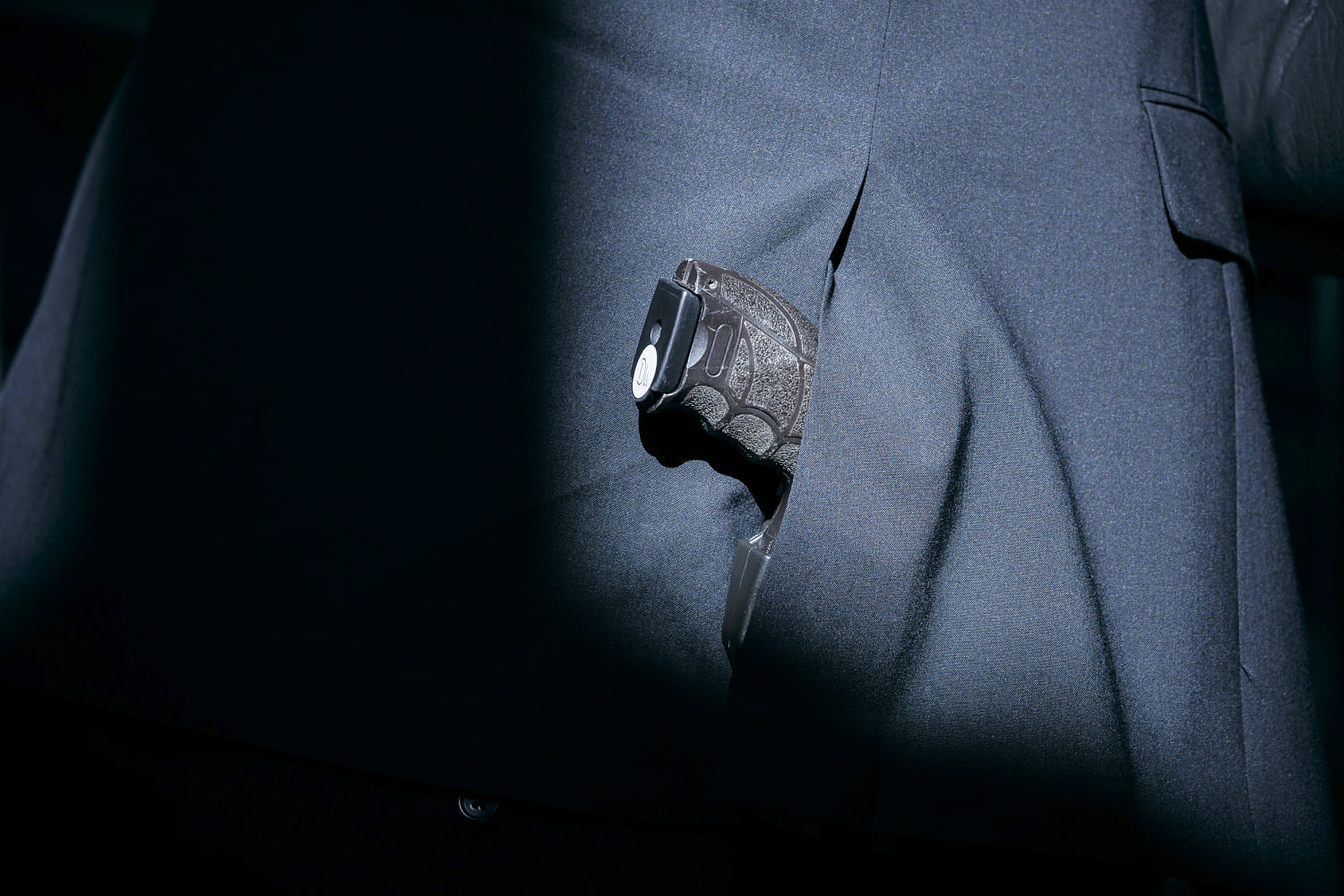
The United States Supreme Court refused to intervene in a major Second Amendment dispute, declining to hear an emergency challenge to Maryland’s sweeping restrictions on carrying firearms in "sensitive places." By denying the petition without comment, the justices left in place a lower court framework that allows state officials to bar concealed carry permit holders from parks, mass transit, museums, healthcare facilities, and establishments serving alcohol while broader appellate litigation continues.
That procedural silence carries massive weight. When the high court declines an emergency docket request—often called the shadow docket—it is not issuing a final ruling on the constitutional merits of the underlying statute. Instead, it is signaling a deep reluctance to short-circuit the appellate process before lower courts have fully developed a historical record. For gun rights advocates who expected rapid intervention following the Court's landmark 2022 decision in New York State Rifle & Pistol Association v. Bruen, this denial is a sobering reminder that dismantling state-level gun control laws will take years, not months. For an alternative perspective, consider: this related article.
The Post-Bruen Battlefield
To understand why Maryland’s law survived this initial brush with the Supreme Court, you have to look at the legal earthquake caused by Bruen. In June 2022, Justice Clarence Thomas wrote for a 6-3 conservative majority that the Second Amendment protects an individual's right to carry a handgun for self-defense outside the home. Crucially, the Court threw out the traditional two-step balancing test that federal courts had used for over a decade—a test that weighed public safety benefits against constitutional burdens.
In its place, the Court installed a strict historical analogue test. Under Bruen, the government can no longer justify a gun restriction by pointing to crime statistics or public safety studies. Regulators must instead prove that the modern law is consistent with the nation’s historical tradition of firearm regulation, specifically looking at laws enacted around 1791 when the Second Amendment was ratified, or 1868 when the Fourteenth Amendment applied those protections to the states. Further analysis on this matter has been published by NBC News.
Maryland, like New York, New Jersey, and California, responded to Bruen by rewriting its concealed carry rules. Forced to abandon its "good and substantial reason" requirement for issuing permits, the Maryland General Assembly passed Senate Bill 1 in 2023. Unable to stop citizens from getting permits, lawmakers drastically shrank the map of where those permits could actually be used.
How Sensitive Places Became the New Frontline
Justice Thomas acknowledged in Bruen that the government has always had the authority to ban firearms in certain "sensitive places," such as legislative assemblies, polling places, and courthouses. He noted that courts could use analogies to those historical locations to justify modern restrictions in similar spaces.
States immediately seized on that footnote.
Maryland’s Senate Bill 1 designated huge swaths of public and private life as off-limits to armed citizens. The law prohibited carrying handguns in:
- Government and educational buildings, including public schools and state universities.
- Healthcare facilities, ranging from major hospitals to private medical offices.
- Public gathering spaces, such as stadiums, amusement parks, racetracks, and casinos.
- State parks, forests, and mass transit systems, effectively barring armed commuters from taking the bus or train.
- Locations selling alcohol or cannabis for on-site consumption, turning every restaurant with a liquor license into a gun-free zone.
- Private property by default, known as the "vampire rule," which made it a crime to carry a firearm onto any private property open to the public—like a grocery store or gas station—unless the owner posted explicit signage granting permission.
Gun rights organizations, led by the Maryland Shall Issue coalition and the Firearms Policy Coalition, immediately sued. They argued that Maryland had twisted the "sensitive places" exception into a rule that swallowed the right itself. If you cannot carry a gun on public transit, in a park, or inside any business without a special sign on the door, the right to carry outside the home becomes a legal fiction.
Inside the Litigation Chess Match
The procedural path that brought this case to the Supreme Court's doorstep reveals the friction between federal district courts and appellate panels trying to apply Bruen.
U.S. District Judge George L. Russell III initially gave challengers a partial victory. He blocked the state from enforcing the ban in locations serving alcohol, inside museums, and on private property open to the public, concluding that Maryland had failed to produce 18th- or 19th-century historical analogues for those specific bans. However, Judge Russell allowed the state to continue enforcing bans in parks, mass transit, healthcare facilities, and entertainment venues while the lawsuit moved forward.
Both sides appealed to the U.S. Court of Appeals for the Fourth Circuit. While the full appeal was pending, the Fourth Circuit granted Maryland's request to stay—or pause—the district court's injunction, allowing nearly the entire law to take effect while the judges considered the merits.
Challengers then turned to the Supreme Court, filing an emergency application to vacate the Fourth Circuit's stay. They argued that every day the law remained in effect constituted an irreparable injury to the constitutional rights of law-abiding permit holders.
Why the Justices Refused to Step In
The Supreme Court’s denial of that emergency request fits a clear, emerging pattern. Over the past two years, the justices have repeatedly turned away emergency petitions seeking to immediately halt state gun laws in New York, Illinois, and Maryland.
There is a straightforward institutional reason for this restraint. Emergency docket petitions are decided on compressed timelines, often with limited briefing and no oral arguments. When the Court intervenes at this preliminary stage, it effectively decides the outcome of a complex constitutional case before the lower courts have finished examining the historical record.
The historical analysis required by Bruen is notoriously messy. Historians and legal scholars have flooded federal courts with conflicting interpretations of obscure colonial statutes, Reconstruction-era municipal ordinances, and territorial laws. Determining whether a 19th-century ban on carrying weapons at "social gatherings" justifies a modern ban in a museum or a restaurant requires dense, granular litigation. By rejecting the emergency appeal, the justices signaled that they want the Fourth Circuit—and other federal appellate courts—to do the heavy lifting first.
The "Vampire Rule" and Private Property Rights
One of the most fiercely contested elements of Maryland's law—and similar statutes in New York and Hawaii—is the default ban on private property open to the public. Critics call it the "vampire rule" because, much like folklore vampires, gun owners cannot enter a building unless explicitly invited.
Historically, the legal default in the United States worked in the opposite direction. A business open to the public, such as a hardware store or a diner, extended an implied license to the public to enter. If a property owner did not want firearms on the premises, they posted a "No Guns Allowed" sign, and anyone who ignored it committed criminal trespass.
Maryland inverted that presumption. Under Senate Bill 1, entering a retail store while carrying a concealed handgun became a crime unless the store owner affirmatively posted a sign saying guns were welcome.
Proponents of the law argue this protects property rights and reduces the risk of accidental shootings or escalations in crowded commercial spaces. They contend that in a modern economy dominated by corporate retail chains, most store owners prefer a gun-free environment but fear losing customers if they post a prohibition sign. Flipping the default removes that commercial pressure.
Second Amendment litigators counter that the state is using private property owners as proxies to nullify a constitutional right. In practice, almost no major retailer—even in gun-friendly states—posts signs explicitly inviting customers to bring firearms inside, largely due to corporate liability insurance policies. By setting the default to "prohibited," the state effectively bans concealed carry across nearly the entire commercial sector without having to justify each location as historically "sensitive."
Several federal appellate courts have already expressed deep skepticism toward this default rule. Even the U.S. Court of Appeals for the Second Circuit, which upheld much of New York's post-Bruen restrictions, struck down New York's version of the private property default rule as unconstitutional, noting that it infringed on both Second Amendment rights and First Amendment compelled-speech principles. Yet in Maryland's case, the Supreme Court still declined to step in early, choosing to let the Fourth Circuit weigh in first.
The Broader Circuit Split Brewing Across America
While Maryland's law remains largely intact for now, the national legal map is fracturing into incompatible interpretations of Bruen.
Federal appellate courts are currently split on fundamental questions regarding where firearms can be carried and what types of weapons are protected:
- The Second Circuit (covering New York, Connecticut, and Vermont) upheld broad sensitive-place designations, including parks, zoos, theaters, and places serving alcohol, ruling that historical laws regulating weapons in crowded public forums provided sufficient precedent.
- The Third Circuit (covering New Jersey, Pennsylvania, and Delaware) has taken a much narrower view, questioning whether states can simply declare vast stretches of public land off-limits by labeling them "sensitive."
- The Ninth Circuit (covering California, Hawaii, and several Western states) issued a split ruling that upheld bans in parks, playgrounds, and bars in California and Hawaii, while striking down Hawaii's private property default rule and California's bans on hospitals and public transit.
This growing patchwork means that a concealed carry permit holder's constitutional rights currently depend entirely on which federal judicial circuit they happen to stand in. A law deemed completely constitutional in Baltimore or New York City is considered a blatant violation of the Second Amendment in Philadelphia or Phoenix.
The Supreme Court exists precisely to resolve these kinds of geographic splits in federal law. However, the justices prefer to wait until multiple appellate courts have issued final, thoroughly reasoned opinions before granting full review—a process known as letting the issue "percolate."
What Happens Next for Gun Owners and State Legislators
The denial of the emergency stay is a tactical victory for Maryland Attorney General Anthony Brown and gun control advocates, ensuring the state's restrictions remain enforceable throughout the immediate future. For the hundreds of thousands of Maryland residents who obtained wear-and-carry permits after Bruen struck down the state's strict permitting regime, the practical reality remains frustrating: they have a license to carry a firearm, but very few places outside their own homes and vehicles where they can legally do so.
Meanwhile, the underlying case continues to wind its way through the Fourth Circuit. Once the appellate panel issues its final ruling on the merits of Senate Bill 1—likely alongside companion challenges to similar laws in other states—the losing side will almost certainly petition the Supreme Court for a full writ of certiorari.
At that stage, the calculus changes entirely. Unlike an emergency docket application, a petition for full review gives the justices the opportunity to hold oral arguments, examine amicus briefs from constitutional historians, and write a definitive opinion establishing clear boundaries for "sensitive places."
Until that day arrives, state legislatures across the country will continue testing the outer limits of Bruen. Blue states will keep expanding the definition of sensitive locations to restrict public carry, while red states expand permitless "constitutional carry" laws. The Supreme Court has made clear that it will eventually referee this fight, just not on an emergency schedule.