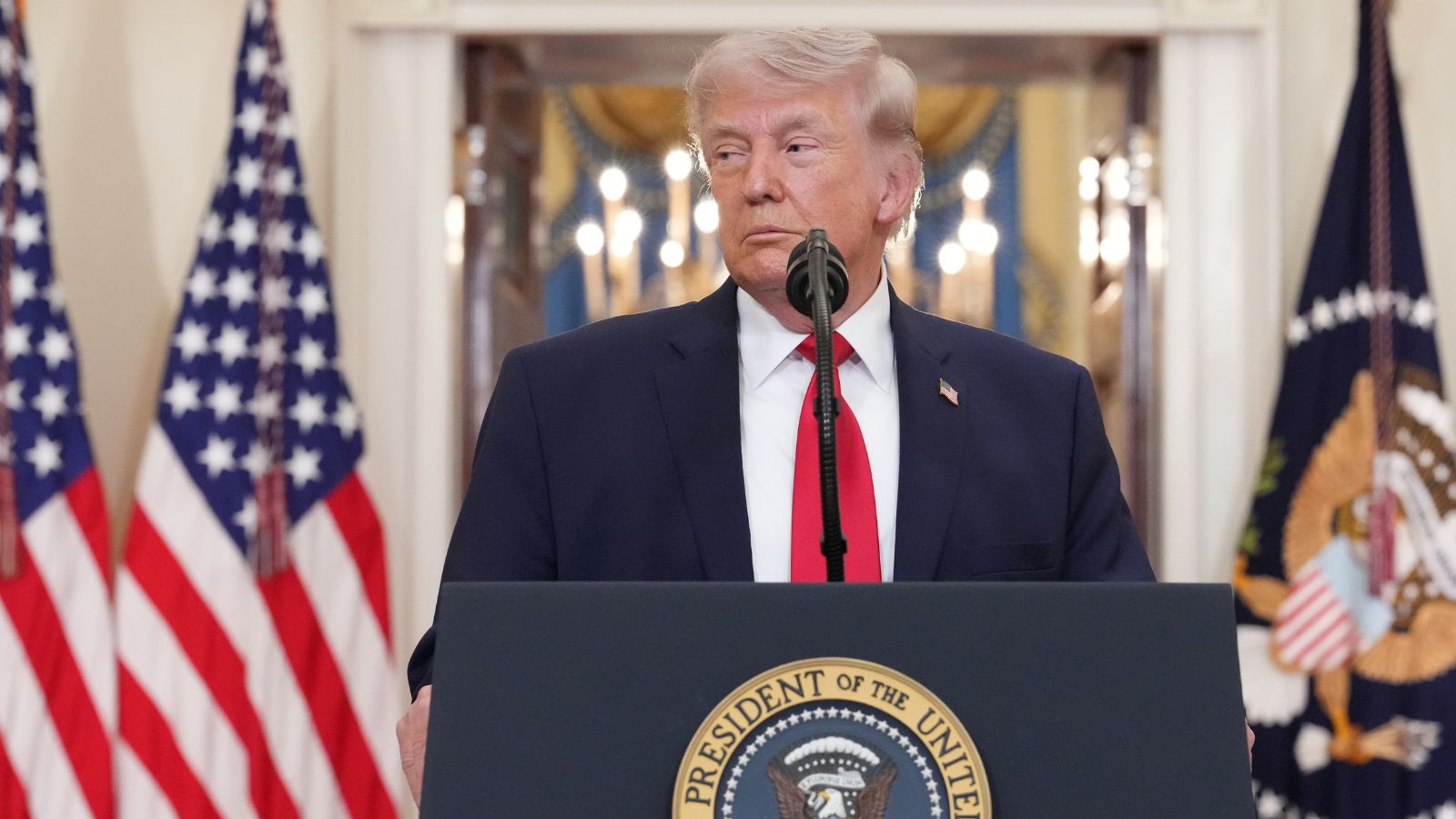
Donald Trump’s recent address to the nation marks a departure from standard diplomatic decorum, replacing the veiled language of the State Department with the blunt force of a ledger. By cataloging the destruction of Iranian naval assets and the elimination of high-ranking military figures—including the "evil genius" label applied to Qasem Soleimani—the administration has signaled a move toward a doctrine of personalized warfare. This is no longer just about regional containment. It is an aggressive restructuring of how the United States projects power, shifting from broad economic sanctions to the precision-guided decapitation of command structures and the systematic dismantling of kinetic capabilities.
The rhetoric used in this address serves a dual purpose. Domestically, it frames complex geopolitical maneuvers as simple, decisive victories. Internationally, it functions as a warning to peer competitors that the traditional "red lines" of diplomacy have been erased. When a sitting president openly celebrates the death of a foreign military leader as the removal of a specific "evil," the conflict moves from the realm of state-versus-state to the realm of individual accountability.
The Engineering of Deterrence
Behind the bombastic language lies a calculated use of superior military technology. The "navy gone" claim refers to the rapid neutralization of fast-attack craft and patrol vessels that Iran utilizes for asymmetrical warfare in the Strait of Hormuz. These vessels are designed to harass oil tankers and Western warships using swarm tactics. However, modern sensor fusion and automated targeting systems have rendered these maneuvers increasingly obsolete.
The US Navy’s ability to track and engage dozens of small, high-speed targets simultaneously is not just a matter of firepower. It is a matter of data. By integrating radar feeds with unmanned aerial surveillance, the military can create a real-time map of every moving object in the Persian Gulf. When the order is given to engage, the response is not a broad barrage but a series of surgical hits. Each missile or guided munition is assigned a specific target, ensuring that an entire fleet can be neutralized in a timeframe measured in minutes rather than hours.
This level of efficiency changes the math for Iranian leadership. If their primary tool for closing the world’s most vital oil transit point can be wiped out without the US losing a single sailor, the leverage of the "swarm" evaporates.
The Cult of Personality as a Target
Labeling Qasem Soleimani an "evil genius" was more than a post-mortem insult. It was an acknowledgment of the Iranian general’s unique role in weaving together a disparate network of proxies across Lebanon, Iraq, Syria, and Yemen. Soleimani was the architect of the "Axis of Resistance," a decentralized military strategy that relied heavily on his personal relationships and charisma to function.
The decision to target him specifically was a bet that the Iranian proxy network was not a self-sustaining machine, but a top-down hierarchy dependent on a single point of failure. History shows that when a charismatic leader is removed, the movement often fractures into infighting. By focusing on the "genius" of the man, the administration justified a move that many international legal experts viewed as a dangerous precedent. If the architect is gone, the building is expected to collapse.
However, this strategy carries a significant risk. Killing a leader can turn a strategist into a martyr. While the physical capabilities of the Quds Force may have been momentarily hampered, the ideological fervor often intensifies. The US is betting on the idea that in modern warfare, technical skill and institutional knowledge are harder to replace than religious or nationalistic zeal.
The Economics of Targeted Strikes
War is an expensive endeavor, but the current administration is attempting to run it like a lean business. Traditional ground invasions cost trillions of dollars and result in decades of regional instability. In contrast, the targeted strike model—using drones, cyber warfare, and precision missiles—offers a "high ROI" alternative.
Consider the cost-benefit analysis. A single Reaper drone mission costs a fraction of a percent of what it takes to maintain a carrier strike group on station for a month. If that drone can eliminate the person responsible for planning attacks on US embassies, the administration views it as a massive win for the taxpayer. This "efficiency" is what allows the President to claim he is ending "forever wars" while simultaneously increasing the intensity of specific engagements.
The Vulnerability of Global Supply Chains
The rhetoric regarding the Iranian navy is directly tied to the security of the global energy market. Roughly 20% of the world’s petroleum passes through the Strait of Hormuz. Any disruption there sends shockwaves through the global economy, raising gas prices in Ohio and shipping costs in Shanghai.
By claiming the Iranian navy is "gone," the President is attempting to reassure global markets that the flow of oil is secure. It is a message to investors: the US has the situation under control, and the "premium" usually added to oil prices during Middle East tensions is unnecessary. This is the intersection of military might and global finance. The goal is to prove that Iran no longer has the "off switch" for the world economy.
The Intelligence Gap and the Risk of Miscalculation
The certainty expressed in the President’s address masks the inherent fog of war. Claims that leaders are "dead" or assets are "destroyed" rely on intelligence that is rarely 100% accurate. Battle Damage Assessment (BDA) is a grueling process of analyzing satellite imagery and intercepting communications to confirm hits.
When a leader makes such definitive statements, they leave no room for error. If a "dead" leader suddenly appears on video three weeks later, the entire narrative of American dominance is punctured. This creates a high-stakes environment where the intelligence community is under immense pressure to provide the "right" answers rather than the most accurate ones.
Furthermore, the "evil genius" rhetoric ignores the institutional depth of the Iranian Revolutionary Guard Corps (IRGC). While Soleimani was a singular figure, the IRGC is a massive bureaucratic entity with deep roots in the Iranian economy. It is not a gang that disappears when the boss is killed; it is a state-within-a-state with a clear line of succession.
The Erosion of International Norms
The most significant takeaway from the address isn't the list of destroyed hardware, but the total disregard for traditional diplomatic "off-ramps." In previous decades, even at the height of the Cold War, there was a shared understanding that certain lines were not crossed to avoid total escalation.
The current strategy operates on the "Madman Theory" of international relations—the idea that if your opponent thinks you are unpredictable and willing to use extreme force, they will be too afraid to provoke you. By openly bragging about the assassination of a state official, the US is rewriting the rules of engagement. This might work against a smaller power like Iran in the short term, but it sets a precedent that peer competitors like China or Russia might one day use to justify their own "targeted" operations against Western interests.
The "evil genius" of today becomes the "legitimate target" of tomorrow. This shift moves the world closer to a state of perpetual, low-intensity conflict where no individual is safe, regardless of their rank or diplomatic status.
The Role of Cyber in the Shadows
While the President focused on physical destruction—ships and bodies—much of the actual "navy gone" reality may be happening in the digital realm. The modern Iranian fleet relies on GPS, digital communication, and automated engine management.
An invisible strike on a ship’s software can be just as effective as a missile. A vessel that cannot communicate with its command or navigate accurately is effectively neutralized. The address focused on the "kinetic" results because they make for better television, but the real "genius" of modern warfare is the ability to turn off an enemy's capabilities without firing a shot. This silent war continues 24/7, far away from the cameras of a national address.
The New Reality of the Middle East
The US presence in the Middle East is shifting from a stabilizing force to a reactionary one. Instead of keeping 100,000 troops on the ground to prevent conflict, the new model uses a skeleton crew of elite operators and high-tech sensors to punish specific actions.
This is a more sustainable model for the US in terms of blood and treasure, but it offers less stability for the region. It creates a "whack-a-mole" dynamic where the US reacts to threats with overwhelming force, but does little to address the underlying political or social causes of those threats. It is a strategy of management, not resolution.
The Iranian leadership now knows that the US is willing to strike the head of the snake. This might deter them from large-scale conventional attacks, but it will likely push them further into the shadows. Expect an increase in deniable operations: cyberattacks on infrastructure, maritime sabotage via "unaffiliated" actors, and proxy strikes that are harder to trace back to a single "evil genius."
The President's address was a victory lap, but in the world of high-stakes geopolitics, the race never actually ends. The "evil" might be gone, but the vacuum it leaves behind is rarely filled by something better. It is usually filled by someone who has learned from the mistakes of their predecessor.
The true test of this "navy gone" era will not be the initial strike, but the ability of the US to maintain this level of dominance as the target adapts. Warfare is a constant cycle of measure and counter-measure. By showing its hand so clearly, the US has given its enemies a blueprint for what they need to overcome next.
Military superiority is not a static condition; it is a temporary advantage that must be defended every single day. The boast of today is the challenge of tomorrow. Decisions made in the heat of a crisis often have echoes that last for decades, and the removal of a single "genius" does not change the fundamental geography or the historical grievances of a region that has seen empires come and go for millennia.
The ships may be at the bottom of the Gulf, but the intent remains. Control is an illusion that lasts only as long as the next missile launch.