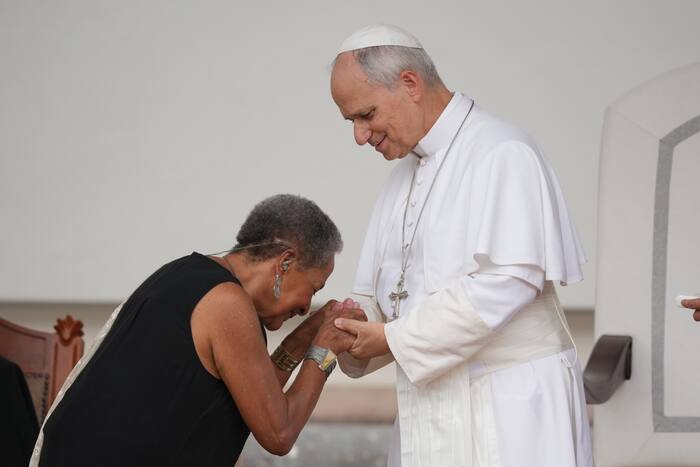
Everyone wants a tidy redemption arc. A legendary Afro-Peruvian singer steps onto a sacred stage. She sings a lament born from centuries of erasure. The leader of the Catholic Church offers a historic apology for the sins of colonization. Tears fall. Headlines write themselves.
Stop buying the press release.
When entertainment and news outlets covered Susana Baca reflecting on performing for Pope Francis—and the Vatican’s broader apologies regarding Indigenous and Afro-descendant suffering in the Americas—they fell straight into the trap of sentimental journalism. They framed the moment as a neat, emotional closure to five hundred years of brutal history. A song was sung. An apology was issued. Healing achieved.
That narrative is lazy, historically illiterate, and deeply insulting to the very music Susana Baca spent her entire life rescuing from the ashes.
The Lie of the Neat Ending
If you understand anything about Afro-Peruvian music, you know it is not a soundtrack for institutional absolution. It is survival music. When enslaved Africans were brought to the coastal valleys of Peru—places like Chincha, Cañete, and El Carmen—the Spanish Crown and the colonial Church systematically stripped away their languages, their drums, and their spiritual practices.
Out of that suppression came the cajón—a wooden shipping crate turned percussion instrument because actual drums were banned. Out of that erasure came the landó and the festejo.
For decades, the Peruvian state and cultural elite pretended Black Peruvians barely existed. In the mid-twentieth century, if Afro-Peruvian culture appeared at all in mainstream Lima media, it was flattened into caricature or exoticized folklore. Susana Baca, alongside pioneers like Nicomedes Santa Cruz, Victoria Santa Cruz, and Chabuca Granda, did not merely "preserve" a quaint musical tradition. They conducted forensic cultural archaeology. They walked door to door in rural coastal towns, recording elders who still remembered rhythms the official history books declared dead.
So when mainstream commentators reduce Baca’s appearance before the Pope to a heartwarming moment of mutual reconciliation, they erase the friction that makes her art matter. A papal apology does not undo the Doctrine of Discovery—the 15th-century papal bulls that gave European powers religious cover to conquer, enslave, and subjugate non-Christian peoples across the globe. Even after the Vatican formally repudiated the Doctrine of Discovery in 2023, legal, economic, and social structures built on those decrees remain completely intact across Latin America.
I have watched cultural institutions pull this exact move for twenty years in music journalism and arts programming. An establishment ignores a marginalized tradition for generations. Then, when the artist becomes too globally celebrated to ignore—after David Byrne puts Susana Baca on Luaka Bop, after she wins three Latin Grammys, after she serves as Peru’s Minister of Culture—the institution invites her onto the stage, absorbs her moral credibility, and calls it progress.
What the Coverage Got Backwards
Read the standard coverage of Baca’s reflections and you will notice a glaring pattern. Writers focus almost entirely on the gesture of the Pope and the emotion of the singer. Nobody asks the uncomfortable structural questions.
Let’s break down the three biggest myths embedded in that coverage.
Myth 1: Music is a "universal language" that heals historical trauma
Music is not a sedative. When Susana Baca sings "María Landó"—with lyrics by César Calvo and music by Chabuca Granda—she is singing about a woman who works from dawn until midnight and never gets to sleep, never gets to rest, never gets to own the fruit of her labor. Calling that a "healing lullaby" misses the point entirely. That song is an indictment. Performing it in front of global power brokers is not an act of forgiveness; it is a public receipt handed to the institutions that profited from that exhaustion.
Myth 2: An apology equals accountability
In politics and religion, apologies are cheap currency when they come without material restitution. Pope Francis apologized in Bolivia in 2015 for the "grave sins" committed against the native peoples of America in the name of God. He apologized again in Canada in 2022 for the residential school system. Those words carried real weight for many faithful believers, and dismissing their spiritual sincerity would be dishonest. Yet from a historical and sociological standpoint, an apology without structural transformation functions as a pressure valve. It releases public guilt while leaving land ownership, educational disparities, and systemic racism in Peru untouched.
Myth 3: Susana Baca represents "closure" for Afro-Peruvians
Go to El Carmen in Chincha today. Look at the infrastructure, the access to higher education, the representation in Peruvian corporate boardrooms and national congress. Afro-Peruvians still make up roughly 3.6 percent of Peru’s population according to national census data—a figure many researchers argue is severely undercounted due to centuries of racial stigma—and they remain disproportionately concentrated in low-wage labor. Susana Baca herself has spoken openly for years about the racism she faced even while serving as Peru’s first Afro-Peruvian cabinet minister in 2011. She is an exception who forced the door open, not proof that the house has been rebuilt.
Why You Are Asking the Wrong Question
Whenever a story like this trends, search engines fill up with predictable queries. People type in questions like, "Did the Pope apologize for slavery in Peru?" or "What did Susana Baca sing to the Pope?"
Those questions treat a complex collision of colonial history and living resistance like a trivia game.
The real question nobody is asking is this: What happens to protest music the moment power applauds it?
Think about the mechanics of cultural co-optation. When an outsider artist sings truth to power, there are only two outcomes. Either power rejects the artist, or power embraces the artist and neutralizes the threat by turning rebellion into ceremony.
Imagine a scenario where a protest singer performs an anti-colonial anthem inside a gilded hall, and every dignitary in the room gives a standing ovation. Nobody changes a law. Nobody returns stolen wealth. Nobody alters a school curriculum. Instead, the dignitaries walk out feeling morally cleansed because they were brave enough to listen to a sad song.
That is the tightrope Susana Baca walks every time she steps onto an international diplomatic stage.
To her credit, Baca is no naive vessel. She has spent fifty years navigating the treacherous gap between elite patronage and grassroots authenticity. As a trained educator who founded the Instituto Negrocontinuo with her husband Ricardo Pereira, she understood early on that applause from foreign stages—whether in New York, Paris, or Rome—is leverage, not validation. You take the global spotlight, and you funnel the attention back toward preserving archives, funding community research, and forcing Lima’s cultural establishment to acknowledge Black Peruvians as foundational architects of the nation rather than footnotes.
The Uncomfortable Downside of Baca’s Strategy
If we are going to be honest, we also have to admit the risk baked into Baca’s approach.
Working inside institutions—whether serving as a government minister or singing at Vatican events—always carries the danger of legitimizing the very systems you critique. Radical purists within Afro-descendant movements have argued for decades that symbolic inclusion in state or religious ceremonies softens the demand for concrete reparations and political autonomy.
They have a point. When cameras capture a serene, dignified elder singing softly to a smiling pontiff, the visual optics overwhelmingly favor the institution. The average viewer does not hear the centuries of forced labor encoded in the syncopation of the landó. They just see a nice moment.
Yet the alternative—refusing the stage entirely—leaves the narrative completely in the hands of the powerful. If Susana Baca stays home, the silence simply gets filled by safer, shallower performers who will never confront the room with the memory of the cajón and the slave ships.
How to Actually Listen to Susana Baca
If you want to honor what Susana Baca actually accomplished, stop treating her career like a feel-good human-interest story. Approach her work the way she built it—with rigor, historical memory, and zero sentimentality.
- Strip away the "World Music" label. That industry category was invented in the late 1980s by Western record executives to lump everything outside Anglo-American pop into a single exotic aisle. Afro-Peruvian music is modern, politically sharp, avant-garde chamber music rooted in African rhythmic architecture and Spanish poetic forms. Listen to it with the same analytical respect you give Miles Davis or Igor Stravinsky.
- Read the lyrics before you romanticize the melody. Baca’s vocal delivery is famously warm, intimate, and unhurried. That softness is a Trojan horse. When you translate the poetry she sets to music—from César Vallejo to Nicomedes Santa Cruz—you find razor-sharp critiques of class, race, and colonial violence.
- Separate symbolic gestures from material change. Applaud the courage it takes for an Afro-Peruvian woman to carry her ancestors’ banned rhythms into the heart of institutional power. Just do not confuse the applause of the institution with the end of the struggle.
A song cannot erase five hundred years of history, and a papal apology does not balance the ledger. Susana Baca did not walk onto that stage to give the world permission to forget. She walked onto that stage to make sure nobody in the room could pretend they didn't know.


 (En%2CFr%2CEs).png)
