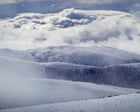
The arrival of Storm Dave represents a localized intersection of deep Atlantic cyclogenesis and a high-pressure block over Scandinavia, a configuration that creates a steep pressure gradient across the British Isles. While conventional reporting focuses on individual weather events, the objective reality is a systemic stress test of United Kingdom critical infrastructure. The convergence of sub-zero temperatures and wind speeds exceeding 70mph creates a non-linear risk profile where the cumulative damage to the energy grid and transport networks far outweighs the sum of the individual meteorological threats. Understanding the impact of Storm Dave requires a decomposition of three primary variables: thermal contraction of materials, kinetic load on surface-level assets, and the catastrophic failure modes of the "last-mile" supply chain.
Kinetic Energy Transfer and Structural Integrity
The primary threat from Storm Dave is not the wind speed itself, but the dynamic pressure exerted on structures. This is calculated through the formula $q = \frac{1}{2} \rho v^2$, where $\rho$ is air density and $v$ is wind velocity. As air temperature drops, air density increases, meaning a 70mph wind at 0°C exerts significantly more force than the same wind speed at 20°C.
Structural failures in the UK power grid during such events typically follow a predictable cascade. High-voltage transmission lines are designed for significant tolerances, but the distribution network—the wooden poles and lower-voltage lines—remains vulnerable to "galloping." This phenomenon occurs when ice accumulates on a cable, changing its aerodynamic profile into an airfoil. Wind then creates lift, causing the cable to oscillate violently. These oscillations lead to:
- Mechanical Fatigue: Rapid stress cycles at the attachment points of insulators.
- Phase-to-Phase Contact: Cables swinging into one another, causing immediate short circuits and localized transformer explosions.
- Pole Snapping: The lateral force exceeding the shear strength of aged timber supports, particularly where ground saturation from preceding rainfall has compromised the soil's anchoring capacity.
The Cryospheric Impact on Rail and Road Friction
The transition from rain to heavy snow during Storm Dave introduces a phase-change challenge for the UK’s transport matrix. The critical threshold exists at the "triple point" where slush forms. Unlike dry powder snow, which can be displaced by standard pneumatic tires or rail plows, wet snow under gale-force winds undergoes rapid compaction and refreezing, creating a layer of "black ice" or bonded snow.
Rail Network Bottlenecks
The UK rail system operates on a fine-tuned friction coefficient. When snow enters the points (switches), it is compressed by the movement of the blades. If the heating elements—often outdated or under-powered—cannot maintain a temperature above 2°C at the metal surface, the compressed snow turns to ice, preventing the point from locking. This triggers a safety lockout, paralyzing entire sections of the line. Furthermore, the "third rail" electrification used in Southeast England is uniquely susceptible. A thin veneer of ice on the conductor rail acts as a dielectric insulator, preventing power from reaching the train's pickup shoes, effectively stranding rolling stock between stations.
Road Logistics and High-Sided Vehicle Instability
For road freight, the risk is a function of the vehicle's lateral surface area. A standard 44-tonne Heavy Goods Vehicle (HGV) acts as a sail. When wind gusts hit the side of a trailer, they create a moment of force that can overcome the friction between the tires and the road, especially when that friction is already reduced by snow. This leads to jackknifing, a failure mode that creates total blockages on arterial motorways like the M62 or A1(M). The economic cost is measured in "lost-link-hours," where the closure of a single trans-Pennine route forces a 100-mile diversion, cascading into the driving hours regulations for logistics personnel and delaying "just-in-time" deliveries to regional distribution centers.
Atmospheric Dynamics and the Orographic Lift Effect
Storm Dave's severity is amplified by the UK’s topography. As the moist, warm air from the storm's leading edge hits the Pennines and the Scottish Highlands, it is forced upward. This orographic lift causes rapid cooling and condensation, turning what might be light rain at sea level into intense, blizzard-grade snowfall at elevations above 200 meters.
This creates a "microclimate volatility" where coastal regions experience gale-force winds and minor flooding, while inland areas just 20 miles away face total isolation. The meteorology dictates that the snowfall will be most persistent on the windward slopes, but the "rain shadow" effect on the leeward side can lead to deceptive conditions: clear skies followed by sudden, violent "snow squalls" as the storm's core moves overhead. These squalls are particularly dangerous because they reduce visibility from several miles to less than 50 meters in a matter of seconds, a phenomenon responsible for the majority of multi-vehicle collisions during winter storm events.
Quantifying the Economic Friction of Extreme Weather
The financial impact of Storm Dave is not merely the cost of repairs, but the "coefficient of friction" it applies to the entire national economy. This can be broken down into three distinct tiers of loss:
- Direct Asset Destruction: The capital expenditure required to replace downed power lines, repaired roof structures, and cleared rail debris.
- Labor Productivity Decay: The loss of man-hours due to transit cancellations and the necessity of remote work in sectors not optimized for it.
- Supply Chain Latency: The inflationary pressure caused by shortages of perishable goods and the increased fuel consumption of diverted logistics fleets.
Insurance models typically underestimate these events by focusing on property damage while ignoring the systemic "drag" on the service economy. When Storm Dave hits, the UK's high dependency on centralized logistics hubs in the Midlands means that a localized weather event in the North can cause stock-outs in London within 48 hours.
Telecommunications Resilience and Signal Attenuation
Modern crisis management relies on the 5G and 4G LTE networks, yet these are not immune to the physics of Storm Dave. High-frequency signals are subject to "rain fade" and "snow attenuation." The physical presence of dense falling snow scatters the microwave signals used for backhaul between cell towers.
In rural areas, many cell towers rely on microwave dishes rather than fiber-optic cables for their connection to the core network. If wind speeds cause these dishes to vibrate or shift by even a few degrees, the link budget is compromised, leading to a total loss of signal. This creates a "data blackout" exactly when emergency services and the public require real-time information. Furthermore, the backup batteries at these sites are designed for short-term outages. If Storm Dave prevents engineers from reaching a site for 24 hours, the local communication node will fail, complicating rescue efforts and power restoration.
Vulnerability of the Domestic Energy Sector
The UK’s shift toward renewable energy introduces a specific irony during Storm Dave. While wind speeds are high, many wind turbines must be "feathered" or shut down entirely once speeds exceed 55-60mph to prevent catastrophic bearing failure. Consequently, during the peak of the storm, wind power contribution to the National Grid may actually drop.
Simultaneously, the drop in temperature drives a massive spike in gas demand for heating. This creates a "dual-peak" stress on the energy market. If the storm disrupts the offloading of Liquefied Natural Gas (LNG) tankers at terminals like Milford Haven due to sea state conditions, the UK must rely on sub-surface storage and imports via interconnectors from Europe. The volatility in "day-ahead" energy prices during Storm Dave is a direct reflection of this physical insecurity.
Strategic Mitigation for Immediate Implementation
To navigate the operational disruptions of Storm Dave, stakeholders must move beyond reactive measures and adopt a high-frequency risk management posture.
The first priority for logistics managers is the immediate suspension of high-sided vehicle movement across designated "wind-corridors" (e.g., the A66, M8, and Severn Bridge) four hours prior to the predicted peak gusts. Waiting for official closures is a failure of lead-time management; by the time the police close a road, the "bottlenecking" effect has already locked the surrounding secondary routes.
For energy and utility providers, the deployment of "pre-staged" repair teams in hardened locations near known weak points in the distribution grid is mandatory. These teams must operate on a "cell" structure, capable of autonomous decision-making when central communications fail.
The final strategic move involves the redirection of all non-essential data traffic on regional networks to prioritize VOIP and emergency service packets. By artificially throttling high-bandwidth consumer services (video streaming) in the storm's path, network operators can preserve the integrity of the thin-margin signal required for life-safety operations. Storm Dave is not a weather event to be endured; it is a predictable mechanical failure of interconnected systems that requires a hard-coded technical response.