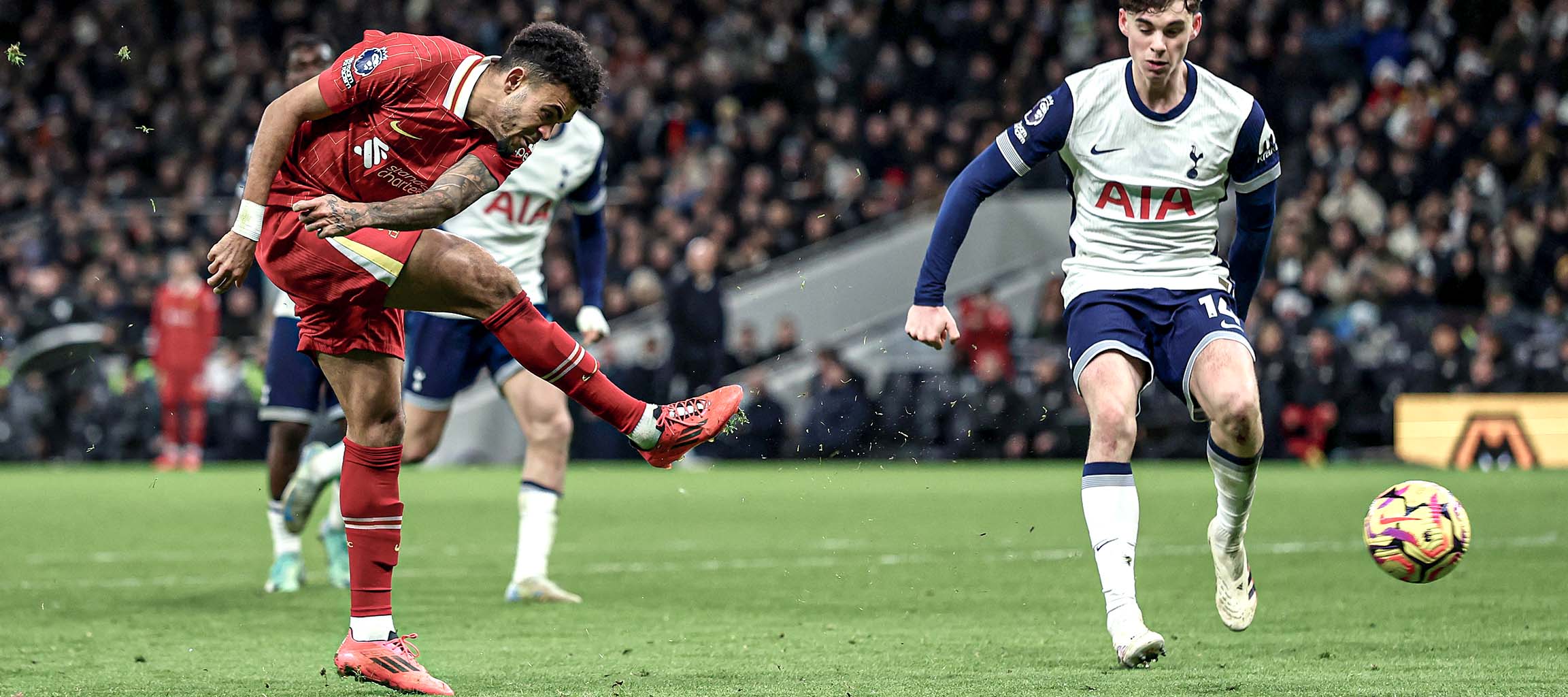
The 4-0 margin by which Liverpool defeated Galatasaray to secure a Champions League quarterfinal berth was not a product of superior individual talent alone, but a comprehensive failure of the Turkish side’s defensive transition structure under high-velocity pressing. While scorelines of this magnitude are often attributed to "momentum" or "clinical finishing," the underlying data points to a systematic breakdown in Galatasaray's build-up play, specifically within the middle third of the pitch. Liverpool’s progression was a result of three distinct operational efficiencies: optimized turnover conversion, the exploitation of lateral defensive stretching, and a disciplined rest-defense that nullified Galatasaray’s counter-attacking outlets.
The Pressing Trigger and Turnover Efficiency
Liverpool’s defensive strategy functioned on a principle of "selective aggression." Rather than a continuous high press, which risks physical depletion, the team utilized specific triggers to initiate a trap. These triggers were most visible when Galatasaray’s center-backs attempted to find their deep-lying playmaker under pressure.
The efficiency of this system is measured by the time elapsed between winning possession and generating a shot. In this fixture, Liverpool’s average "possession-to-shot" duration in the final third was less than six seconds. This rapid verticality exploits the disorganized state of a defense that has just transitioned from an expansive attacking shape to a restrictive defensive one.
The Mechanics of the First Phase
Galatasaray’s initial setup relied on a 4-2-3-1 that transitioned into a 3-2-5 during build-up. By pushing their full-backs high, they inadvertently created "half-spaces" that Liverpool’s wingers occupied immediately upon a turnover. When the ball was won in the central circle, the immediate lateral pass to a sprinting winger forced Galatasaray’s remaining three defenders to choose between closing the ball-carrier or tracking the overlapping run.
- Zone 14 Dominance: Liverpool controlled the area just outside the penalty box. By occupying this space, they forced Galatasaray’s double-pivot to drop deeper, creating a vacuum in the midfield that allowed Liverpool to recycle second balls.
- The Overload Principle: On the right flank, the combination of the right-back and the interior midfielder created 2-on-1 scenarios against Galatasaray’s left-back. This forced the nearest center-back to slide out of position, leaving the central corridor vulnerable to late runs from deep.
Structural Vulnerabilities in the Galatasaray Low Block
A 4-0 deficit suggests a total collapse, but the technical reality was a failure of "vertical compactness." As the match progressed, the distance between Galatasaray’s defensive line and their forward line exceeded 45 meters. This gap is unsustainable against an elite European transition side.
Lateral Stretching and the Horizontal Shift
Liverpool utilized "diagonal switches" to exploit the speed of the ball versus the speed of the human shift. By rapidly moving the ball from the left touchline to the right, they forced the Galatasaray block to slide horizontally.
Physical fatigue leads to a "lag" in this horizontal shift. By the 60th minute, the Galatasaray weak-side winger failed to track back with sufficient intensity, leaving the far-side full-back isolated. The third goal was a direct consequence of this mechanical failure; a cross delivered from a wide area found an unmarked attacker because the defensive unit had failed to reset its spacing after a lateral shift.
The Failure of the "Mid-Block" Press
Galatasaray attempted to disrupt Liverpool’s rhythm by deploying a mid-block. However, this lacked the "intensity of engagement" required to bother elite ball-circulators. Liverpool’s center-backs were granted too much time on the ball (averaging over 3 seconds per touch), allowing them to pick out line-breaking passes into the half-spaces.
- Directness: Liverpool bypassed the first line of the press with vertical passes into the "pockets" behind Galatasaray’s midfielders.
- Third-Man Runs: The receiver of the line-breaking pass would immediately lay the ball off to a teammate facing forward, a classic "up-back-through" combination that Galatasaray’s static midfield could not track.
Quantifying the Quarterfinal Qualification
Qualification for the quarterfinals is often the point where the financial and tactical stakes of the Champions League pivot. For Liverpool, this victory validates a recruitment and tactical philosophy centered on high-intensity output. For Galatasaray, it serves as a case study in the risks of "tactical idealism" when facing a superior transition team.
The probability of a comeback was effectively neutralized by Liverpool’s "rest-defense." While attacking, Liverpool kept a minimum of three players plus one holding midfielder behind the ball at all times. This 3-1 or 4-1 structure ensured that even if a cross was cleared, Galatasaray’s lone striker was immediately swarmed, preventing the ball from being "held up" to allow the Turkish midfield to join the attack.
Technical Constraints and Limitations
It is necessary to acknowledge that a 4-0 scoreline can sometimes mask internal inefficiencies. Liverpool’s reliance on high-intensity bursts requires a squad depth that may be tested in the later rounds. A team capable of maintaining a "low-block" with better lateral discipline and a more effective "out-ball" could potentially frustrate this system.
The primary limitation of Liverpool’s approach in this match was a brief period of "over-commitment" in the first half where a more clinical opponent might have exploited the space behind their high defensive line. Galatasaray lacked the pace in their forward line to capitalize on these 40-meter gaps.
Strategic Trajectory for the Quarterfinals
The data from this 4-0 victory suggests that Liverpool are currently operating at a peak "Transition Efficiency Rating." To maintain this momentum into the quarterfinals, the coaching staff must address the physical load on the central midfielders, who covered an average of 11.8 kilometers each during the 90 minutes.
Opponents in the next round will likely analyze this tape and conclude that a "deep-sitting" 5-4-1 or 4-5-1 is the only viable counter-measure. This would deny Liverpool the space in behind that they feasted on against Galatasaray. The tactical evolution for Liverpool must now involve a "Plan B" centered on sustained positional play and "patience-based" breaking of a low block, rather than relying solely on the chaos of the transition.
The most effective strategy for Liverpool moving forward is the integration of "false" movements in the wide areas to drag disciplined defenders out of the central lanes. If they encounter a defensively rigid side like an Italian or German powerhouse, the reliance on raw transition speed will yield diminishing returns. The quarterfinal stage demands a shift from "reactive" pressing to "proactive" space creation through intricate third-man rotations in the final third.