Burn.
That is the first word that enters your mouth before you even smell the canister. It rises from the back of the throat like swallowed battery acid, turning a cool morning breath into a sharp, sudden panic that makes your eyes squeeze shut against your will and your lungs lock up as if someone has pulled a drawstring tight around your ribs.
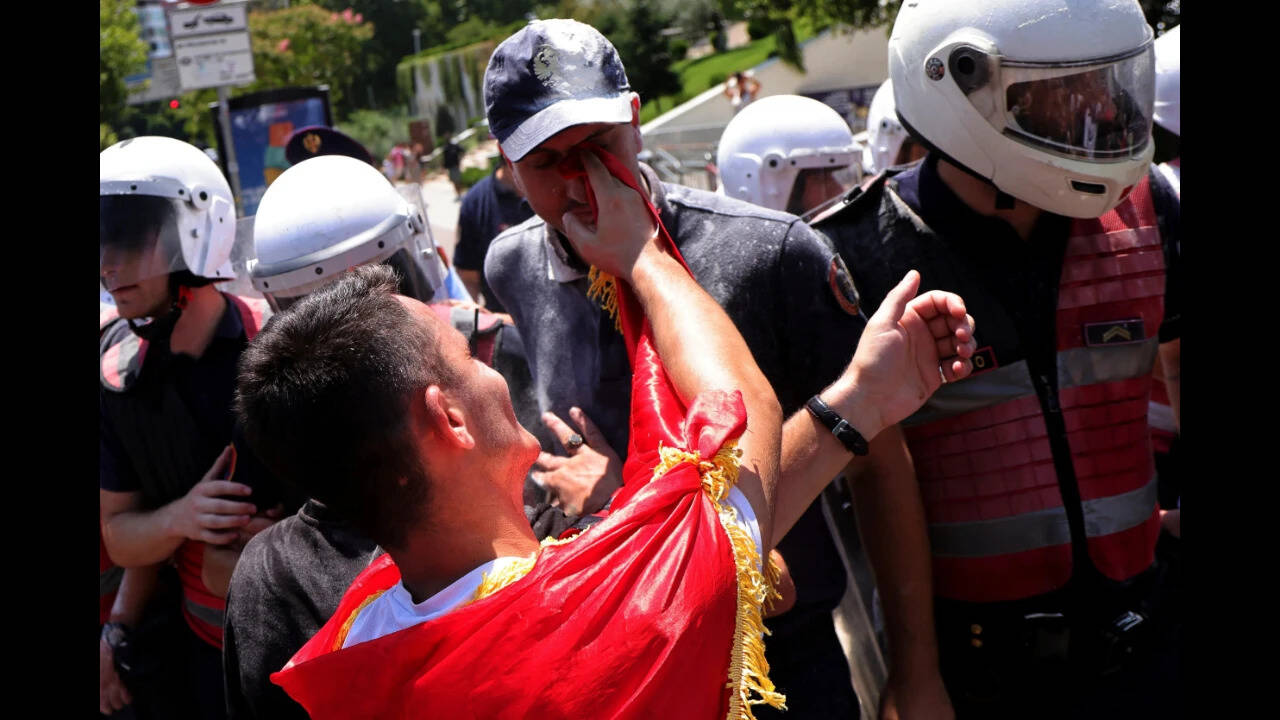
I know that sensation from reporting on street clashes across southeastern Europe over the past decade. You think you are walking into a story about tuition fees, municipal decrees, or an angry afternoon outside a ministry building, and suddenly the air itself turns hostile. In Tirana, when police fire tear gas at protesting students as a demonstration tips from shouting into shattered glass, flying stones, and scuffles along crowded boulevards, the headline reduces the whole hour to a single mechanical transaction. Stir turns violent. Police deploy gas. Order is restored or contested.
Yet a headline cannot tell you what happens to a twenty-year-old holding a damp paper napkin to her face while sirens bounce off Italian-era facades. Nor does it explain why a generation that grew up staring at screens and dreaming of flights out of the Balkans suddenly decides to stand in front of riot shields.
When street unrest erupts in Albania, the immediate battle looks like a clash between restless youth and state authority. Look closer, and you see a deeper fracture: a country trying to build a modern, European future on top of old economic anxieties, fragile public trust, and a quiet, gnawing fear among young people that hard work at home buys very little security.
When a Protest Crosses the Line
Every street confrontation has a tipping point, and it rarely arrives with a neat warning bell.
Before a single canister hisses across the pavement, a protest usually begins in a register that feels almost ordinary. Students gather with handwritten cardboard signs, megaphones crackle with borrowed sound systems, and chants roll down the avenue in waves that sound more like a stadium crowd than an insurrection. Someone brings thermoses of coffee. Someone else films on a phone held high above the pack.
Then the temperature shifts.
A push from the front row meets a wall of dark helmets. A bottle arcs through the air and shatters against asphalt. Shouting grows sharper, thinner, less rhythmic. On one side stand officers ordered to hold a perimeter, prevent property damage, and keep traffic lanes or government buildings secure; on the other stand young citizens whose frustration has spilled past speeches into physical defiance. Once tear gas enters the air, clarity leaves first. Coughing crowds scatter sideways into side streets, some furious, some terrified, some caught in the drift simply because they were walking to class or a bakery around the corner.
Let me be clear about how I am framing the individuals in this story. To show how these moments play out on the ground without invading the privacy of real bystanders whose names rarely make a wire report, I am introducing two composite characters—Arta and Dritan—drawn directly from the lived realities of university students and young workers I have spoken with in Tirana and other Balkan capitals. They are representative figures, not real individuals, created to ground abstract political tension in human experience.
Arta is a third-year economics student living in a cramped shared flat near the university district, stretching a modest family allowance while working evening shifts at a cafe to cover books, rent, and basic expenses. Dritan finished a technical degree eighteen months ago, spent half a year applying for jobs that paid barely enough to cover bus fares and lunch, and now wonders whether staying in Albania means spending his twenties waiting for a break that keeps moving further out of reach.
When a crowd like theirs surges forward and meets a wall of riot gear and chemical irritants, outsiders often ask a deceptively simple question: why do students protest so fiercely, and why do demonstrations turn violent?
There is never just one spark. Grievances pile up quietly for months—rising living costs, frustrations over university conditions or public policy, anger at perceived unfairness—until a single flashpoint gives the pressure a street address. Once shoving starts or objects fly, both sides get pulled into a feedback loop of adrenaline and reaction. A crowd angry at institutions sees police batons and gas as proof of indifference; police facing thrown projectiles see a threat that must be contained immediately.
Both realities coexist in the same cloud of smoke. Pretending the street is a simple morality play with only one kind of fault makes the politics easy to recite and impossible to understand.
The Invisible Stakes Behind the Smoke
Tear gas clears in minutes, or hours if the wind is stubborn. The real cost lingers much longer.
Consider what happens next: after the sirens fade and the street sweepers wash away broken glass, nobody wakes up with all their problems solved. Students still have exams or part-time shifts. Families still add up grocery receipts and utility bills. Officials still face pressure to project control while answering critics who argue that force is a substitute for real reform.
Think of a pressure cooker with a stuck valve. Turning up the flame does not fix the seal; it just makes the rattle louder until something gives way. In societies where young people feel locked out of fair opportunity or unheard by institutions, street anger acts like steam finding a crack. Deploying tear gas vents the immediate pressure in the square, yet if the underlying grievances remain untouched, the heat simply builds somewhere else.
That is where honesty matters most, including admitting my own limits as an observer. I cannot sit inside a cabinet meeting in Tirana, nor can I read the private conscience of every officer standing behind a visor or every student throwing a stone. Street reporting gives you fragments—the sting in your eyes, the tremor in someone's voice, the sight of a shoe left behind on wet concrete—and you have to piece the larger pattern together carefully without inventing motives you cannot verify.
What can be verified is the broader predicament facing young Albanians. For years, Albania has navigated the heavy work of democratic institution-building, economic transition, and aspirations toward closer European integration. Progress in parts of the economy and tourism has been real, yet many young citizens experience a sharp gap between glossy national ambitions and everyday life: modest entry-level wages, high housing pressure in growing cities, and a lingering skepticism toward public institutions.
When you are twenty-two and doing everything "right"—studying, showing up, trying to build a life—and the math still feels stacked against you, anger stops looking like a hobby. It starts looking like self-defense.
Even among students themselves, there is rarely a single voice. Some come to protest with clear demands and strict discipline, determined to keep things peaceful so public sympathy stays on their side. Others arrive already bitter, ready to test barriers or vent years of stored resentment. When chaos breaks out, the peaceful marcher and the rock-thrower end up breathing the same chemical haze.
History Has a Long Memory in the Balkans
To understand why a street clash in Tirana carries weight beyond a single afternoon's news cycle, you have to listen to the echo of history.
In the Balkans, public squares have never been neutral spaces. Over the past century, people in this region have lived under rigid authoritarian rule, sudden economic collapse, political upheaval, and painful transitions toward open markets and constitutional governance. Older generations carry memories of a state that demanded obedience and punished dissent harshly; younger generations often measure their country not against an oppressive past, but against the brighter, more stable standards they see across the Adriatic or in northern Europe.
That generational lens changes everything.
When Arta looks at her phone and sees peers in other European cities enjoying stronger wages, clearer career ladders, or more responsive public services, her frustration isn't just local—it is comparative. She isn't comparing today to thirty years ago alone; she is comparing her Tuesday afternoon to what she believes a young European adult ought to be able to build.
At the same time, authorities in countries striving for stability and international credibility are acutely sensitive to disorder. Images of burning bins, broken windows, and clouds of tear gas travel fast. They can rattle investors, complicate diplomatic messaging, and make governments reach for tough crowd-control measures to show they are in command.
Yet tough tactics carry a steep political and human price. When students—people who are supposed to represent a nation's future—are met with chemical irritants rather than credible answers, the rift between youth and state widens. A young person who feels met with force rather than fairness rarely becomes more trusting the next morning. More often, they grow cynical, disengaged, or determined to leave the country altogether.
Brain drain is the quietest tragedy in all of this. When talented graduates pack suitcases instead of organizing at home, a country doesn't just lose workers; it loses the very energy that could renew its institutions from within.
What Happens When Nobody Is Really Listening
Street clashes thrive in silence—the silence that comes when leaders talk past citizens and citizens feel their voices only register when they break something.
If this is a hypothetical scenario of what happens when dialogue fails in a tense moment like Tirana's: picture a student representative trying to explain why living costs and campus conditions are pushing classmates to the brink, while an official reads from a prepared statement insisting that public order comes first and agitators are to blame. Both sentences can sound reasonable in isolation, yet together they miss each other completely. One person is talking about survival and dignity; the other is talking about perimeter control and law.
Violence rarely resolves that mismatch. It drowns out nuance. Once stones fly and gas canisters roll, the original issue—whether tuition, governance, economic opportunity, or accountability—gets buried under coverage of the clash itself. Suddenly the story isn't what students were asking for; the story is the riot.
Still, reducing a volatile demonstration to mere hooliganism is just as lazy as pretending every act of street aggression is noble. Real life is messier than slogans. A protest can begin with legitimate grievances and still spiral out of control when tempers flare, crowds press against police lines, or a small minority pushes toward confrontation.
And when a government responds solely with force, it may clear the square for the evening while leaving the underlying wound open. Real resolution requires something much harder than crowd control: visible accountability, practical policies that ease real pressure on young people and families, and restraint from security forces so that legitimate dissent is protected even when tempers run high.
None of that is quick. Fixing economic bottlenecks, reforming institutions, and rebuilding public trust take years of patient work that never fit neatly into a twenty-second television clip. Tear gas takes seconds.
After the Wind Shifts
Night settles differently over a city that has spent the day in turmoil.
Streetlamps flick on over damp asphalt. Shop shutters stay half-drawn or rattled. Somewhere in a small apartment, Arta rinses her stinging eyes with cool water, her throat still raw, while Dritan sits by a window watching traffic thin out below, wondering whether tomorrow will bring a real opening or just another round of waiting.
The smoke always lifts eventually. The memory of who stood where—and whether anyone chose to listen before the canisters flew—stays in the air much longer.