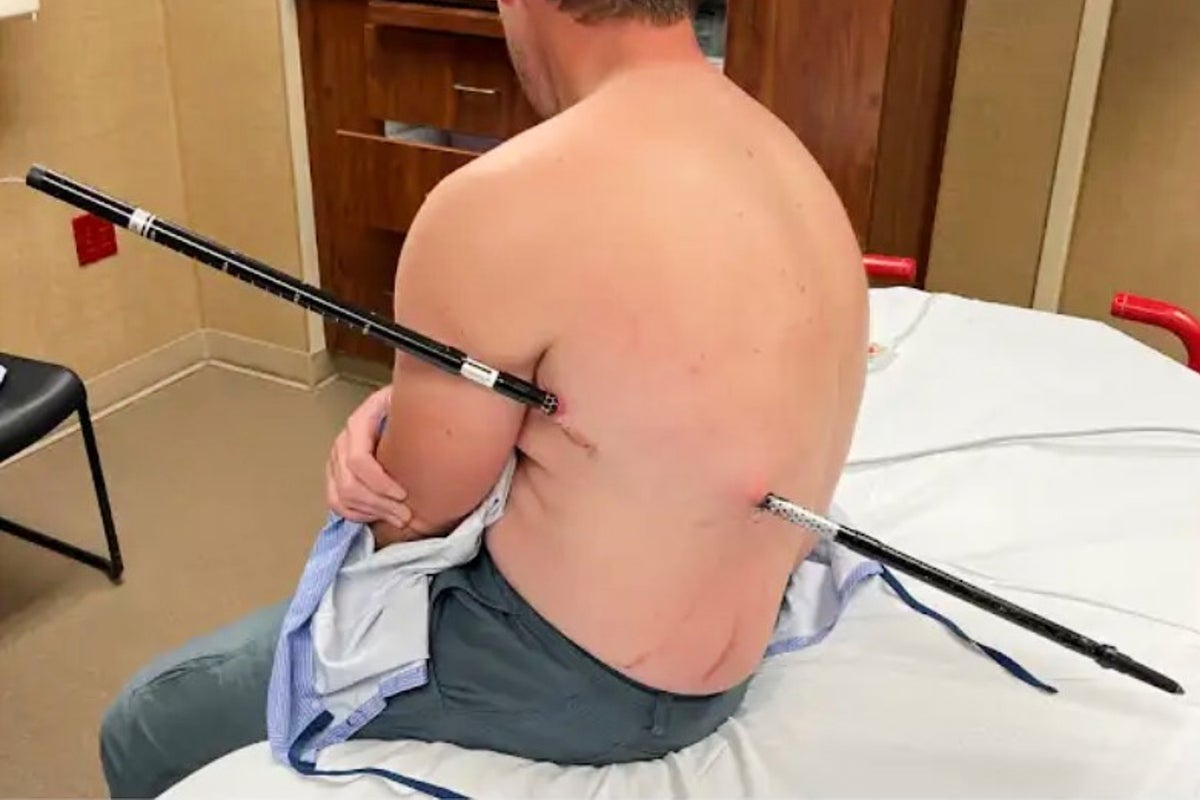
Pain is a language. Usually, it is a whisper, a dull ache that reminds you of a long day, an awkward step, or the passing of years. But sometimes, pain becomes a scream. Sometimes, it is a rod of cold, unyielding steel entering the human frame with the sudden, violent indifference of a falling star.
Consider what happens next: The world narrows. The horizon shrinks to the space between one breath and the next.
This is the story of a man who walked ten miles with a steel pole piercing his body. It sounds like myth. It sounds like the hyperbole of an epic poem translated from a dead language. Yet, the emergency room charts, the bewildered X-rays, and the quiet disbelief of trauma surgeons confirm the geometry of the impossible. A body took a heavy blow. A jagged piece of metal found a pathway through flesh, missing major arterial highways by millimeters, threading a needle of anatomical luck that defies statistical reason.
And then, the man stood up.
He did not wait for a siren. He did not map out his symptoms on a glowing screen or wait for a rescue team to decode his coordinates. He walked. One foot forward. Then the other. Ten miles of dirt, asphalt, and rising panic, driven by an ancient, stubborn engine that refuses to shut down when the lights go out.
We live in an era obsessed with comfort. We complain about the friction of daily life, the minor delays, the slight discomforts of an ergonomic chair adjusted wrong. We have outsourced our survival instincts to algorithms and automated alerts. We forget what a human animal is capable of when the thin veneer of civilization is stripped away by catastrophe.
Let us be clear about the mechanics of trauma. When a foreign object violates the integrity of the skin, the human body initiates a cascade of chemical alarms. Adrenaline floods the bloodstream. Blood vessels constrict. The mind, in an act of profound mercy, often dissociates, creating a protective fog between the conscious self and the raw mechanics of the injury.
(Note: While the exact psychological state of the individual during those ten miles can only be deduced from behavioral patterns observed in extreme survival scenarios, the physiological shock unquestionably created a state of hyper-focused dissociation.)
He felt the weight. He felt the cold drag of the metal against bone and muscle with every stride. But the alternative was surrender. And surrender, in the middle of nowhere, is just a quiet word for dying.
Think about the geography of those ten miles. Every step was a gamble. A twist of the torso, a misstep on a loose stone, a sudden drop in blood pressure—any of these could have tipped the balance from survival to catastrophe. The steel pole acted as a horrific anchor, shifting with the momentum of his stride, testing the tensile strength of human tissue.
Medical professionals later shook their heads. They used terms like anomalous trajectory and fortunate clearance. They marveled at how the spike managed to slip between vital organs like a ghost passing through walls. Science loves its terminology. Science needs categories to make sense of the chaos. But terminology fails to capture the sheer grit required to ignore the body screaming in protest and keep moving forward.
We often look for heroes in cinematic explosions and grand historical gestures. We look to the skies or the history books. But true endurance is quiet. It is mundane. It is ugly, sweaty, and covered in dust.
When he finally reached help, the shock broke. The adrenaline faded, replaced by the sterile hum of fluorescent hospital lights and the frantic, professional movements of nurses and surgeons. The marvel was not just that the metal missed his heart. The marvel was that he refused to let it stop his feet.
We can learn something from the man who walked. Not about how to survive a freak accident involving industrial hardware, but about the reservoirs of resilience we keep locked away in the basement of our daily routines. We spend so much energy avoiding discomfort, shielding ourselves from friction, forgetting that our ancestors crossed oceans on rotting wood and walked across continents in bare feet.
The road is long. The metal is heavy.
Keep walking.