He sat in a noodle shop in Sham Shui Po, staring at a screen that was trying to tell him he was rich.
Let us call him Alex. He is a hypothetical composite of a new, hyper-efficient breed of entrepreneur currently moving through Hong Kong, but his anxiety is entirely real. Five minutes ago, a localized digital marketing tool he built using autonomous AI agents crossed a major threshold. It had just secured its fiftieth corporate client. Alex had no co-founders. He had no employees. He had no board of directors. His monthly recurring revenue was ticking toward figures that, a decade ago, would have required a staff of twenty and a sleek office in Central.
Yet, as he sat under the flickering fluorescent lights, a cold knot formed in his stomach.
Alex realized that if his cloud bill spiked unexpectedly, or if a malicious actor compromised his AI agents' data stream, he was entirely on his own. He was a CEO without an army, vulnerable to the kinds of technical and regulatory liabilities that crush solo operators before they can even get a lawyer on the phone.
This is the invisible friction of the solo tech boom. The tools to build a massive business independently have arrived, but the institutional infrastructure to protect them has lagged behind. Until now.
The Myth of the Carefree Solopreneur
The public loves the myth of the lone genius running a million-dollar empire from a laptop at a beachside cafe. We look at the rise of agentic AI—autonomous digital assistants capable of executing market research, handling customer support, and writing code without human intervention—and assume the barrier to entry has vanished.
It has. But the barrier to survival remains brutally high.
When you operate a one-person company, or OPC, you quickly discover that the traditional corporate world does not know what to do with you. If you go to a major cloud provider or an enterprise security firm as an individual, you are treated as a rounding error. You pay retail prices for computational power. You get automated chat-bot responses when your security is breached.
Consider the sheer mathematical weight of training and deploying an AI agent. To make these digital workers truly autonomous, you need heavy compute resources, constant cloud storage, and immense API token budgets. For a solo founder, these day-to-day operational costs can swallow seed capital long before the product finds its market fit.
Worse is the silent threat of compliance and security. If a multi-person corporation suffers a data breach, it deploys a legal team and a PR department. If Alex's autonomous AI agent accidentally scrapes protected data or suffers a smart-contract vulnerability on a blockchain network, the legal and financial fallout lands squarely on his shoulders.
The dream of the autonomous solo business was stalling on the harsh reality of corporate overhead and systemic risk.
An Unexpected Lifeline in Telegraph Bay
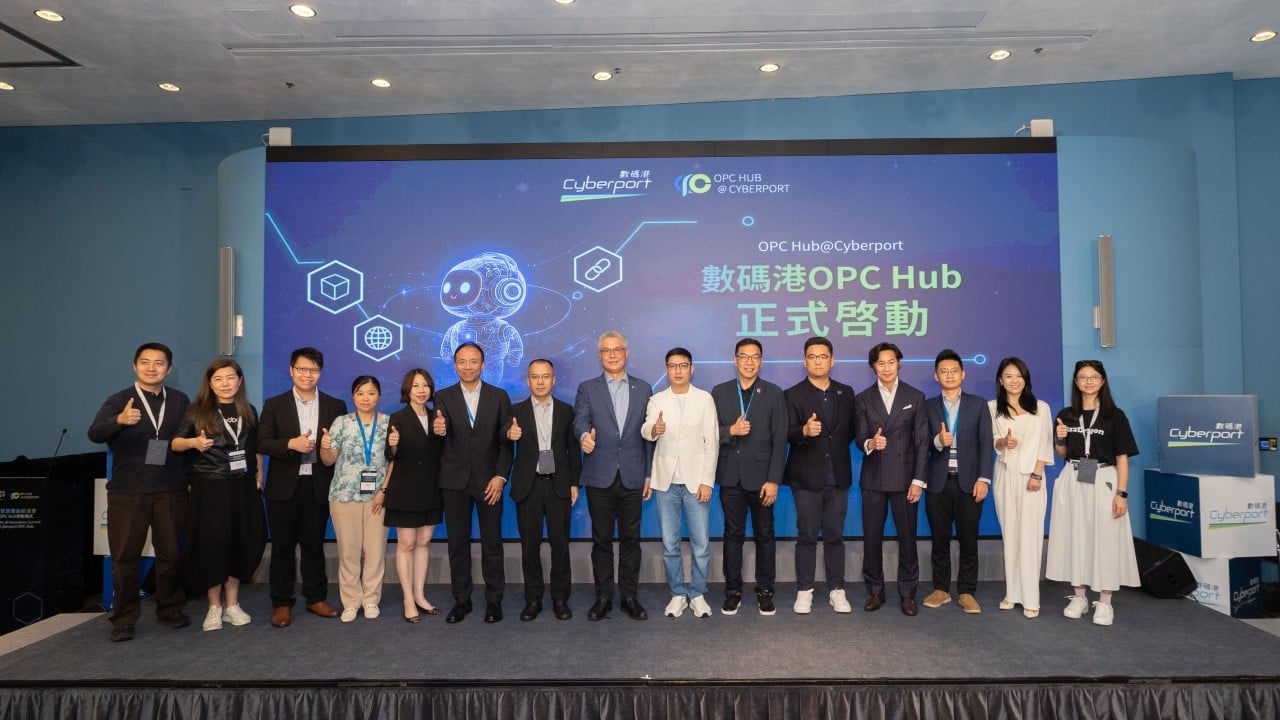
On July 13, 2026, Hong Kong's technology park, Cyberport, quietly fundamentally changed this dynamic. At the Web4.0 & Agentic AI Innovation Summit, they launched the OPC Hub @ Cyberport—the city’s very first dedicated incubator built exclusively for one-person companies and hyper-agile teams.
It is an acknowledgment of a massive structural shift in how human beings build businesses.
The strategy behind the hub is elegant in its simplicity: take the massive institutional bargaining power of a state-backed technology ecosystem and hand it directly to the solo operator. By partnering with global technology giants like Alibaba Cloud, AWS, BytePlus, Cobo, Dell Technologies, Lenovo, and NVIDIA, the hub effectively aggregates solo founders into a collective buying bloc.
For someone like Alex, this changes the equation completely.
Instead of burning through thousands of dollars trying to secure independent computational resources, a member of the OPC Hub gains direct access to AI inference tools, model usage credits, and cloud services at preferential, discounted rates. You no longer need a venture capital round just to pay your computing bill. You just need a laptop, a verified connection to AI agent development, and a company incorporated in Hong Kong that is under two years old.
The Invisible Armor
But the real breakthrough of this initiative isn't just cheaper cloud space or the physical desks waiting at Cyberport 3. It is a direct assault on the vulnerability that keeps solo founders awake at night.
Alongside the hub, Cyberport established the Web4.0 & Agentic AI Security Alliance.
To understand why this matters, you have to look at how rapidly technology is moving. We are entering an era of programmable value and autonomous digital assets where AI agents talk directly to other AI agents to execute financial transactions. If those lines of communication are compromised, the damage is instantaneous.
The newly formed alliance brings together a defensive front of twelve major cybersecurity and infrastructure firms, including names like 360 Digital Security Group, Beosin, BlockSec, CertiK, DAS-Security, and FORMS HK. By embedding these institutional protectors directly into the hub's ecosystem, solo founders are no longer left to defend their digital perimeters alone. They receive the kind of enterprise-grade security auditing and compliance frameworks that are usually reserved for multinational banks.
It removes the terror of the unknown. It allows a founder to focus entirely on building, knowing that a vast network of digital sentries is watching the perimeter.
The Re-imagined Factory Floor
Walk through the co-working spaces of the new hub and you will not see the sprawling, hierarchical corporate offices of the past. You see individuals sitting in front of large monitors, orchestrating small digital armies of autonomous code.
The traditional startup model required you to pitch an idea, raise capital, hire a team of ten, and spend months managing human friction before a single line of product met the market. The modern model is different. It is a single human mind acting as a conductor, utilizing AI to handle the operational weight while they focus purely on strategy, creativity, and localized problem-solving.
This is not about replacing human talent; it is about amplifying it. Hong Kong, with its deep historical roots in global finance, banking, insurance, and logistics, is uniquely positioned for this shift. The city is packed with mid-career professionals who understand the specific, agonizing pain points of traditional industries.
Before this, an insurance executive who discovered a massive flaw in how claims were processed could rarely do anything about it on their own. The cost of building a software solution from scratch was too high. Today, that same executive can step away, build an AI agent tailored to that exact structural loophole, and deploy it through the OPC Hub with minimal overhead.
The barriers have cracked. The lone creator has been given an institutional spine.
Alex finished his noodles and closed his laptop. The screen was still showing the rising client count, but the feeling in his stomach had shifted from isolation to a strange, sharp focus. He was still a one-person operation, working out of a single chair. But as he looked out at the city skyline, he knew that the heavy machinery of an entire technological ecosystem was finally standing right behind him.