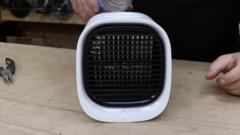
You are scrolling through your phone in a room that feels like an absolute oven. Sweat is dripping down your back. Suddenly, a slick social media video pops up. A friendly presenter, or maybe a realistic voiceover, promises a way out of this misery. They hold up a tiny, sleek plastic cube. The caption boldly claims it will drop your room’s temperature to a crisp chilly breeze and make you cool in 90 seconds.
Even better, they say it uses less power than a lightbulb, costs under fifty bucks, and requires absolutely no window hose. They might even drop a line about secret NASA engineering or a lone inventor sticking it to Big Air Con. Discover more on a connected subject: this related article.
Put your wallet away. It is an absolute lie.
The internet is currently crawling with these viral cooling advertisements, pushing items under names like Epicooler, WellaCooler, and Breezamax. They target people when temperatures spike and local stores run out of real stock. But if you buy one, you are not getting a high-tech cooling miracle. You are paying a 1,000% markup for a cheap, battery-powered desk fan wrapped in deceptive marketing. Additional analysis by TechCrunch delves into related perspectives on this issue.
The Brutal Physics of Actual Air Conditioning
To understand why these viral boxes are fake, you have to look at how real cooling works. True air conditioning is not about creating coldness out of nowhere. It is about heat transfer.
A real portable air conditioner or window unit relies on a heavy compressor, a closed loop of chemical refrigerant, and a system of fans. The machine sucks in the hot air from your room, passes it over freezing evaporator coils to absorb the heat, and then pumps that trapped heat somewhere else. This is exactly why every single legitimate air conditioner on earth features a thick plastic exhaust hose that must vent out of a window. If you do not pump the heat outside, it stays right in the room.
Those viral video units do not have compressors. They do not have refrigerant. Most importantly, they do not have an exhaust hose.
When you strip away the flashy marketing terms like FrostCore Technology, you are left with a tiny plastic box containing a computer cooling fan and a piece of damp fabric. These are actually low-grade evaporative coolers, traditionally called swamp coolers. While commercial swamp coolers work okay in massive, bone-dry desert environments, these tiny desktop versions are useless for room cooling.
How Evaporative Fans Trick Your Senses
If you put ice water into one of these scam boxes and sit exactly two inches away, the air hitting your eyelids will feel slightly chilled. This momentary relief is what the scammers use to film their deceptive review videos. It tricks your brain into thinking the device actually works.
But check the thermodynamics. As the fan blows air over the wet filter, moisture evaporates into the room. In a tiny radius, the breeze feels cool because of basic evaporation. However, that moisture has nowhere to go. It enters your room's atmosphere, rapidly raising the humidity level.
Once the air inside your room becomes humid, your body can no longer evaporate its own sweat efficiently. The room actually begins to feel stickier, stuffier, and more miserable than it did before you turned the device on. Within twenty minutes, the ice water inside the plastic reservoir warms up to room temperature. At that point, you are just running a noisy, low-powered fan that is actively making your room more humid.
Data from tech supply chain audits shows that these generic plastic cubes are bought wholesale from overseas drop-shipping factories for roughly fifteen to seventeen dollars a unit. The slick websites then flip them to desperate, overheating consumers for eighty to one hundred dollars.
Spotting the Scam Playbook in Real Time
The advertising watchdog groups, including the Advertising Standards Authority, have repeatedly issued warnings about these exact campaigns. The companies behind them operate on a fly-by-night model. They spin up a brand name, flood social media with aggressive ads, collect millions of dollars, and disappear before the bad reviews catch up to them. Then, they simply relaunch the exact same plastic box under a brand-new name the following week.
You can spot these fraudulent listings easily if you know what red flags to look for.
First, watch out for the lone inventor narrative. The ads frequently use AI-generated voices or cheap actors claiming a brilliant student or disgruntled engineer invented this tech because commercial air conditioning is too expensive. It is pure fiction designed to build unearned trust.
Second, look for fake scarcity and urgency tactics. The checkout pages almost always feature bright red countdown timers, tickers claiming thousands of people are viewing the item right now, or alerts screaming that only five units remain in stock.
Third, check the missing specs. Legitimate cooling appliances list their cooling capacity in British Thermal Units or kilowatts. They tell you the power draw and the compressor type. Scam sites completely avoid hard engineering numbers, relying instead on vague, trademarked buzzwords that mean absolutely nothing.
Finally, look for the missing footprint. Try to find a real corporate address, a working customer service telephone number, or a functional return policy on the website. You won't find them. If you attempt to return the product, you will find yourself ghosted by a dead email inbox, leaving you with no way to get your money back unless you file a fraud claim directly with your credit card company.
How to Actually Cool Your Space Without Getting Ripped Off
If you genuinely want to lower the temperature in your home, you have to buy real mechanics. Do not click on random social media ad links during a heatwave. Instead, stick to reputable local brick-and-mortar retailers or established online suppliers where you can verify the product details and access a real warranty.
If you have two hundred dollars or more to spend, look for a genuine portable air conditioner with a dedicated window installation kit. Ensure it has a verified BTU rating suited for your specific room size.
If you are on a tight budget and cannot afford a real compressor-based unit, skip the fake miniature AC boxes entirely. Buy a standard, high-velocity metal box fan or an oscillating tower fan from a known brand. A large, well-made fan will move significantly more air volume across your skin than a tiny desktop toy ever could.
During the peak heat of the day, close your windows and pull down the blinds to block direct sunlight from baking your interior rooms. Once the sun drops and the outside air cools down, place your large box fan directly in the window frame facing inward to aggressively pull the crisp night air into your living space. You can even set up a second fan at an opposite window facing outward to create a high-speed cross-breeze that forces the trapped ambient heat out of your home. It is basic, effective, and won't cost you a single cent in scam marketing markups.