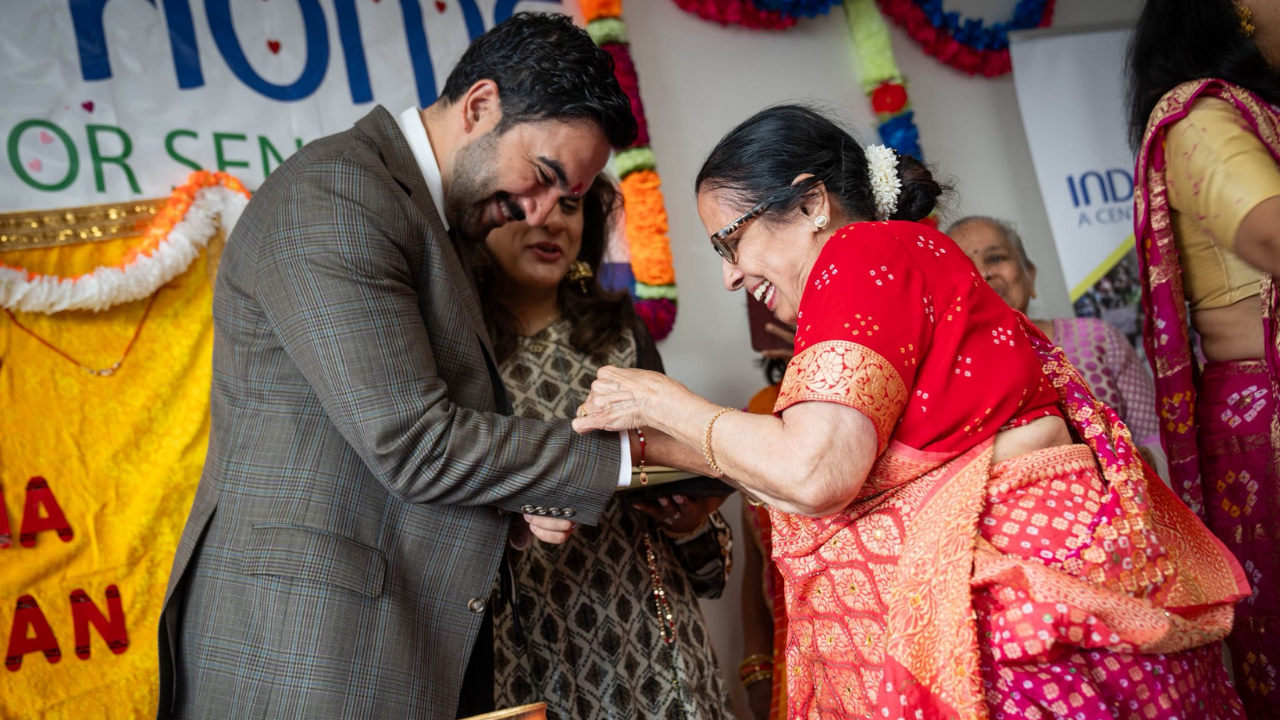
The subway rumbles beneath Queens, shaking the floorboards of a crowded community room where the air smells of cardamom, worn wool, and old paper. Outside, August in New York is a relentless engine of heat and exhaust. Inside, time slows down.
Zohran Mamdani stands near a folding table stacked high with boxes of mithai. He is holding a spool of colorful thread. Silk, mostly. Red and yellow, braided with thin metallic tinsel that catches the fluorescent overhead glare.
Across from him sits a man named Ramesh, eighty-two years old, whose hands have known the precise weight of ledger books in Lahore, the frantic pace of a Manhattan bodega, and now, the quiet trembling of a life lived long past retirement. Ramesh extends his right wrist.
Mamdani ties the rakhi. A simple knot.
For most people rushing past on the 7 train overhead, Rakshabandhan is a distant memory tied to childhood photos sent via WhatsApp from Mumbai or Delhi. It is an ancient ritual of protection and mutual obligation, usually celebrated within the intimate walls of a family home between brothers and sisters. But what happens when the family is scattered across oceans, fractured by migration, or narrowed down to a single room in an outer-borough apartment?
Loneliness in a city of eight million souls is a particular kind of violence. It is silent. It does not announce itself with sirens. It arrives in the mailboxes filled only with circulars, in the television left on for the sound of a human voice, in the terrifying expanse of an empty Sunday.
New York is built on the backs of immigrants who traded their support systems for a shot at rent checks and college tuition. They came with suitcases. They stayed for decades. And then, the children grew up and moved to Chicago or Seattle, or the spouses passed away, and the grand apartments shrank into subsidized senior housing.
This is where the thread comes in.
Consider the mechanics of isolation. When a community ages out of its own workforce, it often slips beneath the cultural radar. Politicians court the youth vote with TikTok algorithms or appeal to suburban homeowners with property tax promises. The elderly immigrant—the one who spent forty years pressing shirts in a dry cleaner or driving a yellow cab twelve hours a day—fades into the background. They become demographic data. A line item in a municipal aging report.
Mamdani’s presence in that room is not just about retail politics. It is a recognition of a missing geography.
When you leave your homeland, you leave behind the calendar of your people. You lose the shared smells of the autumn festivals, the specific cadence of a regional dialect spoken without an apology, the casual touch of an auntie who has known you since you were knee-high. Recreating those rituals in a fluorescent-lit community center in Astoria is an act of defiance against erasure.
Ramesh looks down at his wrist. The red and gold threads are bright against his dark, weathered skin. He touches the knot with his thumb. For a fraction of a second, the decades dissolve. He is not an elderly man waiting for a home-health aide in a borough that feels increasingly foreign. He is a brother. He is part of a chain that stretches back centuries.
That is the invisible stake of local politics that rarely makes the evening news. It is not just about zoning laws or bike lanes, though those matter. It is about emotional infrastructure. Who remembers you when you are old and your children are three time zones away? Who ties the thread when the family tree has been pruned by migration?
Cities are engines of reinvention, but they are also machines of forgetting. We consume neighborhoods, spit out storefronts, and rebrand street corners every decade. In that relentless churn, elders are often treated like outdated software—obsolete, difficult to update, easier to ignore.
Yet, touch matters. Ritual matters. The physical act of someone bending down to tie a piece of string around an old man’s wrist creates an anchor in a storm of anonymity. It says: You are here. You were seen. Your history is part of this zip code.
The boxes of sweets empty out. The tea grows cold in the paper cups. People begin packing up their coats and folding their walkers, preparing to step back out into the humid roar of the afternoon. But the room feels slightly heavier than it did two hours ago. Weighted down with dignity.
Ramesh adjusts his cuffs, hiding the bright red thread beneath his sleeve, but he keeps checking it with his thumb, making sure it is still there.