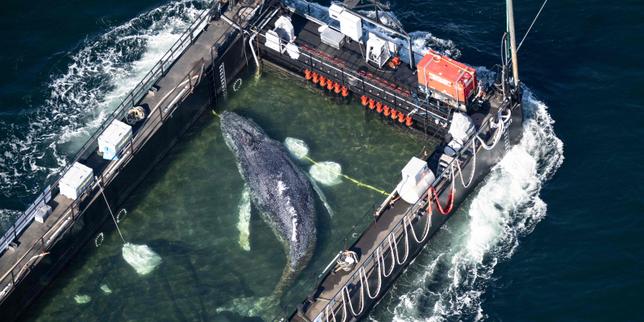
We love a good rescue story. We crave the shot of the giant mammal sliding back into the grey surf, the crowd cheering, and the experts nodding in self-congratulatory triumph. The viral video of Timmy the whale being "released" into the North Sea is the latest hit in this genre of ecological fiction.
It feels good. It looks great on a 15-second social media loop. It is also an ecological distraction that ignores the brutal reality of marine biology.
The media coverage surrounding these releases is built on a foundation of sentimentality rather than science. We treat a 40-ton wild animal like a lost golden retriever. We spend hundreds of thousands of dollars on a single individual while the habitat that individual is returning to remains a toxic, noisy, and depleted mess.
If we actually cared about the North Sea, we wouldn't be cheering for a crane. We would be questioning the very premise of the "rescue."
The Survival Myth of the Lone Whale
The "lazy consensus" dictates that if an animal is swimming away, the mission is a success. This is a narrow, human-centric view of time. Success isn't the moment of release; success is the following five years.
Marine biologists who aren't chasing grants or TV cameos know the data on long-term survival for stranded and rehabilitated large cetaceans is sobering. When a whale like Timmy ends up in shallow waters or stranded, it isn't usually an "accident." These animals possess sophisticated sonar and deep ancestral knowledge of migration routes. They strand because they are sick, deafened by seismic surveys, or starving.
By "saving" an individual that was naturally selected for removal from the gene pool, we are intervening in a process we barely understand. We are forcing a stressed, immunocompromised animal back into an environment that already defeated it once.
The Opportunity Cost of a Viral Moment
Let's talk about the math. A rescue operation of this scale—logistics, specialized transport, veterinary round-the-clock care, and the release vessel—costs a fortune.
Imagine a scenario where those same funds were diverted from a single high-profile whale to habitat restoration or the enforcement of "quiet zones" to prevent sonar-induced internal hemorrhaging in thousands of other mammals.
We don't do that because habitat restoration is boring. It doesn't have a name like "Timmy." It doesn't have a face. You can't put a "quiet zone" on a t-shirt and sell it to donors. We have traded actual conservation for Compassion Theater.
- Individualism vs. Ecosystems: We prioritize the one over the many because it fits a narrative structure.
- Optics vs. Impact: A crane lowering a whale into the water is a better PR win than a report on reduced nitrogen runoff.
- Short-term dopamine vs. Long-term health: We want the happy ending now, regardless of whether the whale survives the winter.
The North Sea is a Construction Site
The competitor's fluff piece paints the North Sea as a pristine wilderness welcoming its son home. This is a lie. The North Sea is one of the most industrialized bodies of water on the planet. Between wind farm construction, bottom trawling, and the constant thrum of shipping lanes, it is a sensory hell for a creature that relies on sound to survive.
Releasing a rehabilitated whale into these waters without addressing the systemic noise pollution is like "saving" a person from a burning building and then throwing them back into the basement because "that’s where they live."
If the goal is truly the welfare of the species, the conversation should be about the Carrying Capacity of the environment, not the emotional state of the public watching the news.
The Expert Gap
I have seen organizations burn through their annual budget on a single "charismatic megafauna" case while local shellfish populations—the literal bedrock of the food chain—collapse in silence.
True expertise in this field requires admitting that sometimes, the most ethical choice is the hardest one. Euthanasia is a dirty word in the world of public relations, but in the world of biology, it is often the only way to prevent prolonged suffering in an animal that can no longer navigate the modern ocean.
Instead, we choose "rehab." We subject a wild animal to human touch, artificial tanks, and a diet of frozen fish, only to dump it back into a sea that is increasingly hostile to its existence.
Moving Beyond the Heartstrings
The public asks: "Is Timmy happy?"
The wrong question.
The public asks: "When can we see him swim?"
The wrong focus.
The real question is: Why are they stranding in the first place?
If we don't address the acoustic smog and the depletion of caloric-dense prey species, we are just running a very expensive, very public hospice program for the ocean's giants.
Stop liking the videos. Stop sharing the "miracle" stories. Start demanding that the money follows the science, not the hashtags. The ocean doesn't need more heroes; it needs less interference and more room to breathe.
If you want to save the whales, stop obsessing over the one on the beach and start looking at the industries in the water.