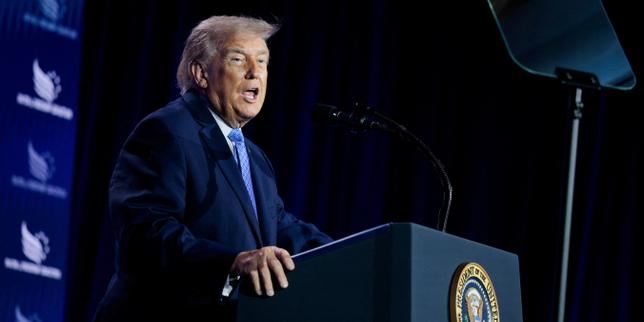
President Donald Trump blindsided global markets on Friday by threatening an immediate 100 percent tariff on any nation that imposes a digital services tax on American technology firms. In a fiery declaration on Truth Social, the administration warned that these retaliatory duties will instantly supersede all existing trade pacts, signed or unsigned. The move shifts the simmering transatlantic debate over corporate taxation into an outright trade war, threatening to derail a hard-fought 15 percent tariff cap agreement between the United States and the European Union just days before its July 4 implementation deadline.
For nearly a decade, European capitals have watched billions in revenue generated within their borders slip away to low-tax jurisdictions like Ireland or Luxembourg. Silicon Valley giants profit heavily from local users while avoiding traditional corporate income taxes due to a lack of physical infrastructure. To claw back this revenue, nations like France, Italy, and the United Kingdom designed a workaround: a gross revenue tax on local digital activities, specifically targeting online marketplaces, search engines, and targeted advertising. In other news, read about: Selling the Grand Ole Opry is the Best Move Nashville Corporate Music Ever Made.
Washington views this workaround as an asymmetric assault on American industrial dominance.
The Real Mechanism Behind the Silicon Valley Shield
A digital services tax operates differently from traditional corporate taxes. Instead of skimming profits after expenses, it takes a direct cut of gross revenue generated from localized user data and digital interactions. For example, if a company crosses specific global and local revenue thresholds—such as France's requirement of 750 million euros globally and 25 million euros locally—it pays a fixed percentage on every local ad click or marketplace transaction. The Wall Street Journal has also covered this fascinating issue in extensive detail.
Because American giants like Alphabet, Meta, and Amazon dominate these sectors, the financial burden falls almost exclusively on United States companies. Trump’s retaliatory approach treats these tax codes not as legitimate revenue policy, but as discriminatory trade barriers.
By threatening 100 percent import tariffs on all goods from offending nations, the White House is using the massive American consumer market as leverage. If France taxes an American ad click, Washington will effectively ban French luxury goods, aerospace components, and wine from American shores by doubling their price overnight.
The Legal Chaos Threatening the Executive Mandate
Executing a blanket 100 percent tariff based on a single social media post is vastly more complicated than the White House suggests. Earlier judicial challenges have chipped away at the executive branch's trade authority. The Supreme Court previously invalidated parts of the administration’s sweeping, country-specific tariff structures, ruling that the International Emergency Economic Powers Act does not grant the president unlimited unilateral power to reshape global trade on a whim.
To bypass these restrictions, the administration has previously leaned on Section 301 of the Trade Act of 1974, which permits retaliation against foreign practices that burden or restrict United States commerce. However, Section 301 investigations take months of formal review, public comment, and administrative processing.
Alternatively, Section 122 of the same act allows for immediate balance-of-payments emergency tariffs, but it carries a strict statutory ceiling. Those emergency duties automatically expire after 150 days unless Congress intervenes with an explicit extension.
| Trade Provision | Activation Speed | Legal Hard Ceiling | Vulnerability |
|---|---|---|---|
| Section 301 | Slow (requires formal investigation) | None, if discrimination is proven | Long administrative delay |
| Section 122 | Immediate emergency action | 150 days maximum without Congress | Strict statutory time expiration |
| IEEPA Emergency | Immediate executive order | Overturned by Supreme Court precedent | High risk of federal injunction |
The European Commission responded to the threat within hours, maintaining that its member states possess full regulatory autonomy to levy non-discriminatory corporate taxes. Privately, European trade diplomats admit they are trapped. Stripping away the digital services tax means surrendering vital public revenue during a period of intense fiscal strain. Proceeding with the tax means watching their manufacturing, agricultural, and luxury export sectors decimated by a 100 percent American tariff.
The Imminent Collapse of the July Fourth Truce
The timing of this escalation introduces immediate volatility into global markets. The United States and the European Union finalized a trade deal in May that capped standard tariffs on European exports at 15 percent, celebrating a rare moment of transatlantic economic stability. That deal required months of negotiations after European Commission President Ursula von der Leyen met with Trump in Scotland to defuse previous auto tariff threats.
Digital taxation was deliberately left out of that agreement because the two sides could not bridge the ideological chasm. European lawmakers rushed to codify their tariff-reduction commitments before a strict July 4 deadline imposed by Washington. Now, that entire framework is fundamentally compromised before the ink is dry.
Multinational corporations are left operating in a structural vacuum. If a single European nation moves forward with its digital services tax, the resulting 100 percent American tariff will disrupt supply chains far beyond the technology sector. Car manufacturers, industrial equipment suppliers, and consumer goods companies will bear the direct cost of a geopolitical battle fought over digital ad revenue.
The strategy hinges on total economic deterrence, betting that foreign capitals will blink before the July deadline rather than risk total exclusion from the world's largest consumer market.


