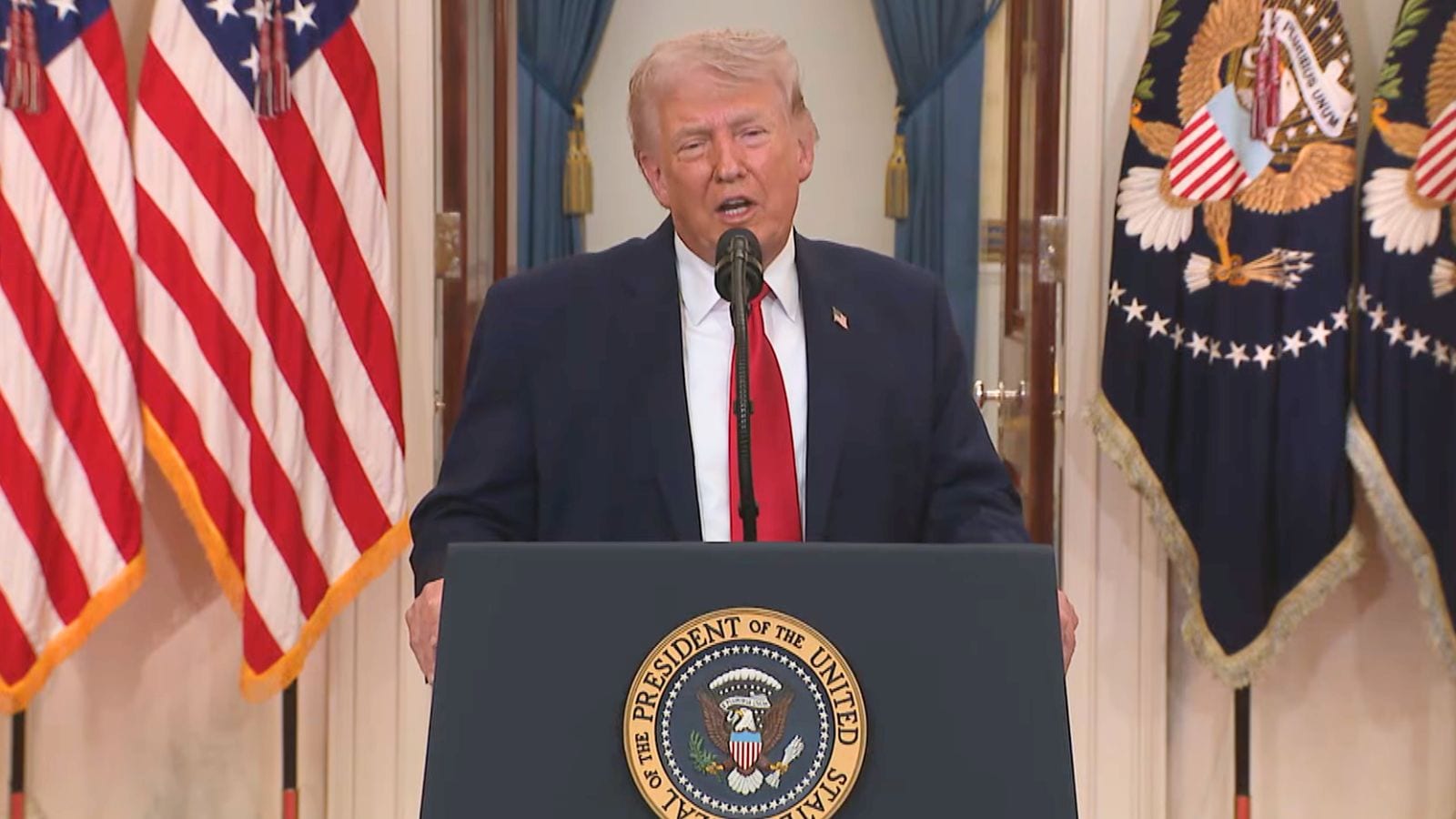
The window for diplomacy has slammed shut. In a series of high-stakes briefings, Donald Trump has signaled that the United States is prepared to execute a "Stone Age" kinetic strike against Iran within the next 21 days if Tehran does not immediately dismantle its remaining nuclear infrastructure and cease regional proxy operations. This isn't the usual campaign trail bluster. It is a calculated escalation designed to force a total collapse of the Iranian regime's strategic depth before it can secure a permanent nuclear deterrent. While previous administrations relied on the slow burn of economic sanctions, the current directive focuses on a rapid, overwhelming dismantling of the Iranian military machine.
The threat centers on a specific three-week timeline. This period coincides with intelligence reports suggesting Iran is on the verge of "breakout capacity," the point where they have enough fissile material for a functional weapon. By framing the strike as a move to return the country to a pre-industrial state, the administration is signaling a shift from "surgical strikes" to "systemic erasure." The goal is not just to hit a few labs, but to neutralize the power grid, command centers, and oil export terminals that keep the Islamic Republic afloat. If you found value in this article, you should check out: this related article.
The Mechanics of a Total Infrastructure Reset
A "Stone Age" strike is a specific military doctrine. It does not necessarily mean carpet bombing or nuclear fallout. Instead, it involves the synchronized use of Electronic Warfare (EW) and Graphite Bombs to kill the national power grid instantly. When the electricity goes out in a modern nation, everything else stops. Water pumps fail. Hospitals switch to limited fuel-fed generators. Communication networks go dark.
Military planners are looking at the integrated air defense systems (IADS) protecting sites like Natanz and Fordow. To reach these deeply buried facilities, the U.S. would likely employ the GBU-57A/B Massive Ordnance Penetrator (MOP). This 30,000-pound bunker buster is designed to drill through 200 feet of reinforced concrete before detonating. However, the threat of a broader strike implies that the targets are no longer just centrifuges. They are the bridges, the fiber-optic nodes, and the port of Bandar Abbas. For another perspective on this event, see the latest coverage from The New York Times.
By removing the ability to export oil, the U.S. effectively kills the regime's heart. Without petrodollars, the Islamic Revolutionary Guard Corps (IRGC) cannot pay its various militias in Iraq, Syria, or Yemen. This is the "decimation" Trump refers to—a structural bankruptcy that renders the government unable to govern. It is a gamble that the Iranian people, exhausted by decades of mismanagement and repression, would see the collapse of the grid as the final sign to move against the leadership.
The Intelligence Behind the Three Week Clock
Why now? Intelligence circles suggest that Iran has moved its advanced IR-6 centrifuges into hardened underground halls that are becoming increasingly difficult to hit even with the best conventional explosives. There is a "now or never" mentality permeating the Pentagon. If the U.S. waits another six months, the technical hurdles to a successful strike might become insurmountable without resorting to tactical nuclear weapons—an option no one wants on the table.
Furthermore, the regional landscape has shifted. The "Axis of Resistance" is frayed. Hezbollah is tied down, and Hamas has been severely degraded. This creates a vacuum. The U.S. calculates that Iran’s primary shields are down, leaving the "head of the snake" exposed.
There is also the matter of the cyber component. We are seeing an unprecedented level of penetration into Iranian state networks. Before a single physical bomb drops, the "Stone Age" begins with code. If the U.S. can flip the switch on the country’s industrial control systems (ICS), they can cause physical damage to turbines and cooling systems without firing a shot. This creates a psychological paralysis. The regime finds itself unable to trust its own hardware.
The Economic Aftershocks of a Persian Gulf Blackout
The world economy isn't ready for this. If Trump follows through, the price of Brent Crude will likely spike past $150 a barrel in a matter of hours. Even the threat of a strike has sent tremors through the shipping insurance markets in London. The Strait of Hormuz, a narrow choke point through which 20% of the world's oil passes, would become a combat zone.
Iran’s primary counter-move is "asymmetric chaos." They don't need a blue-water navy to win. They have thousands of fast-attack boats and sea mines. They have drones. They can target the desalination plants in Saudi Arabia and the UAE, turning a military conflict into a regional humanitarian crisis. This is the "grey zone" where the U.S. advantage in raw firepower is mitigated by the fragility of global supply chains.
Key Strategic Targets for a Systemic Strike
| Sector | Target Type | Strategic Intent |
|---|---|---|
| Energy | Oil Terminals & Refineries | Immediate halt of hard currency flow. |
| Communication | Satellite Uplinks & Fiber Hubs | Internal command and control paralysis. |
| Logistics | Major Rail Links & Bridges | Prevention of internal troop movements. |
| Military | IRGC Command Bunkers | Decapitation of the regime's enforcement arm. |
The Brinkmanship of the Ultimatum
Diplomacy by threat is a dangerous game. When you tell a sovereign nation they have 21 days before they are bombed back to the 19th century, you leave them with two choices: total surrender or a pre-emptive "hail mary" attack. The Iranian leadership is famously prone to the latter. Their ideology is built on the concept of resistance at all costs.
However, there is a faction within Tehran that is terrified. They have watched the precision of recent Western-aligned operations and realize that their Russian-made S-300 and S-400 systems might be little more than expensive lawn ornaments against modern stealth tech and electronic jamming. These pragmatists are the target of Trump's rhetoric. The goal is to spark an internal schism. If the IRGC thinks the "Great Satan" is truly coming for everything—not just the nukes, but the lights, the water, and the internet—they might decide that preserving their own lives is more important than the nuclear program.
Overlooked Variables in the Escalation Ladder
Everyone is focused on the bombs, but the real story might be the sanctions-evasion networks. For years, Iran has operated a "shadow fleet" of tankers to move oil to China. A strike on the infrastructure is irrelevant if the money keeps flowing through illicit digital channels and Chinese banks. Any military action would have to be paired with a total financial blockade that targets the facilitators in Beijing and Dubai.
Then there is the "Day After" problem. If you decimate a country's infrastructure, you are responsible for the fallout. A "Stone Age" Iran is a breeding ground for radicalization and a massive refugee crisis that would swamp Europe. The U.S. military is excellent at breaking things; it is less effective at managing the vacuum that follows. This is the part of the plan that remains suspiciously vague.
Technical Specifications of the Threat
The hardware involved is not just about raw power. It is about precision and frequency.
- Electronic Pulse (EMP) Capabilities: Non-nuclear EMP weapons (CHAMP) can fry electronics in specific buildings without harming people.
- Stealth Penetration: The F-35 and B-21 Raider represent a generation of aircraft that Iranian radar simply cannot see in time to react.
- Autonomous Swarms: The use of cheap, expendable drones to saturate air defenses, allowing the expensive missiles to hit their marks.
The Reality of the "Decimated" Claim
Trump’s claim that Iran is already "decimated" is a reference to the internal economic collapse. Inflation in Iran has been hovering near 50%. The rial is effectively worthless. The middle class has been erased. In this context, a military strike is seen by the administration as the "final push." It is the application of force to a structure that is already riddled with cracks.
But history shows that external threats often unite a fractured population. The "rally 'round the flag" effect is real. If the U.S. hits civilian infrastructure like the power grid, the regime will use it to paint the Americans as the monsters they have always claimed they were. This could backfire by giving the regime a new lease on life, justified by the need for national defense against a foreign invader.
The next three weeks will determine the trajectory of the Middle East for the next fifty years. We are no longer talking about "containing" Iran. We are talking about the end of the Islamic Republic as a modern state. Whether this leads to a new era of regional stability or a catastrophic wildfire that consumes the global economy depends entirely on who blinks first in this high-stakes game of nuclear chicken.
The move toward a kinetic solution suggests that the era of the "Nuclear Deal" is not just dead, but buried under thirty feet of reinforced concrete. The U.S. is betting that the regime is a paper tiger. If they are wrong, the "Stone Age" won't be confined to the borders of Iran. It will be felt at every gas pump and in every stock market on the planet.
Ground assets are moving. The carrier strike groups are in position. The ultimatum is on the desk in Tehran. The clock is ticking toward a zero-hour that might rewrite the map of the world.
Prepare for a world where the Persian Gulf is silent.