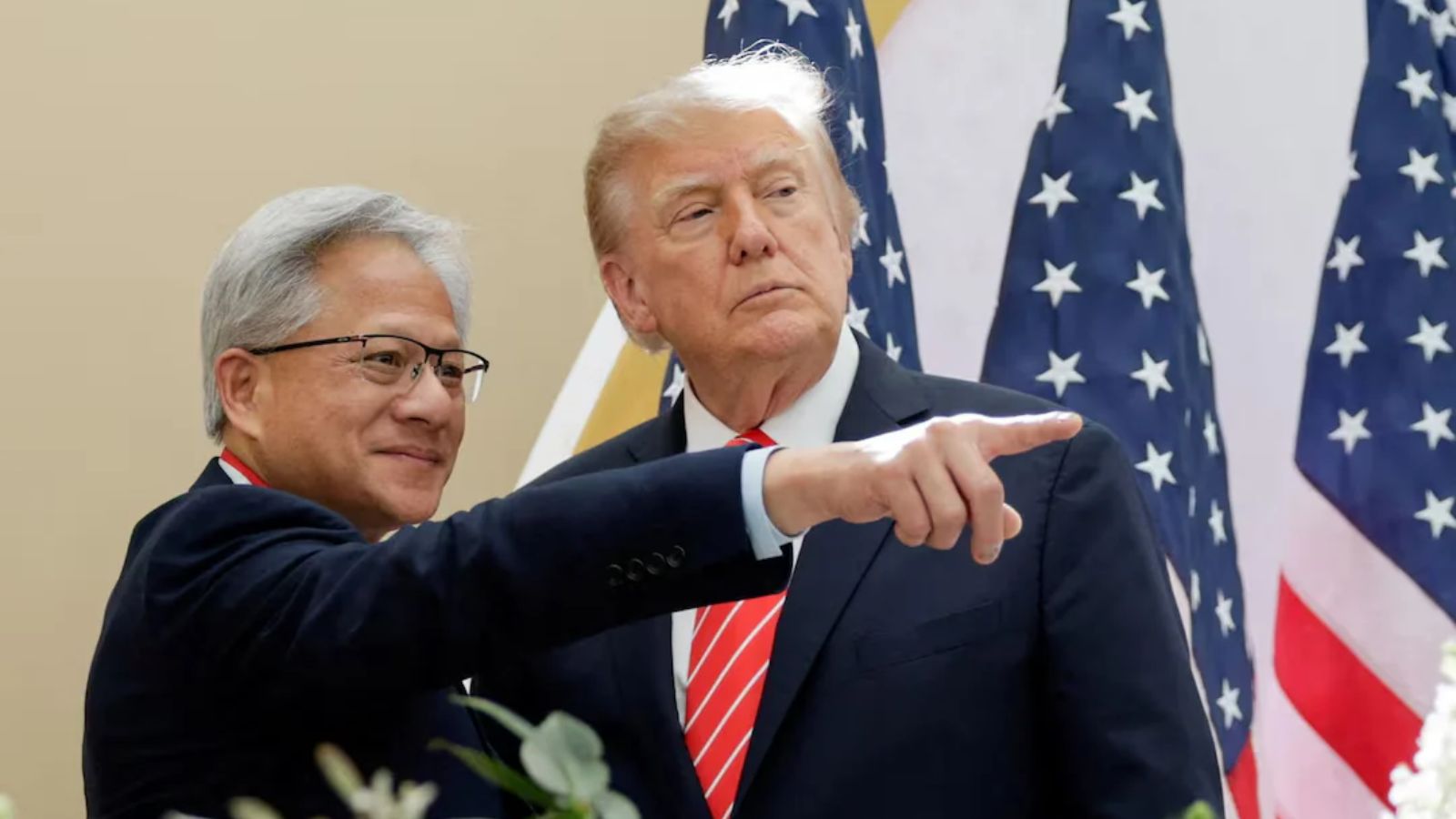
The political media treats every billionaire endorsement like a high school cafeteria alliance. When Donald Trump and Elon Musk step up to defend Nvidia CEO Jensen Huang against Washington’s latest China espionage panic, the pundits immediately reach for lazy tropes about ideological solidarity, anti-woke alliances, or blind loyalty among tech titans.
They are missing the entire board.
This is not a brotherhood of billionaires protecting one of their own. It is a calculated, ruthless defense of the single most critical supply chain chokepoint on earth. If Washington’s national security hawks succeed in kneecapping Huang over alleged backdoors, smuggling rings, or intellectual property leakage to Beijing, the immediate casualties will not be Chinese AI labs. The casualties will be xAI, the American industrial base, and the exact domestic energy and manufacturing boom Trump promises to deliver.
You have to look past the cable news theater. The real story is not whether Jensen Huang is loyal to America. The real story is that America’s most ambitious political and industrial operators have realized they cannot execute their own plans if Washington strangles the only man holding the keys to global compute.
The Lazy Consensus of the Washington China Hawks
Every few months, a fresh wave of panic washes over Capitol Hill regarding Nvidia. First, it was export controls on the A100 and H100 chips. Then it was outrage over Nvidia designing slightly detuned versions—like the H20—to legally comply with Commerce Department rules while keeping Chinese revenue flowing. Now, the narrative has mutated into outright suspicion of corporate espionage, hardware tracking failures, and the accusation that Huang is playing both sides of a cold war.
The consensus among Beltway commentators is simple: Nvidia is addicted to Chinese cash, Jensen Huang is prioritizing quarterly margins over national security, and any American leader who defends him is being soft on Beijing.
That consensus is built on a fundamental ignorance of how semiconductor economics actually work.
I have watched defense contractors and enterprise tech firms burn hundreds of millions of dollars trying to build "sovereign" hardware stacks divorced from global volume. They always hit the exact same mathematical wall. Semiconductor fabrication is not a boutique craft. It is a brutal, capital-intensive volume game where R&D costs double with every process node shrink.
Nvidia does not maintain a two-generation architectural lead over AMD, Intel, and every hyperscaler’s custom silicon because Jensen Huang wears a nice leather jacket. Nvidia leads because it captures roughly 80% to 90% of the data center AI accelerator market, pooling global capital from every major economy to fund a multi-billion-dollar annual R&D budget that no single-country supplier could ever sustain.
When Washington hawks demand that Nvidia sever every commercial artery to China overnight, they are not proposing a surgical strike against Beijing. They are proposing to strip billions of dollars out of Nvidia’s R&D flywheel while simultaneously handing Huawei a captive domestic market of 1.4 billion people.
Why Elon Musk Cannot Afford a Weakened Nvidia
Look at Elon Musk’s public backing of Huang through the lens of pure self-interest, because that is the only lens that matters in Austin and Silicon Valley.
Musk is currently executing one of the most aggressive infrastructure builds in corporate history with xAI’s Colossus supercomputer cluster in Memphis. Hundreds of thousands of Nvidia H100 and H200 GPUs, wired together with Nvidia’s proprietary Spectrum-X networking, represent the beating heart of Musk’s entire artificial intelligence strategy. Tesla’s Full Self-Driving neural networks rely on massive Nvidia clusters. Even Musk’s robotics ambitions with Optimus depend on simulated training environments running on Nvidia hardware.
Imagine a scenario where congressional investigations, export freezes, or federal compliance audits tie Nvidia up in knots for eighteen months.
Supply chains freeze. Blackwell and Rubin architectures get delayed at TSMC packaging facilities in Taiwan while lawyers argue over end-user verification protocols. Enterprise customers—including xAI and Tesla—suddenly face hardware allocation bottlenecks and skyrocketing unit costs because Nvidia has to amortize its massive fixed costs across a smaller addressable market.
Musk does not defend Jensen Huang because they share a group chat. Musk defends Huang because if Washington breaks Nvidia’s momentum, Musk’s own multi-billion-dollar AI infrastructure becomes instantly more expensive, slower to deploy, and vulnerable to supply shocks.
The Open-Source and CUDA Lock-In Reality
Critics frequently ask why Musk or Trump don't simply push American companies to use domestic alternatives like AMD, Intel, or custom ASICs from Broadcom and Marvell.
This question reveals a total misunderstanding of what Nvidia actually sells. Nvidia does not sell chips. Nvidia sells CUDA—the Compute Unified Device Architecture—alongside NVLink interconnects and full-stack software libraries that have become the native operating language of modern AI.
- Hardware is replaceable; developer ecosystems are not. You can buy a cheaper GPU tomorrow, and your engineering team will spend six months rewriting kernels just to get 60% of the theoretical FLOPS out of it.
- Time-to-market dictates survival. In frontier model training, a three-month delay in cluster deployment means your model is obsolete before it finishes its pre-training run.
- Supply chain concentration is absolute. TSMC manufactures the wafers, SK Hynix and Micron supply the High Bandwidth Memory (HBM), and Nvidia integrates the stack. Disrupting the top of that pyramid destabilizes the entire pyramid.
Musk knows this intimately. He tried building custom silicon with Tesla’s Dojo project, and while Dojo serves specific vision-training workloads, Musk still had to buy tens of thousands of Nvidia GPUs to keep pace. You do not pick a fight with your sole irreplaceable supplier while you are sprinting to build the world's largest supercomputer.
Donald Trump’s Transactional Calculation
Donald Trump’s defense of Huang is equally misunderstood by pundits who expect him to automatically endorse any anti-China hawkishness.
Trump views international trade and industrial policy through a strictly transactional, balance-of-trade framework. To a traditional Washington neoconservative, selling any advanced technology to a Chinese entity is an unacceptable security breach. To Trump, having an American company dominate a global market, extract billions of dollars in foreign capital, and reinvest those profits into U.S.-based engineering and onshore manufacturing is the definition of winning.
Consider the numbers. Under immense pressure from the White House, Nvidia committed to massive U.S. manufacturing investments alongside partners like TSMC and Foxconn to build AI supercomputers and packaging capacity in Arizona and Texas.
Trump understands basic leverage. You cannot force a company to spend tens of billions of dollars building factories in the American Southwest while simultaneously threatening to indict its executives or destroy its global revenue base.
Furthermore, Trump’s broader economic agenda relies heavily on the AI infrastructure boom to justify massive deregulation of the U.S. power grid. Data centers require gigawatts of baseload power—natural gas, nuclear restarts, and grid modernization. Nvidia is the primary catalyst driving that capital expenditure across red states and industrial corridors. If Washington kneecaps Nvidia over China spy allegations, the AI capex wave stalls, data center construction slows, and the domestic energy renaissance loses its biggest customer.
Trump backing Huang is pure pragmatism: keep the golden goose laying eggs in Texas and Arizona, and stop bureaucrats from choking it to death over chips that are already two generations behind the American frontier.
Dismantling the "Spy Chip" and Smuggling Fallacies
To understand why the current controversy is built on shaky technical ground, you have to separate real national security risks from Hollywood fiction.
The loudest accusations against Nvidia usually fall into two buckets: either Nvidia is failing to stop Chinese shell companies from smuggling restricted GPUs into mainland China, or Nvidia’s hardware and software ecosystems create covert intelligence vulnerabilities.
Let us examine both with actual engineering reality.
1. The Smuggling Myth vs. Physical Logistics
When critics point out that restricted Nvidia H100s are showing up in Chinese universities or startup clusters, they act as though Jensen Huang is personally shipping crates out the back door of Santa Clara.
In reality, Nvidia sells chips to Original Equipment Manufacturers (OEMs) like Dell, Supermicro, Lenovo, and Gigabyte, as well as global cloud providers and distributors. Once a server rack is sold to a legitimate data center operator in Singapore, Malaysia, or the Middle East, Nvidia does not own that physical asset.
If a shell company in Southeast Asia rents bare-metal cloud capacity on those servers, or physically strips the GPUs out of a server chassis and ships them across a border in luggage, demanding that Nvidia "prevent" it is like demanding that Ford prevent its pickup trucks from ending up in conflict zones overseas.
Recently, lawmakers pushed proposals requiring hardware-level location verification—essentially baking GPS or cryptographic ping-back tracking directly into the silicon.
Here is the massive downside that Washington completely ignores: enterprise customers will revolt.
If Nvidia builds a hardware kill-switch or mandatory telemetry beacon into every GPU so the U.S. government can track its physical location, every sovereign wealth fund in the Middle East, every European bank, and every private American corporation will suddenly realize their core compute infrastructure has a built-in backdoor. You cannot claim to protect hardware from Chinese espionage by mandating that the hardware itself carry a permanent surveillance beacon.
2. The Huawei Acceleration Trap
The greatest flaw in the hawkish strategy is the assumption that denying Nvidia chips to China freezes Chinese AI development in amber.
It does the exact opposite. It forces Beijing to subsidize its domestic semiconductor sector with infinite state capital until it achieves self-sufficiency.
Huawei’s Ascend 910B and 910C chips are already closing the gap faster than Western analysts predicted two years ago. Why? Because U.S. export controls handed Huawei a guaranteed domestic customer base. Chinese tech giants like ByteDance, Alibaba, and Tencent previously preferred Nvidia because CUDA was superior and reliable. Once Washington made Nvidia unreliable, Chinese hyperscalers had no choice but to pour engineering talent into Huawei’s CANN software stack to make domestic silicon viable.
Jensen Huang has warned about this dynamic repeatedly, and he is right. When you lock an American monopoly out of a major market, you do not destroy the market. You incubate your own replacement.
Once Huawei perfects a competitive AI accelerator and software stack inside China’s protected domestic market, it will immediately export that cheaper, sanctions-free hardware to the rest of the developing world—Southeast Asia, Latin America, Africa, and the Middle East. Washington’s attempt to contain China ends up eviscerating American market share globally.
The Uncomfortable Truth About Tech Sovereignty
I am not arguing that Nvidia is a charity or that Jensen Huang is motivated by pure patriotism. Nvidia is a $3 trillion public corporation whose fiduciary duty is to maximize shareholder value. Huang will sell every single chip the Commerce Department legally permits him to sell, and he will lobby fiercely to keep those legal boundaries as wide as possible.
That is the downside of relying on a single commercial juggernaut for strategic national infrastructure: corporate incentives and national security incentives will never align 100%.
If you leave Nvidia completely unchecked, it will naturally optimize for global market share over domestic exclusivity. Ignoring real counter-intelligence threats—such as Chinese talent recruitment inside Silicon Valley labs or state-backed cyber espionage targeting chip designs—would be catastrophic.
But there is a massive difference between targeted counter-intelligence enforcement and burning down your own industrial champion in a fit of congressional grandstanding.
Right now, Washington is trying to solve a structural industrial problem with punitive regulatory theater. You do not win a technological cold war by hobbling your fastest runner so he cannot trip over the border. You win by ensuring your runner stays two laps ahead of everyone else on the track.
What Actually Works Instead of Regulatory Theater
If policymakers, investors, and industry leaders want to actually protect American compute dominance without triggering self-inflicted supply chain collapse, the playbook is straightforward:
- Enforce laws at the border and customs level, not inside the silicon. Go after the shell companies, freight forwarders, and corrupt distributors illegally transshipping hardware through third countries. Prosecute smugglers aggressively instead of forcing chip designers to cripple their own architectures with tracking backdoors.
- Focus export controls exclusively on manufacturing equipment, not finished commercial chips. The real chokepoint in semiconductors is not an H20 GPU; it is Extreme Ultraviolet (EUV) lithography from ASML, advanced etching tools from Lam Research and Applied Materials, and EDA design software from Synopsys and Cadence. Keep the chokehold on the tools required to make sub-5nm chips, and let Nvidia drain Chinese capital by selling generation-behind commercial hardware.
- Accelerate domestic energy and permitting reform. The true bottleneck to American AI supremacy over the next five years is not whether China buys detuned Nvidia chips. It is whether the U.S. electrical grid can deliver 50 gigawatts of new power to domestic data centers before 2030.
Donald Trump and Elon Musk did not step in to defend Jensen Huang out of sentimentality. They stepped in because they understand a brutal reality that Washington’s career politicians still refuse to accept: in the twenty-first century, geopolitical power flows through whoever controls the compute.
Destroy Nvidia to spite Beijing, and Washington will wake up holding a stack of strict compliance memos while someone else owns the future.