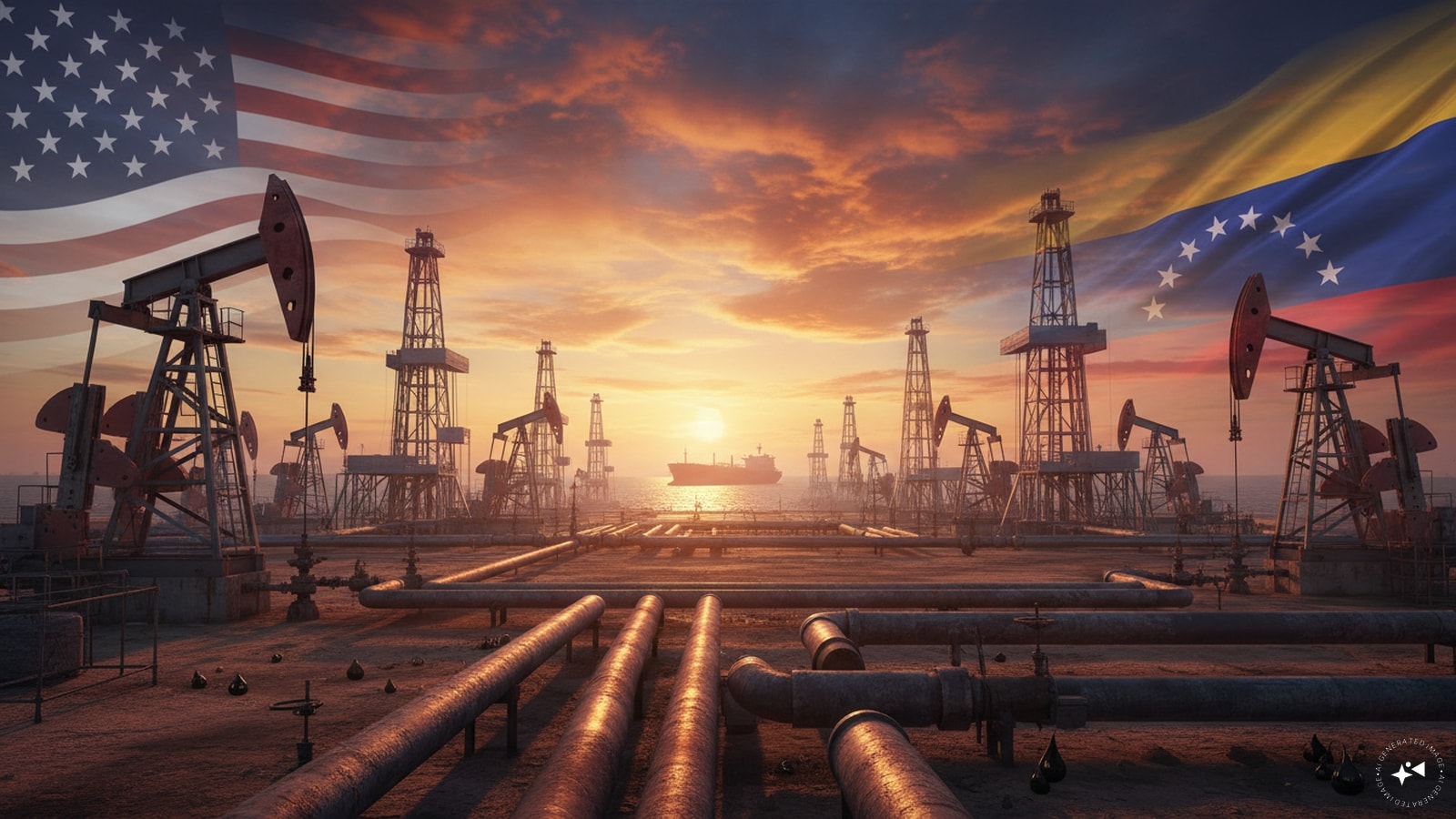
Every desk in Houston and London lit up the second the headlines crossed the terminal. Sixty-five billion barrels. The biggest prize in the Western Hemisphere, supposedly handed over on a silver platter through sheer political bravado. Analysts fell over themselves updating DCF models, politicians drafted victory speeches about energy dominance, and retail traders smashed the buy button on any shell company with a pipeline sketched on a napkin.
They are walking straight into a woodchipper. Don't miss our earlier article on this related article.
I have spent two decades watching smart capital lose its shirt in heavy oil basins because men in suits confuse gross volume in the ground with net cash in the bank. Owning a barrel of Venezuelan crude on paper is worth less than zero if getting it out of the ground costs more than someone is willing to pay for it at the terminal.
Let us start with the lazy consensus making the rounds on financial television. The narrative goes that American control or management equals an instant production renaissance. Pumping stations spin up, tankers line the coast of Maracaibo, and global supply swells, dragging down prices at the pump. It sounds great in a three-minute cable news segment. It completely ignores the physics, chemistry, and financial reality of Venezuela's subsurface geology. To read more about the history here, The Motley Fool offers an excellent summary.
Venezuela does not possess light, sweet Brent crude that practically forces its way up the drill pipe. It sits on the Orinoco Belt, home to the heaviest extra-heavy oil on planet Earth. This stuff is not a liquid under reservoir conditions. It is liquid asphalt, bitumen so dense and sluggish that it refuses to flow without a fight.
To make Venezuelan crude even remotely usable, you have to do two things before it ever sniffs a refinery. First, you have to inject massive quantities of steam, diluents, and lighter hydrocarbons straight into the reservoir just to lower the viscosity enough to pump it. Second, because domestic production of light naphtha collapsed years ago, you have to import expensive diluents from the United States or Russia just to thin the sludge out so it can move through a pipe without clogging it solid like cholesterol in an artery.
When politicians talk about taking control of billions of barrels, they are talking about acquiring a massive, immobilized liability.
Imagine a scenario where a major operator inherits a closed-in Orinoco upgrader facility. The power grid supplying it has been rolling blackouts for a decade. The local substations are stripped of copper wire by desperate locals. The specialized diluent supply chains require millions of dollars in upfront cash before a single valve turns. You do not just turn a key and watch cash flow. You inject hundreds of millions of dollars into dead steel before you see your first drop of marketable crude.
This brings us to the capital expenditure delusion. The infrastructure in Venezuela is not merely dated; it is archaeological. Pipelines are pitted with internal corrosion, storage tanks have sunken roofs, and export terminals lack basic vapor recovery units. Bringing production back to pre-collapse levels does not require a quick government decree. It requires a sustained, multi-year capital deployment that rivals the Apollo program, executed in a legal jurisdiction where contract enforcement depends entirely on who holds the rifle today.
Wall Street loves to compare this potential recovery to the shale boom of the last decade. That comparison is a sign of acute financial illiteracy. Shale wells in the Permian Basin cost a few million dollars to drill, come online in weeks, and pay back their capital within a year or two. They offer high initial decline rates, but they provide massive operational flexibility. You can ramp up or dial back drilling rigs based on weekly spot prices.
Orinoco heavy oil projects are the exact opposite. They are mega-projects. They require billions in upfront sunk costs, take five to seven years to reach first oil, and operate on plateau profiles that must run continuously for decades to break even. If you sink ten billion dollars into a heavy oil upgrader in Venezuela and crude prices drop to fifty dollars a barrel, you cannot just turn off the valve and walk away. The bitumen cools in the pipes, solidifies into concrete, and destroys the entire asset base. You are locked into a capital-intensive marriage with a commodity that punishes high fixed costs.
Let us look at the legal and sovereign risk profile, because pretending that a change in political rhetoric erases decades of expropriation history is professional negligence. ConocoPhillips and ExxonMobil spent years in international arbitration courts winning multibillion-dollar judgments against Caracas for assets seized under Hugo Chavez. Those judgments remain largely unpaid.
What makes anyone think a new arrangement bypasses the thousands of lienholders circling Venezuelan state assets like sharks? The moment a tanker of Orinoco crude leaves a Venezuelan port under a disputed flag, maritime lawyers in Houston, London, and Rotterdam will slap attachment orders on the cargo faster than you can say admiralty law. Creditors will seize the oil on the high seas to satisfy outstanding arbitral awards. Insurance rates for tankers operating in those waters will skyrocket to prohibitive levels, pricing the crude entirely out of the global market.
Then there is the environmental catastrophe waiting in the wings. Modern institutional investors operate under strict ESG mandates and internal carbon accounting frameworks. Pumping extra-heavy oil requires burning immense amounts of natural gas or crude just to generate the steam needed for extraction. The carbon intensity of Orinoco crude is among the highest in the world. Funding a massive expansion of Venezuelan heavy oil production is a direct violation of nearly every major sovereign wealth fund and pension fund mandate in Western Europe and North America. You are cutting off access to the cheapest institutional capital on the planet to fund the most expensive, carbon-heavy extraction process known to engineering.
The people pushing this deal are playing a game of geopolitical three-card monte. They want you to look at the massive gross number—sixty-five billion barrels—while ignoring the net present value after factoring in discount rates, remediation liabilities, political risk premiums, and structurally low refining margins.
Heavy sour crude trades at a deep discount to light sweet benchmarks because refineries equipped to crack it are rare and expensive to build. The US Gulf Coast has complex refineries designed for heavy crudes, true, but they spent the last decade retooling to process cheap domestic shale and Canadian heavy grades from Alberta. Why would a Gulf Coast refiner swap out reliable, pipeline-delivered Canadian barrels that come with stable legal titles for Venezuelan crude that requires navigating a diplomatic minefield and potential sanctions violations?
They wouldn't. The economics simply do not close.
If you want to make money in energy right now, ignore the political theater playing out on cable news. Stop chasing headlines about phantom barrels and sovereign takeovers. Look at the balance sheets of companies actually solving real logistical bottlenecks in jurisdictions with functioning legal systems. The smart money is not flying to Caracas to negotiate with revolutionary committees over crumbling upgraders. They are optimizing gathering systems in the Permian, expanding LNG export capacity on the US Gulf Coast, and investing in high-margin infrastructure where a contract actually means something tomorrow morning.
Venezuela is not a prize. It is a graveyard for capital, wrapped in a headline designed to separate unsophisticated investors from their money. Let the speculators chase the ghosts in the Orinoco. Stay liquid, look at the net cash flows, and remember that volume without margin is just an expensive way to go broke.