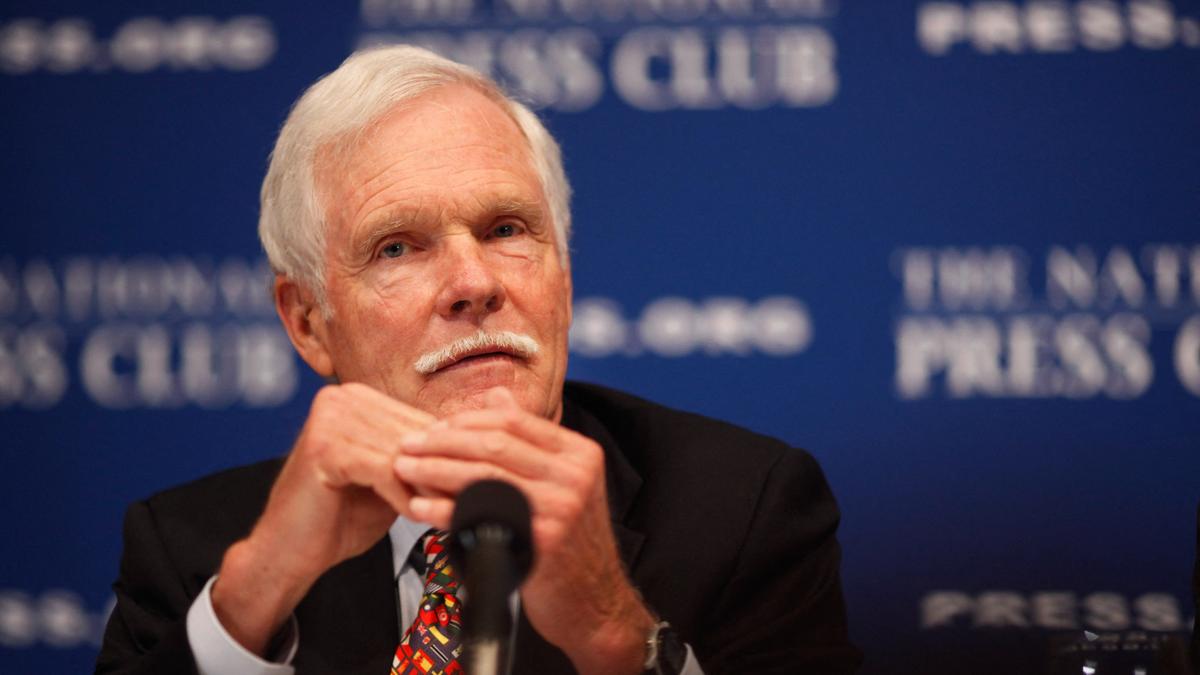
Ted Turner’s death at 87 marks the final closure of the "First Mover" era in satellite-based telecommunications. While public obituaries focus on his personality and the founding of CNN, an objective analysis reveals that Turner’s primary contribution was not journalism, but the aggressive exploitation of infrastructure arbitrage. He recognized that the marginal cost of content distribution drops toward zero as geographical reach expands, a principle he used to disrupt the terrestrial broadcast oligopoly.
The Infrastructure Arbitrage Model
Before Turner, the American media market operated under a scarcity model dictated by the physical limitations of VHF and UHF signals. The "Big Three" networks (ABC, CBS, NBC) controlled the market because they controlled the local affiliate towers. Turner’s first strategic masterstroke was the 1976 transformation of WTCG into a "Superstation" (later WTBS).
He did not compete for towers. He bypassed them by utilizing the RCA Satcom 1 satellite to beam a local Atlanta signal to cable systems nationwide. This created a massive, unintended scaling effect for his advertisers. By decoupling a local station from its geographic constraints, Turner achieved a nationwide footprint at a fraction of the capital expenditure required for a traditional network. This move established the Horizontal Scaling Principle: in a networked economy, the entity that owns the most nodes (cable head-ends) without owning the physical wires wins the most eyeballs.
The 24-Hour News Cycle as a Supply Chain Innovation
The launch of CNN in 1980 is often categorized as a cultural shift, but from a strategic standpoint, it was a move to maximize the utilization of underused assets. Traditional networks viewed news as a "loss leader" or a regulatory obligation, confined to 30-minute evening slots. Turner viewed news as a raw material that could be processed and sold 24 hours a day.
- Cycle Time Compression: By removing the 24-hour wait for the evening news, Turner fundamentally altered the "Information Velocity" of the global market.
- Fixed Cost Dilution: A newsroom operates 24/7 regardless of broadcast length. By filling the entire clock, CNN diluted the fixed costs of its reporting staff across 48 half-hour blocks instead of one, creating an efficiency of scale that the networks could not match without abandoning their entertainment schedules.
- The Feedback Loop: Continuous coverage didn't just report on events; it accelerated them. The "CNN Effect" became a geopolitical variable where real-time visibility forced diplomatic and military responses, essentially turning news into a participatory element of the global power structure.
Vertical Integration and the Content Moat
Turner understood that distribution (the satellite) is a commodity, while content (the IP) is a monopoly. His acquisition of the MGM film library in 1986, often criticized at the time as an over-leveraged gamble, was a textbook example of Asset Repurposing.
The MGM deal gave Turner control over 3,300 films, including Gone with the Wind and The Wizard of Oz. He didn't just want the films; he wanted the library to feed his new cable networks, TNT and later TCM. This move eliminated his dependence on third-party licensing fees. By owning the library, Turner created a closed-loop system where his distribution platforms were guaranteed a supply of high-value content at zero incremental cost.
This strategy highlights a critical mechanism in media economics: Inventory Immortality. Unlike physical goods, media assets do not depreciate through use. They can be rebroadcast, colorized, or digitized indefinitely, providing a perpetual stream of high-margin revenue once the initial acquisition debt is serviced.
http://googleusercontent.com/image_content/210
The Debt-to-Equity Trap and the AOL-Time Warner Failure
The decline of Turner’s direct influence began with the 1996 sale of Turner Broadcasting System to Time Warner for $7.5 billion, followed by the catastrophic $165 billion merger with AOL in 2001. Turner’s downfall provides a case study in the Dilution of Founder Authority.
In the Time Warner era, Turner moved from being an owner-operator to a minority shareholder in a massive, slow-moving conglomerate. The AOL merger was the ultimate expression of "Irrational Exuberance" where a traditional content powerhouse overvalued a decaying distribution platform. Turner lost $7 billion of his personal wealth in the collapse, but more importantly, he lost the ability to pivot. The merger failed because it attempted to force "synergy" between two incompatible cultures: a creative-driven content engine and a metric-obsessed ISP.
The strategic failure here was the inability to recognize that the internet was not just another distribution channel like satellite; it was a disruptor that would eventually unbundle the very cable packages Turner helped build.
Philanthropy as a Strategic Global Hedge
Turner’s $1 billion gift to the United Nations in 1997 was not merely altruism; it was an act of "Soft Power" institutionalization. By funding the United Nations Foundation, Turner secured a seat at the table of global governance.
His environmentalism and "Captain Planet" ethos were early attempts at ESG (Environmental, Social, and Governance) positioning before the term existed. Turner recognized that as a global media mogul, his brand was tied to the stability of the global ecosystem. His land acquisitions—becoming one of the largest private landowners in the U.S.—represented a move into Hard Asset Diversification. While digital assets can be devalued by new technology, arable land and water rights remain the ultimate hedge against systemic volatility.
The Mechanism of the "Mouth of the South"
Turner’s public persona—brash, outspoken, and often offensive—served a specific functional purpose: Cost-Free Brand Awareness. In the early days of CNN, Turner’s antics generated millions of dollars in "earned media." He didn't need an advertising budget when his personal feuds with the networks and his yachting victories were front-page news.
However, this persona also created a "Key Person Risk." When Turner was marginalized within Time Warner, the brand lost its aggressive edge. The transition from a "Founder-Led" organization to a "Manager-Led" organization led to the homogenization of CNN’s programming, eventually leaving it vulnerable to more ideologically driven competitors like Fox News.
Tactical Mapping of the Media Evolution
To understand the vacuum Turner leaves behind, we must map the current state of media against his original pillars:
- Then (The Turner Era): Satellite distribution, 24-hour linear news, high-barrier-to-entry cable bundles, library-driven vertical integration.
- Now (The Fragmented Era): IP-based streaming, algorithmic feed-based news, zero-barrier-to-entry social distribution, creator-driven micro-content.
The core bottleneck today is no longer distribution—it is Attention Density. Turner solved the problem of where people could watch news; modern strategists must solve the problem of why people should care when they are inundated with infinite choice.
Strategic Play: The Post-Turner Media Landscape
The death of the pioneer signals the end of the "Big Bundle" era. For current media strategists, the lesson of Ted Turner is not to build another CNN, but to find the next undervalued infrastructure layer.
The current arbitrage exists in the gap between Generative AI Content and Verifiable Truth. As AI lowers the cost of content production to near-zero, the "Turner Model" of library acquisition is being replaced by the "Verification Model." The next multi-billion dollar media entity will not be the one that produces the most content, but the one that provides the definitive "Truth Layer" for a synthetic world.
The strategic imperative is to move away from "Attention Aggregation" (which is now dominated by Big Tech algorithms) and toward "Authority Aggregation." This requires a shift from broad-scale broadcasting to high-trust, high-utility niche networks that operate on a direct-to-consumer, subscription-based model. The "Superstation" of 2026 is not a satellite feed; it is a proprietary, verified data stream that integrates directly into the user’s decision-making process.
For those attempting to replicate Turner’s success, the path forward is not through the television screen, but through the ownership of the verification protocols that will define the next fifty years of human information consumption.