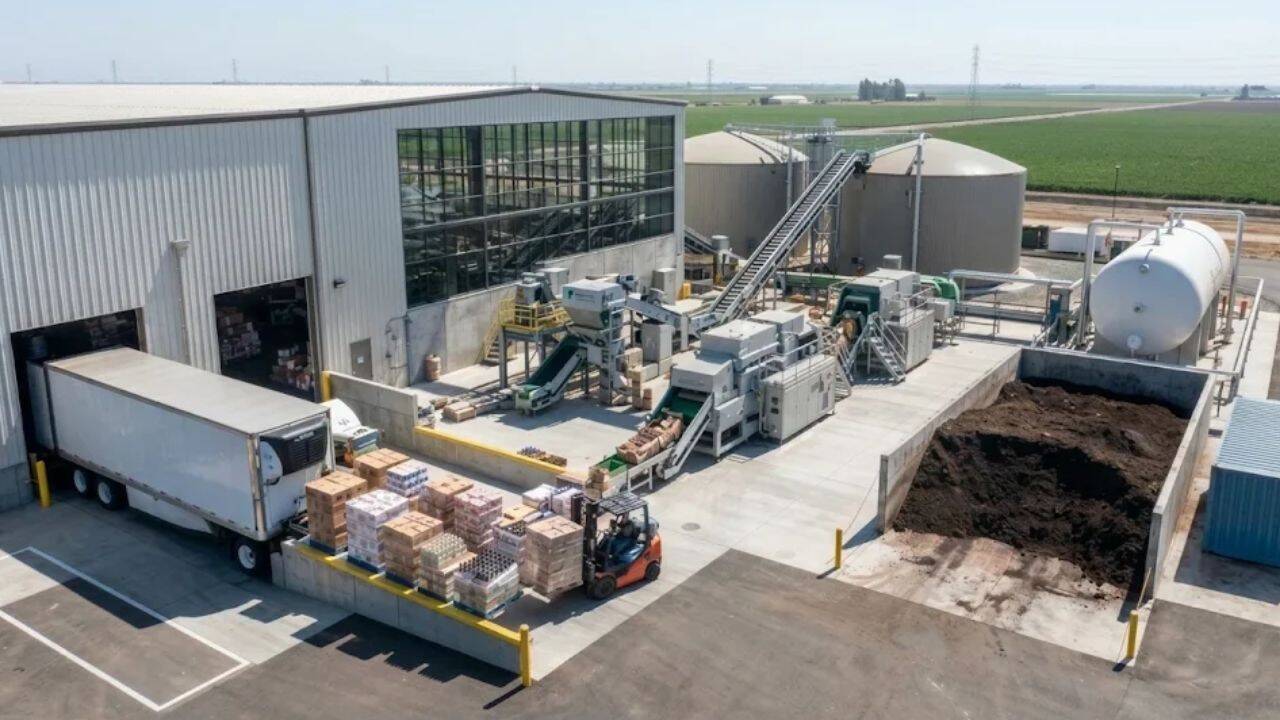
When corporate sustainability press releases announce that a logistics partnership diverted 2.5 million pounds of unsold food and drinks into renewable energy, the headlines write themselves. Readers picture spoiled milk and bruised apples magically powering neighborhood homes. In reality, converting expired retail inventory into usable gas and electricity is an expensive, logistically grueling industrial operation known as anaerobic digestion, and while it keeps methane out of landfills, it sits near the bottom of the food waste hierarchy for a reason.
Press releases celebrate big numbers. Two-and-a-half million pounds sounds massive until you put it against the scale of the American supply chain.
The Anatomy of a 2.5 Million Pound Diversion
To understand what actually happens when a major retailer or beverage distributor hands off 2.5 million pounds of unsaleable inventory, you have to follow the trucks. Most people assume food waste comes out of the back of a grocery store ready to be turned into fuel. It does not.
Retailers do not just throw loose apples into a bin. They reject entire pallets of dented aluminum cans, bloated plastic juice bottles, expired dairy tubs, and crushed cardboard cases. Before a single calorie can become renewable energy, someone has to separate the organic slurry from the packaging.
The Depackaging Bottleneck
This is where most waste-to-energy projects quietly bleed money. Industrial depackaging machines use high-speed paddles or augers to smash open cans, bottles, and cartons, spinning the liquid and soft food out through a fine screen while ejecting the shredded plastic and aluminum.
It is loud, messy, and mechanically punishing. Grit, bottle caps, and shards of rigid plastic routinely slip past the screens, contaminating the organic pulp. If that pulp goes to a municipal wastewater plant or an agricultural digester, microplastics end up spread across farmland as fertilizer. If the contamination is too high, the entire load gets rejected and sent straight back to the landfill the partnership claimed to bypass.
Inside the Anaerobic Digester
Once the organic slurry is clean enough to process, it is pumped into an anaerobic digester—essentially a massive, heated, oxygen-free steel stomach. Inside, naturally occurring bacteria break down the sugars, fats, and proteins over several weeks.
As the microbes feast on yesterday’s unsold sodas and spoiled yogurt, they off-gas biogas, a raw mixture of roughly 60 percent methane and 40 percent carbon dioxide, along with trace amounts of corrosive hydrogen sulfide.
Raw biogas cannot just be piped into your kitchen stove. Facilities have to scrub out the moisture, carbon dioxide, and sulfur to upgrade it into renewable natural gas (RNG), which can be injected into commercial pipelines or compressed to fuel heavy trucks. Alternatively, operators burn the raw gas on-site in giant internal combustion engines to generate electricity.
Putting 2.5 Million Pounds Into Perspective
Let’s look at the numbers without the corporate halo. In the waste management industry, 2.5 million pounds equals 1,250 short tons.
Consider a hypothetical example to see what that volume actually yields in the real world. Depending on the moisture content and fat profile of the waste—liquids like soda have far less energy density than fats and oils—one ton of mixed food waste generates roughly 100 to 200 cubic meters of biogas. Once cleaned and converted into electricity, 1,250 tons of mixed food and beverage waste produces somewhere around 300,000 to 500,000 kilowatt-hours of power.
That is enough electricity to run roughly 30 to 45 average American homes for a single year.
For a single logistics hub or regional distribution center, keeping 1,250 tons out of a landfill over a year or two is a solid operational win. It prevents hundreds of metric tons of fugitive methane—a greenhouse gas vastly more potent than carbon dioxide over a 20-year window—from escaping into the atmosphere.
Yet across the United States, the food system generates tens of millions of tons of surplus food every single year. A 2.5-million-pound milestone is a rounding error in national waste statistics. Treating it as a systemic fix masks the deeper inefficiencies of modern retail.
Why Food Ends Up in Digesters Instead of Pantries
If the food is still sealed in its original packaging, why is it going to an industrial digester instead of a food bank? The answer comes down to liability paranoia, strict cold-chain rules, and thin retail margins.
Grocery chains and beverage distributors operate on razor-thin profits and strict aesthetic standards. When a pallet of sparkling water suffers minor crush damage in transit, a retail buyer will reject the entire load because a torn cardboard case won't sit neatly on a shelf. Once a load is rejected, paying a driver to haul it back to a regional warehouse, inspect it, and coordinate a charitable donation often costs more than paying a waste hauler to dump it.
Date labeling confusion accelerates the problem. Manufacturers stamp "Best By" or "Sell By" dates onto products to indicate peak flavor, not food safety. Despite decades of education campaigns, retailers routinely pull perfectly safe inventory days before those dates arrive because store managers know shoppers won't buy a carton of milk expiring tomorrow.
By the time a third-party logistics firm steps in to broker a waste-to-energy pickup, the window for human consumption has usually slammed shut. Anaerobic digestion becomes the polite corporate exit ramp for inventory that the supply chain failed to move efficiently in the first place.
The Economics Behind the Green Headlines
Corporations rarely sign multi-year waste-to-energy contracts out of pure altruism. The math has to work on a spreadsheet, and right now, government policy is doing most of the heavy lifting.
Tipping Fees vs. Landfill Costs
In regions where landfill space is cheap and abundant—such as large swaths of the Midwest and South—dumping food waste costs as little as $40 to $60 per ton in tipping fees. In those markets, paying to haul heavy liquid beverages to a specialized depackaging facility rarely makes financial sense without corporate sustainability mandates subsidizing the loss.
The equation flips in the Northeast and on the West Coast. States like California, Massachusetts, and New York enforce strict organic waste bans, forbidding large commercial generators from sending food waste to landfills. Simultaneously, landfill tipping fees in these regions regularly exceed $100 to $150 per ton. Suddenly, paying an anaerobic digestion facility $75 a ton to take the waste becomes the cheaper option.
The Renewable Fuel Standard Gold Rush
On the processing side, digester operators are chasing federal and state energy credits. Under the federal Renewable Fuel Standard (RFS) and state programs like California’s Low Carbon Fuel Standard (LCFS), producing renewable natural gas from food waste generates lucrative environmental credits.
Because capturing methane from rotting food carries an ultra-low—and sometimes negative—carbon intensity score, the credits attached to the gas are often worth far more than the physical gas itself. Without those regulatory subsidies, dozens of commercial food-waste digesters across North America would go bankrupt tomorrow.
The Environmental Trade-Offs Nobody Mentions
Every energy technology carries an environmental footprint, and waste-to-energy is no exception. Calling biogas "renewable" does not mean it is zero-emission.
First, there is the transportation penalty. Beverages are mostly water, and water is heavy. Hauling 2.5 million pounds of expired soda and juice across state lines in diesel semi-trucks burns thousands of gallons of fossil fuel. If the nearest depackaging plant is 200 miles away, the tailpipe emissions from the trucks can eat into a significant portion of the carbon savings achieved at the digester.
Second, anaerobic digestion leaves behind digestate, a nutrient-rich sludge that remains after the bacteria finish producing gas. While clean agricultural digestate makes an effective soil amendment, digestate derived from packaged retail waste often carries trace contaminants, salts, and microplastics. Finding farmers willing to spread post-consumer retail digestate on their fields is getting harder every year, forcing some operators to pay to landfill the leftover solids anyway.
Finally, there is methane slip. Seals leak, valves stick, and flares malfunction. Independent studies have repeatedly shown that biogas facilities leak small percentages of unburned methane into the atmosphere during processing and upgrading. Because methane traps heat so aggressively in the short term, even a minor leak rate can undercut the climate benefits of the entire operation.
Where Waste-to-Energy Actually Belongs
The Environmental Protection Agency’s Wasted Food Scale places anaerobic digestion well below source reduction, feeding hungry people, and feeding animals. That hierarchy exists for basic thermodynamic reasons.
It takes massive amounts of water, synthetic fertilizer, diesel fuel, electricity, and aluminum or plastic to grow, process, package, and chill a bottle of juice. When that bottle ends up in an anaerobic digester, we recover a tiny fraction of the energy used to create it—typically less than 10 percent of the total embodied energy—while destroying the nutritional value entirely.
Using an anaerobic digester to handle genuinely inedible waste—spoiled dairy, rancid grease, brewery spent grain, and floor sweepings from food processing plants—is smart industrial ecology. Those materials have no safe path back into the food chain, and capturing their methane beats letting them rot in an open dump.
Using digesters to liquidate millions of pounds of intact, packaged food and beverages because a distributor miscalculated demand or a retailer rejected a dented box is a symptom of a broken supply chain, not a triumph of sustainability.
Real progress in the food industry does not look like a ribbon-cutting ceremony at a biogas plant. It looks like dynamic markdown pricing that sells milk before it expires, secondary liquidation markets that move dented cans to discount grocers, and better inventory forecasting so those 2.5 million pounds never become waste at all.