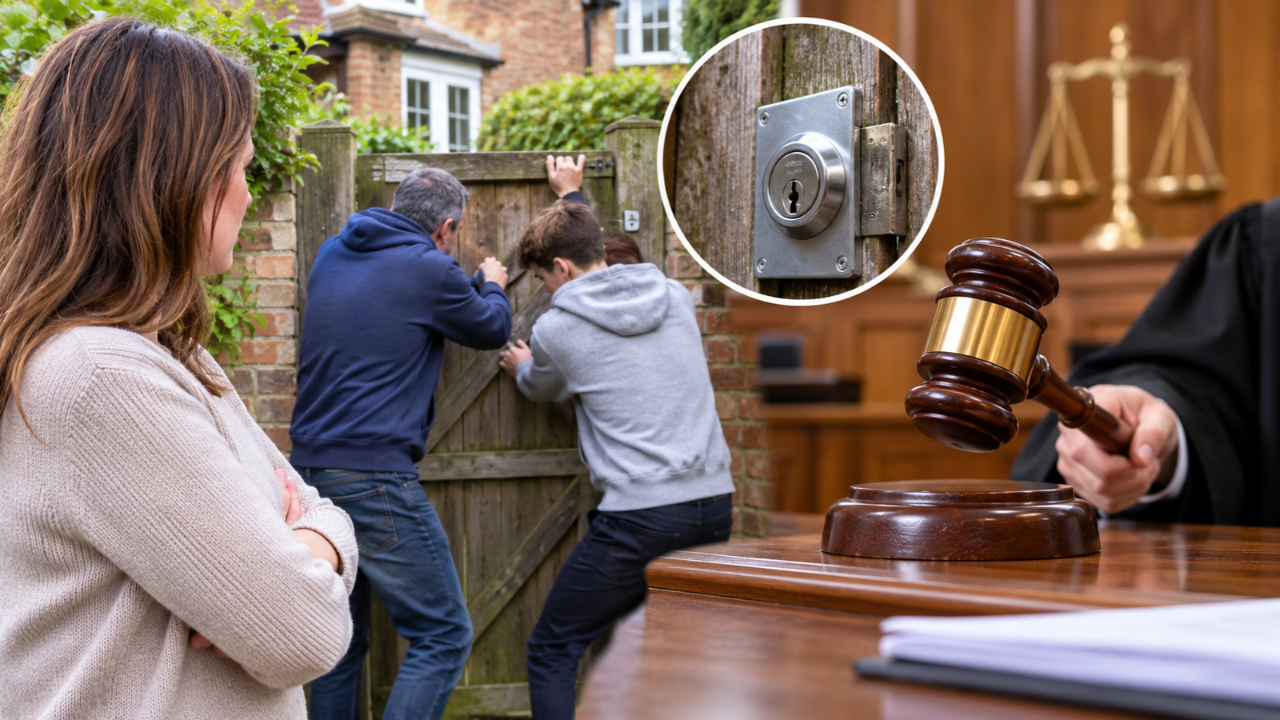
The sound of snapping timber rarely echoes through a quiet London cul-de-sac, yet when it does, it alters the air pressure of an entire street.
Listen closely to that sound. It is not merely the splintering of seasoned oak or the shearing of brass screws from a weathered gatepost. It is the sharp, unmistakable crack of an unwritten social contract breaking in two. For most of us, the boundary between our property and the rest of the world is maintained not by mortar, iron, or the looming threat of the High Court, but by a fragile, unspoken agreement that we will simply leave each other alone. We assume that a closed gate means stay out. We assume that a locked latch is a polite boundary, respected by anyone who shares our postcode.
Until the day someone decides it is not.
In London, a homeowner recently walked away from a protracted legal battle with £20,000 in awarded legal costs after her neighbours forced open her garden gate—not once in a moment of heat, not by accident while wrestling a delivery parcel down a narrow path, but twice. Deliberately. Methodically.
On paper, the headline reads like a classic British absurdity, the kind of parochial skirmish that fuels wry dinner-party chatter about curtain-twitching and boundary obsessions. Twenty grand over a garden gate? the casual observer scoffs, picturing two stubborn adversaries squabbling over six inches of privet hedge while solicitors quietly bill by the six-minute increment.
That reaction misses the entire point. Anyone who has ever stood at their own kitchen window, watching someone uninvited cross the threshold of their private sanctuary, knows that the timber is never just timber.
The Architecture of Quiet Dread
To understand why a person risks financial ruin over a wooden latch, you have to understand what happens to the human nervous system when home stops feeling like a fortress.
I remember the first time a boundary dispute crept into my own life years ago—not as a lawyer, not as a journalist, just as a tenant trying to drink morning coffee in peace while an adjacent landlord decided our shared alleyway was his personal storage depot. At first, you tell yourself to let it go. You swallow the irritation. You step around the obstruction. You rehearse polite, breezy remarks in the shower, hoping a gentle nudge will restore order.
Then comes the second violation.
When a boundary is breached a second time, the dynamic shifts from misunderstanding to dominance. Your home—the single place on earth engineered to let your shoulders drop—transforms into a stage where you are constantly waiting for the next intrusion. Every metallic click outside the window triggers a jolt of adrenaline. You stop opening the blinds all the way. You find yourself listening to footsteps on the gravel, calculating trajectories, wondering if today is the day the latch gives way again.
In the London case, forcing that garden gate twice stripped away any plausible deniability. A single incident can be dressed up as confusion over a right of way, an emergency shortcut, or a lapse in judgment. A second forced entry is a declaration. It says: Your lock does not apply to me. Your perimeter is a suggestion.
Think of a boundary line on a Land Registry title plan like a glass wall in a modern office. Everyone sees it. Nobody walks through it, not because the glass is bulletproof, but because walking through it requires an act of deliberate violence against the room. When a neighbour forces a locked gate twice, they are taking a hammer to that glass just to prove they can reach the other side.
Why English Property Law Takes the Latch So Seriously
Here is where outsiders often misread the British legal system. People assume courts hate neighbour disputes, and to a large extent, they do. Judges routinely beg warring homeowners to seek mediation before setting foot in a courtroom, warning that legal fees will swiftly eclipse the value of the land in question.
Yet when a case does reach the bench, English common law treats the physical integrity of a person's property with a fierce, centuries-old reverence.
Under the law of trespass to land, you do not need to prove that an intruder stole your silver, trampled your prize hydrangeas, or smashed a window. Trespass is actionable per se—meaning the mere unauthorized crossing of the boundary is the injury itself. The law recognizes something that casual observers forget: if you allow a neighbour to force your gate without consequence, you are slowly surrendering your legal sovereignty over your own soil.
Consider what happens next when a homeowner ignores repeated physical breaches. Over years, unchallenged access can morph into claims of prescriptive easements—a legal doctrine where habitual, unopposed use eventually hardens into a permanent right of way. Suddenly, your private garden is no longer legally private. When you eventually try to sell the house, conveyancers uncover an unresolved boundary war, mortgage lenders balk, and tens of thousands of pounds evaporate from your property's valuation overnight.
That is the invisible calculus playing out behind closed curtains across London's terraced streets and suburban avenues. The woman who pursued her neighbours through the courts was not fighting for the replacement value of a broken bolt. She was fighting to prevent a hostile precedent from taking root in her own back garden.
The Anatomy of a Twenty-Thousand-Pound Mistake
How does a dispute over a garden gate balloon into a £20,000 costs order? To anyone who has never received a formal letter before action, the math looks hallucinated.
It rarely starts with a writ. It starts with a polite request that goes unanswered, followed by a repair bill paid out of pocket, followed by a second breach that proves politeness is being mistaken for weakness. Once a homeowner realizes that locks and reasonable conversation have failed, the only non-violent mechanism left in a civilized society is the legal system.
And the legal system moves with expensive precision:
- Title verification and archival mapping: Surveyors and property solicitors must pull historical deeds, original conveyances, and Land Registry plans to establish beyond doubt who owns the post, the hinges, and the strip of earth beneath them.
- Formal injunctions and pre-action protocols: Drafting cease-and-desist notices that meet strict civil procedure rules requires specialist litigation counsel, particularly when seeking an injunction to stop further physical interference.
- Witness statements and evidentiary bundles: Proving that a gate was forced twice requires timestamps, photographs of splintered wood, repair invoices, and sworn testimony capable of surviving cross-examination.
- The cost of stubbornness: In civil litigation across England and Wales, the golden rule is simple—the loser pays. When a defendant refuses to back down, ignores early settlement offers, or forces a matter to a contested hearing despite clear evidence of physical interference, judicial patience runs dry.
By the time a judge hands down a £20,000 costs order, the court is sending an unmistakable signal. The bill is not merely reimbursement for legal hours spent; it is a financial penalty levied against arrogance. The neighbours didn't just lose an argument about access. They funded their opponent's vindication.
The Myth of the "Easy" Right of Way
Whenever stories like this surface, a familiar chorus rises from the comment sections: Maybe they had a right of way! Maybe she locked a shared path!
It is a fair question, and it sits at the very heart of thousands of urban property feuds. Victorian and Edwardian terraces across London are crisscrossed by historic alleyways, side passages, and shared access strips originally designed for coal deliveries and night-soil collectors a century ago. Over decades, those alleys were absorbed into rear gardens, gated off, and forgotten—until a new buyer moves in, spots a dotted line on an old deed, and decides to reclaim passage.
Even if a person genuinely believes they hold a legal easement across a neighbour's land, English law draws a bright, unforgiving red line between asserting a right and taking the law into your own hands.
You do not get to kick down a gate because you think you own the path behind it.
Self-help—the legal term for forcibly removing an obstruction yourself rather than applying to a court—is a perilous gamble. If you break a lock to exercise a right of way that turns out not to exist, or if you use excessive force where a peaceful legal remedy was available, you expose yourself to liability for criminal damage, trespass, and ruinous civil costs. Imagine two hypothetical neighbours, Arthur and Claire, sharing a narrow boundary wall. Arthur believes an old deed lets him walk behind Claire's shed to reach the street. Claire disagrees and bolts the gate. If Arthur marches over with a crowbar and snaps the hasp, he has instantly transformed himself from a potential claimant into an aggressor. Even judges sympathetic to access rights despise vigilante carpentry.
What Living Next Door Really Costs
Numbers like £20,000 grab attention because they are concrete, sharp-edged, and easy to tally on a spreadsheet. Yet anyone who has lived through a war of attrition with the people living three feet away knows that the legal bill is the cheapest part of the ordeal.
There is no line item on a solicitor's invoice for the sleep lost at three in the morning, staring at the ceiling while replaying a shouting match on the driveway. There is no statutory compensation for the subtle humiliation of warning visiting friends: Don't park near the left side of the kerb, and keep your voice down near the fence.
We spend a lifetime working to buy a patch of ground where we get to set the rules. In a city as dense, loud, and relentless as London—where strangers press against your shoulders on the Underground and sirens wail three streets over—that private patch of garden is not a luxury. It is psychological oxygen. It is the place where a child learns to ride a bike without traffic, where an elderly parent sits in the weak afternoon sun, where you can exist without performing for an audience.
When someone forces their way through that perimeter twice, they are stealing something far harder to replace than a brass latch. They are stealing the quiet certainty that you are safe behind your own walls.
The Silence After the Verdict
Walk down almost any residential street in Britain tonight, and you will pass dozens of ordinary timber gates. Most hang slightly crooked on their hinges. Some have peeling paint, rusted bolts, or a tangle of jasmine spilling over the top rail.
They look flimsy because they are meant to be. In a functioning neighbourhood, a garden gate is not a medieval portcullis designed to withstand a siege; it is simply a polite punctuation mark at the end of a property line. It relies entirely on the decency of the person standing on the other side.
When that decency fails, the law steps in—slowly, expensively, and with blunt force—to remind everyone where one life ends and another begins.
Somewhere in London right now, a repaired gate stands closed against the evening chill. Its latch is intact, backed by a court order and a twenty-thousand-pound receipt that will linger in the memories of everyone on that cul-de-sac for years to come. And across the fence, two neighbours have learned, at devastating expense, the true price of ignoring a closed door.