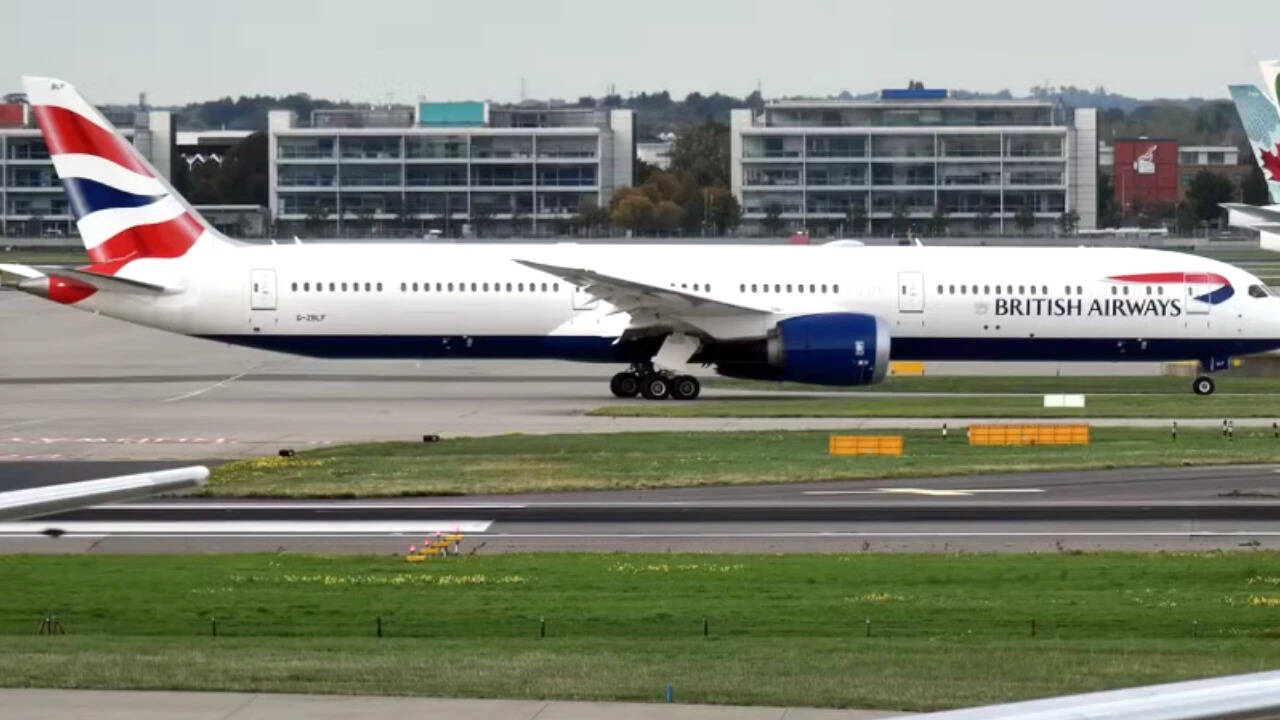
Two hundred tons.
That is the approximate weight of a fully fueled Boeing 787 Dreamliner sitting on the wet tarmac of London Heathrow, its belly packed with suitcases, diplomatic pouches, and boxes of specialty medicine, its passenger cabin humming with the restless energy of two hundred people bound for Lagos, Nigeria. It is a marvel of modern aerodynamics, sculpted from composite carbon fiber, powered by engines that sip fuel with surgical precision, and guided by avionics capable of landing the aircraft in zero visibility.
And yet, on a rain-slicked afternoon in West London, all of that twenty-first-century engineering lost a tug-of-war to a patch of soaked British turf.
The headlines were predictable, clinical, and almost entirely devoid of pulse. A British Airways Dreamliner, preparing to depart for Murtala Muhammed International Airport in Lagos, veered off the paved taxiway at Heathrow and became bogged down in the mud. Nobody was hurt. Emergency vehicles responded. Passengers were bussed back to the terminal. Move along.
If you read the standard aviation wire reports, the story ends there—a minor logistical hiccup, a funny photograph of a massive jetliner tilted at an awkward angle in the grass, an easy punchline for social media commuters.
They missed the real story entirely.
Because when a wide-body jet leaves the concrete at one of the busiest international hubs on earth, the mud doesn't just grab the landing gear. It grabs hundreds of lives, fractures a global schedule, and exposes the fragile, razor-thin margins holding modern air travel together.
The Illusion of the Indestructible Machine
I have spent enough hours staring out of scratched acrylic cabin windows at Heathrow’s Terminal 5 to know the exact psychological spell an airport casts on you. You hand over your passport. You surrender your liquids. You sit in a climate-controlled tube pressurized to simulate eight thousand feet of altitude, and you quietly accept the unspoken contract of modern aviation: We are bigger than the weather, faster than geography, and completely detached from the dirt beneath us.
You stop thinking about friction. You stop thinking about soil saturation.
Until the nose wheel drops six inches into soft clay.
To understand what happened on that Heathrow taxiway, you have to understand the geometry of a modern wide-body jet from the flight deck. Picture yourself sitting two stories above the ground, strapped into the left-hand seat of a Boeing 787. Your forward view is magnificent, framing the horizon and the sprawling concrete arteries of the airfield. What you cannot see, however, is the ground directly beneath your feet, or the precise track of the main landing gear trailing nearly a hundred feet behind you.
Taxiing a Dreamliner through Heathrow is not like driving a sedan down a suburban street. It is closer to maneuvering an ocean liner through a narrow canal using only a periscope and painted yellow lines. Pilots rely on judgment, ground-control instructions, and subtle visual cues to swing the nose wide around sharp corners so the rear wheels—the main bogies—don't clip the edge of the asphalt.
On a dry day, if a tire kisses the shoulder, you feel a slight rumble. On a day when the English rain has turned the grass verges beside the taxiway into an industrial sponge, that tiny miscalculation becomes irreversible. The asphalt ends. The turf gives way. And suddenly, two hundred thousand kilograms of aerospace perfection sinks into the earth like a dropped anchor.
Inside the cabin, there is no Hollywood explosion. There is no dramatic descent. Just a dull, heavy thud, a sudden deceleration that pulls seatbelts tight across laps, and a tilt—a sickening, unnatural lean to one side that every frequent flyer recognizes instantly as wrong.
Inside Cabin 34B
Let us step inside that cabin for a moment, using a hypothetical passenger to ground what those dry news reports gloss over. Call her Tunde.
Imagine Tunde sitting in row 34, aisle seat, clutching a worn Nigerian passport and a folder of medical documents. She is flying back to Lagos after three weeks in London, where her sister has been undergoing post-operative recovery. She has already endured the labyrinth of Heathrow security, the anxiety of overweight baggage scales, and the emotional exhaustion of saying goodbye at the departure gate. Her mind is already six hours ahead, calculating the traffic on the Third Mainland Bridge in Lagos, wondering if her driver will be waiting outside arrivals, hoping the chilled medication in her carry-on stays below threshold temperature.
Then comes the lurch.
For the first thirty seconds, nobody speaks. In an airplane cabin, silence is never peaceful; it is the sound of two hundred brains simultaneously running threat assessments. You look at the flight attendants. If they look calm, you breathe. If they look confused, grabbing for overhead bins to steady themselves as the cabin floor tilts at an angle it was never meant to hold on flat ground, your pulse spikes.
This is the human reality invisible to the airport perimeter cameras. When a flight to Lagos is aborted on the taxiway, it is rarely just a ruined vacation. The London-to-Lagos corridor is one of the most vital, emotionally charged arteries in global aviation. It carries surgeons returning to clinics, engineers heading to offshore rigs, students carrying degrees home to proud parents, and families bridging two continents that share a complicated, deeply intertwined history.
When the captain’s voice finally comes over the public address system—measured, polite, distinctly British, explaining that the aircraft has left the paved surface and cannot move under its own power—the fear in the cabin quickly curdles into a different kind of dread.
Stuck.
The Physics of a Sunken Giant
Why couldn't they just pull it out?
It is the first question everyone asks when they see the photos. Heathrow owns massive, diesel-chugging pushback tugs capable of shoving fully loaded Airbus A380s backward with ease. Why didn't a truck simply hook up a tow bar and yank the Dreamliner back onto the concrete?
Here is where the intuitive analogy breaks down. Pulling a bogged aircraft out of mud is nothing like pulling a stuck SUV out of a ditch.
A Boeing 787 is extraordinarily strong in the directions it was designed to handle: vertical forces when slamming onto a runway at 160 miles per hour, and longitudinal forces when braking hard or accelerating for takeoff. It is remarkably delicate when subjected to lateral twisting or uneven shear forces on its landing gear struts.
Think of the landing gear like the legs of a thoroughbred racehorse. Capable of carrying immense weight at terrifying speeds, yet vulnerable to sideways torque. If a recovery crew hooks a steel cable to a sunken gear strut and pulls aggressively while the tires are suction-locked in thick clay, they risk snapping a hydraulic line, bending a titanium trunnion, or cracking the composite fuselage structure where the gear attaches to the wing box. Turn a minor embarrassment into a hundred-million-dollar write-off in four seconds flat.
So the recovery becomes agonizingly slow.
First, you cannot unload the passengers at a jet bridge because there is no jet bridge in the grass. You have to bring mobile air stairs across the airfield, position them carefully against a tilted fuselage without scraping the carbon-fiber skin, and escort two hundred tired, anxious people down wet metal steps onto waiting tarmac buses. Every bag in the cargo hold has to be manually offloaded. Fuel often has to be defueled to lighten the airframe. Only then can specialized aircraft recovery teams slide pneumatic airbags and aluminum trackway mats beneath the sunken tires, inching the giant upward millimeter by millimeter until it can be safely towed to a maintenance hangar for days of structural inspections.
The Domino Effect Nobody Sees
While Tunde and her fellow passengers are being bussed back into the fluorescent purgatory of Terminal 5—facing rebooking queues, expired visas, missed connecting flights across West Africa, and frantic phone calls to relatives waiting in Lagos—the invisible ripples are already spreading across the globe.
Modern commercial aviation operates on a philosophy of relentless utilization. An aircraft makes zero money sitting on the ground; it is a depreciating asset burning debt every minute its wheels aren't spinning. British Airways does not keep spare Boeing 787s parked behind a hedge at Heathrow just in case one decides to go off-roading.
That specific Dreamliner was scheduled to land in Lagos, turn around within hours, and fly back to London carrying another two hundred passengers—people with chemotherapy appointments in Harley Street, court dates, weddings, and business meetings. Because that jet was sitting nose-down in the British mud, the return flight vanished from the departure boards in Nigeria. The aircraft’s subsequent rotations—perhaps to New York, or Johannesburg, or Delhi—had to be scrambled, delayed, or cancelled entirely.
Meanwhile, back at Heathrow, a blocked taxiway is the aviation equivalent of a jackknifed semi-truck on the M25 motorway at rush hour. Heathrow operates at roughly ninety-nine percent of its runway capacity on a normal Tuesday. There is no slack in the system. Every minute that recovery vehicles, fire engines, and inspection teams occupy that taxiway, air traffic controllers have to reroute dozens of other jets around the bottleneck. Departure slots slip. Arrival stacks over southern England grow tighter. Fuel burns rise.
All because of a patch of grass no wider than a suburban driveway.
Vulnerability in the Age of Automation
We live in an era that worships technological infallibility. We talk endlessly about artificial intelligence, autonomous vehicles, predictive maintenance, and fly-by-wire precision. It is comforting to believe that if we build systems smart enough, we can engineer away human error and physical unpredictability.
I used to believe that, too. Watching aviation from the outside, it looks like a ballet choreographed by supercomputers. Every movement tracked by ground radar, every turn lit by hundreds of embedded green centerline lights, every procedure cross-checked by two highly trained professionals in the cockpit.
Yet accidents and incidents rarely happen because of a single catastrophic failure. Safety investigators have a name for how these things unfold: the Swiss Cheese Model. Imagine several slices of Swiss cheese stacked together. Each slice represents a defense layer—pilot training, taxiway lighting, painted markings, ground control monitoring, weather alerts. Each slice has holes in it, representing minor flaws or human blind spots. Most of the time, the solid cheese stops a mistake from passing through.
Once in a while, the holes line up perfectly.
A late afternoon glare off wet asphalt. A tight turn onto a linking taxiway. A momentary distraction on the radio frequency. A patch of turf softened by days of relentless rain. None of these factors alone causes an incident. Together, they guide a two-hundred-million-dollar aircraft straight into the mud.
There is something strangely humbling about that. No matter how sophisticated the composite weave of the wings, no matter how many millions of lines of code govern the flight controls, aviation remains an intensely physical, human endeavor. Pilots are human. Ground controllers are human. Rain still makes dirt soft. Gravity still wins every argument.
What Remains After the Mud Dries
Eventually, the cameras pack up. The memes on X fade into yesterday’s timeline. The recovery crews pump up their airbags, lay down their aluminum mats, and coax the Dreamliner back onto solid concrete. British Airways issues a polite statement apologizing for the inconvenience, engineers inspect the landing gear with ultrasonic scanners, and the aircraft eventually returns to the sky.
Life moves on.
Except for the people who were sitting inside when the floor tilted. For them, the memory lingers—not as a headline, and certainly not as a joke about British weather, but as a sudden, visceral reminder of how fragile our carefully scheduled lives actually are. We book our tickets months in advance, pack our lives into thirty-kilogram suitcases, and trust that the invisible machinery of global travel will carry us effortlessly from one hemisphere to another.
And almost always, it does.
Until the asphalt ends, the grass gives way, and two hundred tons of human ambition comes to a dead stop in a few square yards of ordinary mud.