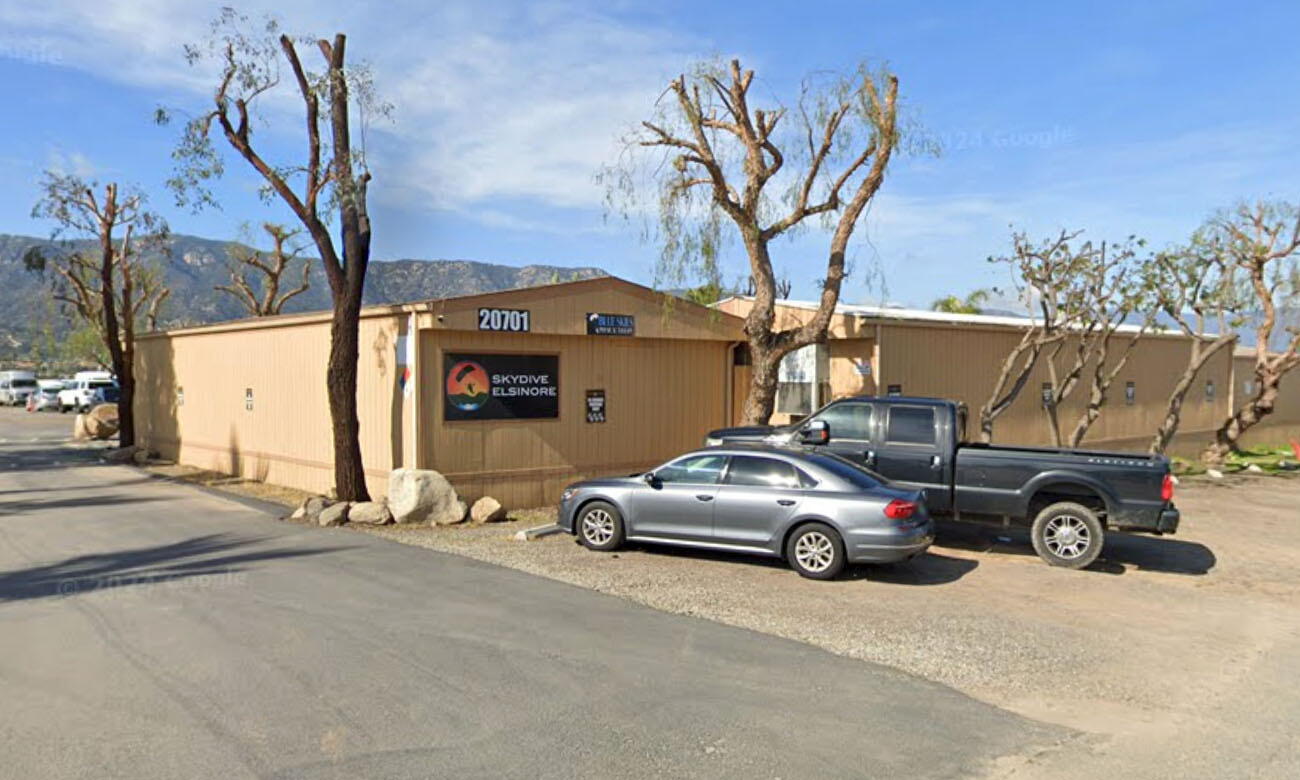
Two experienced skydivers, a former stand-up comedian and a senior lead instructor, died after colliding in midair near Skydive Elsinore in Southern California. Local authorities and dropzone officials confirmed the fatalities following a high-altitude canopy or freefall convergence that left both men unresponsive upon impact. While initial local news reports focused on the personal biographies of the victims and the shock within the Riverside County aviation community, the incident exposes a persistent, structural vulnerability in modern sport aviation. Even the most seasoned flyers face lethal visibility gaps when multiple jumpers share tight vertical airspace.
Tragedy at a premier dropzone rarely stems from a single catastrophic equipment failure. Skydive Elsinore operates as one of the busiest and most respected parachute centers in the United States, boasting decades of operational history and strict adherence to Federal Aviation Administration guidelines. Yet, high-traffic airspace creates an environment where marginal errors in spatial awareness compound within fractions of a second. When two veterans collide, the aviation community cannot simply blame rookie panic or poorly maintained gear. Investigators must examine the invisible mechanics of airspace congestion, human visual limitations, and the high-speed physics of modern parachute flight.
The Victims Behind the Headlines
Public identification of the deceased turned a routine aviation incident notice into a human story that resonated far beyond the dropzone fence. One victim had transitioned from a career in stand-up comedy into the tight-knit world of full-time skydiving, bringing a distinct charisma to a sport built on adrenaline and camaraderie. The other served as a lead instructor, a title earned only after logging thousands of jumps, passing rigorous instructional ratings, and demonstrating an ability to manage chaotic situations under extreme stress.
Instructors at major facilities represent the operational backbone of commercial skydiving. They are the individuals trusted to strap themselves to terrified first-time tandem students or guide nervous novices through their first solo freefalls. When a lead instructor dies in a midair collision, the loss reverberates through the entire facility. It shatters the comforting illusion that experience alone builds an impenetrable shield against the inherent hazards of stepping out of a functional aircraft at 13,000 feet.
How Midair Collisions Happen in Modern Skydiving
Most outsiders assume skydiving fatalities happen because a parachute fails to open. That assumption is wrong. Modern parachute systems feature dual-canopy configurations, sophisticated deployment mechanisms, and Automatic Activation Devices that deploy a reserve parachute if a jumper loses consciousness or falls below a predetermined altitude at high speed. Gear failure accounts for a tiny fraction of modern incidents.
Instead, the primary killer in contemporary sport parachuting is human error under a fully functioning canopy, alongside midair collisions between jumpers.
The Physics of Canopy Traffic
Once a parachute opens, a skydiver ceases to be a falling object and becomes an aircraft pilot. Modern ram-air canopies do not drift gently downward like the round military parachutes of the mid-twentieth century. They are pressurized, inflatable wings capable of forward speeds exceeding 25 to 35 miles per hour, with high-performance models diving at over 60 miles per hour during aggressive turns.
Because these wings generate lift and forward drive, they also create massive blind spots. A jumper suspended beneath a canopy cannot see directly above their own wing. Conversely, a jumper flying higher in the pattern struggles to see someone directly beneath them, obscured by their own legs, chest strap, or the curvature of the flight path. When two canopies converge on an intersecting trajectory, the closing speed can exceed 50 miles per hour. Neither pilot may see the other until the nylon fabric of their wings entangles, collapsing both canopies instantly and turning controllable flight into a lethal, unrecoverable spin.
Freefall Convergence and Group Dynamics
If the collision occurred prior to deployment, the physics are even more unforgiving. During freefall, human bodies fall at terminal velocities ranging from 115 miles per hour in a flat, belly-to-earth position to over 180 miles per hour in head-down vertical orientations.
Modern skydiving frequently involves multiple groups exiting the same turbine aircraft on a single pass. A Twin Otter or Caravan can carry up to 22 jumpers. These individuals exit in separated waves, spaced out by five to ten seconds to create horizontal separation across the ground. However, upper-level winds, drifting flight paths, or jumpers accidentally tracking toward another group's airspace can erase that separation rapidly. In a high-speed vertical dive, a jumper's peripheral vision narrows due to tunnel vision and helmet framing. Two bodies colliding at 150 miles per hour generate forces equivalent to a head-on highway crash, often rendering both individuals unconscious before either can reach a deployment handle.
The Structural Vulnerability of High-Volume Dropzones
To understand why collisions occur at premier facilities like Lake Elsinore, one must look at the economics and logistics of high-volume skydiving operations. Dropzones operate on tight turnaround schedules. Aircraft burn expensive aviation fuel every minute the engines run, incentivizing operators to fill every seat on every load and minimize ground time between flights.
This operational tempo puts immense pressure on airspace management. On a busy weekend in Southern California, hundreds of jumpers cycle through the same column of air over the course of a single day. You have tandem pairs descending slowly under massive canopies, student jumpers flying predictable rectangular patterns, wingsuit pilots covering miles of horizontal distance, and experienced camera flyers or instructors descending rapidly on high-speed cross-braced canopies.
| Flight Discipline | Typical Descent Rate | Horizontal Speed | Primary Collision Risk |
|---|---|---|---|
| Tandem Pairs | Slow to Moderate | 15 - 25 mph | Obscured visibility due to dual harnesses; slower reaction times |
| Student Jumpers | Slow | 15 - 20 mph | Unpredictable turns; fixation on landing target |
| Wingsuit Pilots | Very Slow (Vertical) | 60 - 100+ mph | Massive horizontal travel invading adjacent airspace |
| High-Performance Canopies | Rapid (During Turns) | 40 - 70+ mph | High closing speeds; aggressive swooping maneuvers |
Mixing these wildly different flight profiles in the same sky requires rigid traffic rules, much like an international airport handling both Cessna trainers and commercial airliners simultaneously. Dropzones enforce strict landing patterns, designated separation altitudes, and staggered exit orders. Yet, rules rely entirely on human compliance and continuous visual scanning. One missed head-check before a turn, or one miscalculated wind drift during exit separation, bypasses every procedural safeguard on the books.
The Limits of Federal Oversight
Whenever a high-profile aviation accident occurs, the public naturally looks toward federal regulators for answers. In the United States, the Federal Aviation Administration regulates the aircraft, the pilot, the airspace, and the packing of the reserve parachute. However, the FAA delegates the actual rules of sport parachuting—how jumpers exit, how they fly canopies, and how instructors are trained—to the United States Parachute Association.
This self-regulatory model has served the industry well for decades, allowing experienced practitioners to adapt safety protocols faster than a federal bureaucracy ever could. The USPA mandates minimum separation distances, requires specific licensing tiers for advanced maneuvers, and publishes detailed incident reports every year to educate its membership.
The gray area lies in enforcement. The USPA is a membership organization, not a federal law enforcement agency. While dropzones affiliated with the organization agree to abide by its Basic Safety Requirements, daily enforcement falls entirely on local Safety and Training Advisors and dropzone management. In a culture that prizes personal freedom and individual risk assessment, telling a veteran jumper with thousands of skydives to alter their flight habits requires significant institutional backbone. Sometimes, veteran status itself creates a dangerous blind spot, leading peers to assume that a seasoned instructor needs less oversight than a newly licensed jumper.
Why Experience Can Breed Complacency
Investigative analyses of aviation accidents across both commercial airlines and general aviation consistently uncover a counterintuitive pattern. Beginners crash because they lack skill and panic under pressure. Veterans crash because familiarity dulls their perception of routine hazards.
In skydiving, this phenomenon manifests as normalization of deviance. An instructor who makes ten jumps a day, five days a week, begins to view exiting an airplane at two and a half miles above the earth with the same casual familiarity most people reserve for commuting on a familiar highway. Over thousands of uneventful descents, the brain stops treating every second of canopy flight as a high-threat environment.
Consider a hypothetical scenario common at busy dropzones. A veteran instructor finishes a jump, deploys their canopy at 3,500 feet, and begins flying back toward the landing area. Because they know the local terrain intimately and have landed on that exact patch of grass four thousand times, they might spend three seconds adjusting their chest strap or collapsing their slider while entering the landing pattern. During those three seconds, another jumper—perhaps someone recovering from an off-heading opening—drifts into their blind spot. By the time the instructor looks up, the distance between the two wings has shrunk to fifty feet. At a combined closing speed of forty miles per hour, neither pilot has the physical time to react, flare, or execute an evasive turn.
The Investigation Process and What Comes Next
Following a fatal collision at a facility like Skydive Elsinore, multiple overlapping investigations begin immediately. Local sheriff's deputies secure the scene and work with the county coroner to establish official causes of death and conduct standard toxicology screenings. Simultaneously, FAA inspectors examine the aircraft logs, pilot credentials, and parachute rigging records to ensure no mechanical failure or regulatory violation contributed to the event.
The most valuable analysis, however, usually comes from within the sport itself. Dropzone safety officers review ground-to-air video footage, analyze digital altimeter logs recovered from the jumpers' helmets or wrists, and interview witnesses who were in the air on the same load. Modern digital altimeters record altitude and vertical speed every fraction of a second, allowing investigators to reconstruct the exact three-dimensional flight paths of both individuals down to the moment of impact.
These data logs frequently reveal uncomfortable truths. They show precisely when a jumper initiated a turn, how fast they were descending, and whether any evasive action was attempted prior to impact. While families and local communities grieve the loss of a beloved comedian and a dedicated teacher, the broader skydiving industry relies on this cold, forensic data to adjust exit intervals, modify landing pattern rules, and remind every jumper that the sky remains entirely unforgiving of a single moment of divided attention.
Practical Measures to Reduce Collision Risks
Eliminating midair collisions entirely requires confronting the human factors that technology cannot fix. While audible altimeters and collision-warning devices exist, relying on electronics in a noisy, high-speed environment introduces new distractions. Surviving in crowded airspace demands strict adherence to fundamental visual habits.
- Continuous Visual Clearing: Jumpers must treat every turn under canopy like changing lanes on a blind highway, physically looking over their shoulder and checking beneath their feet before initiating any directional change.
- Rigid Altitude Separation: Maintaining strict adherence to designated deployment altitudes ensures that freefalling bodies do not pass through airspace already occupied by open parachutes.
- Disciplined Landing Patterns: Flying predictable, square patterns—downwind, base, and final legs—allows other pilots in the air to anticipate where a canopy will go next, eliminating erratic S-turns that cut across traffic.
- Honest Peer Accountability: Senior instructors and veteran jumpers must actively critique one another's canopy traffic habits, refusing to let high jump numbers excuse sloppy pattern discipline.
The deaths at Lake Elsinore stand as a stark reminder that gravity does not negotiate with a resume. Whether a jumper has ten skydives or ten thousand, survival in shared airspace depends entirely on seeing the threat before it arrives.