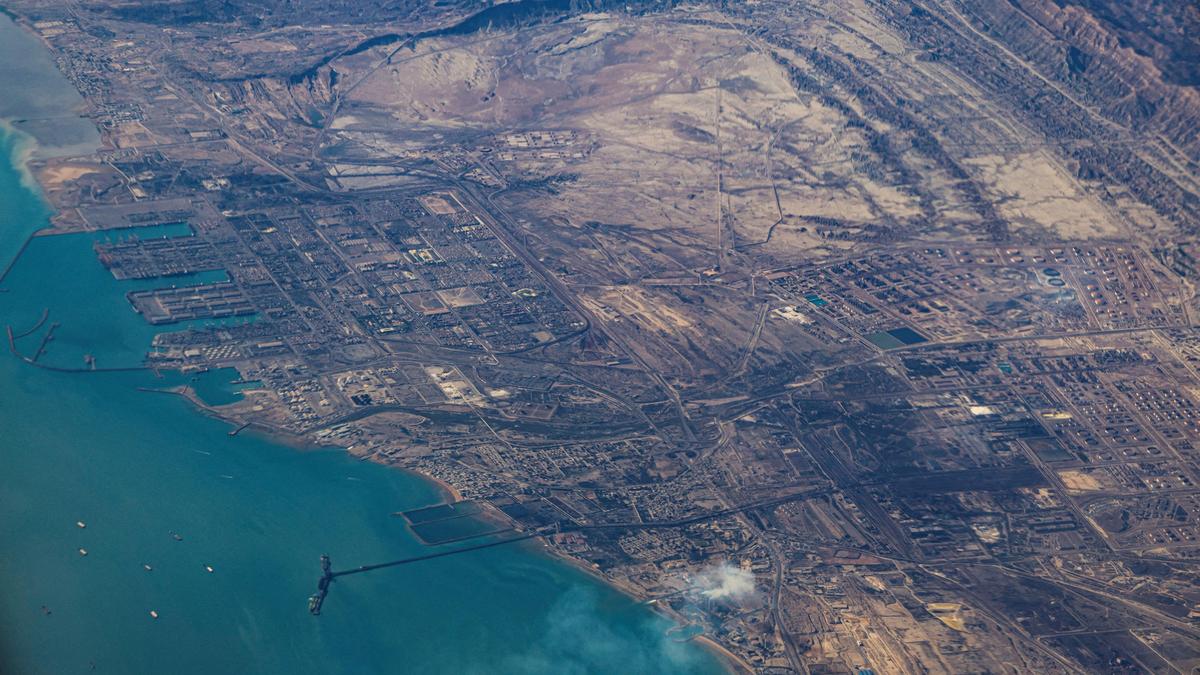
Iran isn't going to blow up Jebel Ali.
The breathless headlines tracking the "third week of the US-Israel war" are selling you a cinematic version of Middle Eastern geopolitics that doesn't exist on the ledger. While cable news pundits point at maps and trace hypothetical missile trajectories from Bandar Abbas to Dubai, they are ignoring the most basic rule of regional survival: You don't set fire to your own ATM. If you found value in this post, you might want to look at: this related article.
The narrative suggests that the United Arab Emirates is a "sitting duck" for Iranian proxies because of its proximity and its normalization with Israel. This "lazy consensus" assumes that the Middle East operates on raw ideology and ancient grudges. It doesn't. It operates on sovereign wealth, re-export markets, and the cold reality of the Rial's collapse.
The Bilateral Insurance Policy
Everyone loves to talk about the "threat" Iran poses to the UAE. Nobody wants to talk about the fact that the UAE is Iran’s largest non-oil trading partner. For another look on this development, refer to the recent coverage from Reuters.
In the real world, beyond the saber-rattling, thousands of Iranian-owned businesses operate out of Dubai. When the West clamped down on Tehran with sanctions that would have leveled any other economy, Dubai became the lungs through which the Iranian economy breathed. To attack the UAE’s ports is to systematically dismantle the only mechanism Iran has left to bypass global financial isolation.
I have spent years watching analysts misread "proxy warnings" as imminent tactical shifts. They see a Houthi drone and assume it’s the start of a regional conflagration. They miss the "Red Phone" diplomacy happening in the background. Iran’s leadership may be many things, but they are not suicidal. They understand that a kinetic strike on DP World infrastructure would trigger an immediate, unified response from the very global capital markets they are trying to court.
The Myth of the Vulnerable Hub
The "UAE is at risk" crowd relies on a fundamental misunderstanding of modern maritime logistics. They treat a port like a static target, a castle wall to be breached. In reality, Jebel Ali is a node in a digital and physical network that is far more resilient than it looks.
If Iran were to launch a meaningful strike on UAE maritime interests, they wouldn't just be hitting "the Emiratis." They would be hitting:
- Chinese Energy Interests: A massive percentage of the flow through the Strait of Hormuz is destined for the East. Beijing does not tolerate disruptions to its energy security for the sake of a regional grudge match.
- Global Insurance Hubs: The moment a missile touches a pier in Dubai, the "War Risk" premiums for the entire Persian Gulf skyrocket. This doesn't just hurt the UAE; it chokes the Iranian shipping industry, which is already struggling with aging tankers and limited coverage.
- The Digital Infrastructure: Most people forget that these ports are the landing points for critical subsea cables. A "hot war" in the Gulf would darken the internet for half of Central Asia and the Middle East.
Iran’s "warnings" are theater. They are designed to extract concessions, not to signal an invasion. They are "bark" meant to keep the UAE from leaning too far into the US-Israel security apparatus. It’s a balancing act, not a countdown to impact.
Stop Asking If They Can and Start Asking Why They Would
People also ask: "Can Iran’s missiles reach Dubai?"
The answer is yes. They’ve been able to do that for decades. The premise of the question is flawed. It’s like asking if a man with a gun can shoot his own foot. Of course he can. But unless he’s trying to get out of a war he’s already losing, he won’t.
The UAE has mastered the art of "Hedging 2.0." While they sign the Abraham Accords and host US fighter jets, they simultaneously send high-level delegations to Tehran to discuss trade and maritime security. They are playing both sides of the board because they know that in a world of shifting American interests, "Total Alignment" is a death sentence.
The Real Threat Isn't a Missile
If you want to be worried about UAE ports, stop looking at the sky and start looking at the balance sheet.
The real disruption isn't an IRGC drone; it's the shift in global trade routes. The proposed IMEC (India-Middle East-Europe Economic Corridor) is a far greater "threat" to the status quo than a few regional skirmishes. This corridor seeks to bypass the very choke points that Iran uses for leverage.
Iran’s rhetoric isn't about starting a war; it’s about maintaining relevance in a region that is rapidly building a future that doesn't require Tehran’s permission. By threatening the ports, Iran is trying to remind the world that they still hold the keys to the Strait. It’s a desperate plea for a seat at the table, disguised as a war cry.
The Consultant’s Fallacy
I’ve seen risk assessment firms charge millions to "simulate" the impact of a Gulf-wide war. They produce glossy maps with red circles and "high-probability" impact zones. These reports are almost always wrong because they treat the Middle East as a series of isolated actors.
They ignore the "Grey Zone" reality.
In the Grey Zone, you don't destroy your enemy's port. You hack their logistics software. You cause a "glitch" in the customs processing system that delays shipments for three days, costing billions in lost revenue. You use cyber-warfare to create plausible deniability. If Iran wanted to hurt the UAE, they wouldn't use a loud, traceable missile that invites a Tomahawk retaliation. They would use a quiet, untraceable line of code.
The Professional’s Playbook
If you are managing assets in the region or advising on supply chains, stop reacting to the "Breaking News" banners.
- Discount the Rhetoric: When Iran warns of attacks, look at the price of oil. If the "smart money" isn't moving, you shouldn't either. The markets have already priced in the bluster.
- Monitor the Re-exports: Watch the volume of trade flowing from Dubai to Bandar Abbas. As long as that number is healthy, the "war" is a fantasy.
- Watch the Insurance Markets: The Lloyd’s of London Joint Cargo Committee is a better indicator of regional stability than any CIA briefing. If they aren't reclassifying the UAE's coastal waters as a "listed area," there is no imminent threat.
The competitor’s article wants you to feel like we are on the precipice of a regional apocalypse. It’s a narrative built on fear, not on the mechanics of power. The UAE is not a victim in this scenario; it is a master orchestrator of its own security through economic entanglement.
Iran knows that if they break Jebel Ali, they break themselves.
Go look at the shipping data for the last 48 hours. The tankers are still moving. The cranes are still swinging. The money is still flowing. The "war" is happening on Twitter and in the minds of people who don't understand how the world actually works.
Quit waiting for the explosion. It’s bad for business and worse for your analysis.
Check the trade volume between Dubai and Tehran tomorrow morning. That’s your real intelligence report.