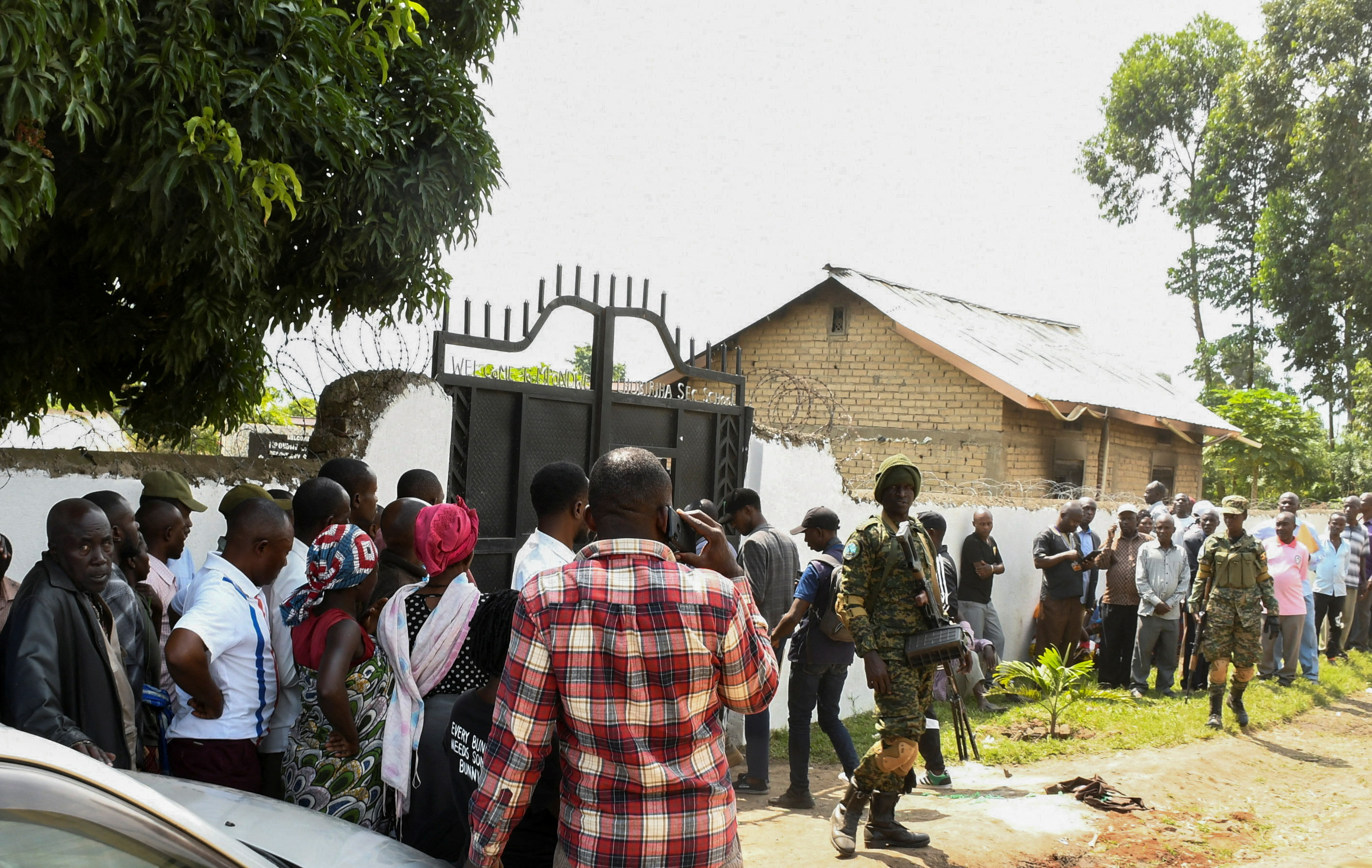
The headlines are bleeding again. Four pupils dead. A Kampala school turned into a crime scene. The usual cycle of "thoughts and prayers" has already begun, followed closely by the standard bureaucratic scramble to blame a "lone actor" or "poor security."
But the media is lying to you by omission.
They treat these events as statistical anomalies—lightning strikes in a clear sky. They aren't. When a tragedy like the Kampala stabbing occurs, the consensus leans on the easiest, most digestible narrative: we need more guards, more fences, and more police. This is a fundamental misunderstanding of school safety. In fact, doubling down on "hard" security often creates the very environment of isolation and institutional friction that allows violence to ferment.
The Myth of the Hard Perimeter
Every time a school attack happens, the immediate outcry is for "fortress schools." The logic seems sound: if you build a higher wall, the monster stays outside.
I have spent years analyzing urban security protocols in developing infrastructure. Here is the cold reality: walls don't stop intent. In many East African educational institutions, the "perimeter" is a psychological comfort for parents, not a tactical deterrent. Most violence in these settings is "insider threat" or localized escalation that a gate guard with a baton is never going to prevent.
When you turn a school into a prison, you don't just keep the bad guys out; you trap the tension in. You create a pressure cooker where behavioral red flags are ignored because the administration is too busy checking IDs and locking turnstiles. True security is a live, organic network of intelligence and human connection, not a pile of bricks and barbed wire.
Why the Mental Health Narrative is a Cop-Out
You will hear experts talk about "mental health" as if it’s a magic wand. "If only we had more counselors," they say.
This is a lazy pivot. While mental wellness is vital, using it as a retrospective shield ignores the systemic failures of school management. In many Kampala schools—and across the globe—the issue isn't just a lack of therapists. It’s the existence of a rigid, hyper-competitive, and often physically abusive disciplinary culture that ignores the "leakage" of violent intent.
In security circles, we talk about Pre-Attack Indicators. People don't just wake up and decide to stab four children. There is a trail of breadcrumbs:
- Grievance formation (a perceived or real injustice).
- Ideation (thinking about violence as a solution).
- Research and Planning.
- Breach of silence (telling a peer about the "plan").
If your school's "security" starts at the gate, you’ve already lost. If your culture doesn't allow for a "snitch-safe" environment where students can report these phases without fear of social or physical reprisal, your fancy security tech is worthless.
The Professional Failure of the Uganda Police Force
The UPF likes to issue statements after the body bags are zipped. They talk about "swift responses" and "ongoing investigations."
Let’s be blunt: a swift response to a school stabbing is an admission of failure. In an active-killing scenario, the timeline is measured in seconds. If the police are "arriving," the damage is done.
The failure here is Intelligence-Led Policing. The authorities in Kampala are reactive. They wait for the blood to hit the floor before they deploy "security sweeps." Real safety comes from local precinct integration—where police aren't scary figures who show up to arrest people, but active participants in the school's daily ecosystem.
The current model of policing in Uganda is built for crowd control and political stability, not for the granular protection of vulnerable soft targets like primary schools. Until the police shift from "responders" to "preventative analysts," these headlines will keep repeating.
The Hidden Cost of the "Elite" School Label
The tragedy in Kampala often hits schools that are perceived as "safe" or "prestigious." There is a dangerous complacency that comes with high tuition fees.
I’ve seen institutions spend millions on aesthetic upgrades while their internal reporting systems are stuck in the 1980s. They assume that because they have a "good" student body, they are immune to the darkness. This is a lethal delusion. Violence is a human variable, not a socioeconomic one.
When a school markets itself on "prestige" rather than "process," they often hide internal conflicts to protect their brand. They suppress reports of bullying. They ignore the volatile staff member. They sweep the "weird" student's behavior under the rug. They are protecting the logo, not the children.
Stop Asking for "Security" and Start Asking for "Resilience"
If you are a parent or a stakeholder, stop asking how many guards a school has. It’s the wrong question. It’s a metric that means nothing.
Start asking these questions instead:
- What is the anonymous reporting protocol? If a student sees a weapon, who do they tell without being seen?
- What is the Threat Assessment Team (TAT) structure? Does the school have a group that meets weekly to discuss "at-risk" individuals?
- What is the "de-escalation" training for staff? Most teachers are trained to teach math; almost none are trained to identify the specific physiological markers of an impending violent outburst.
The downside of this approach? It’s hard. It requires work. It requires a fundamental shift in how we view the relationship between the student and the institution. It’s much easier to just buy another padlock and hope for the best.
The Brutal Truth About "Gun Control" vs. "Knife Violence"
In the West, the debate always shifts to the tool—the gun. In Africa, the tool is often a blade. The contrarian truth is that the tool doesn't matter.
If you take away the knife, the intent finds a club. If you take away the club, the intent finds fire. Focusing on the weapon is a distraction for politicians who don't want to deal with the messy reality of human rage. We are obsessed with the "how" because the "why" is too uncomfortable to fix.
The "why" is a breakdown in the social contract within the school walls. It is a failure of the administration to act as a surrogate family and a failure of the state to provide a baseline of social stability.
The Actionable Pivot
We need to stop treating school safety as an "add-on" service. It isn't a line item in a budget for a security firm. It is the bedrock of the educational experience.
- Decentralize Security: Every teacher and senior student must be trained in basic trauma response and behavioral observation.
- Abolish the "Gate" Mentality: Shift resources from the physical perimeter to internal monitoring and psychological support.
- Radical Transparency: Schools must be legally mandated to report "near-misses." We only hear about the four deaths; we never hear about the ten times someone brought a blade and was "quietly handled." That data is what saves lives.
The blood in Kampala isn't just on the hands of the perpetrator. It’s on the hands of a system that thinks a uniform and a fence constitute safety. Until we stop lying to ourselves about what protection looks like, the next "random tragedy" is already scheduled.
Stop building walls. Start building eyes.