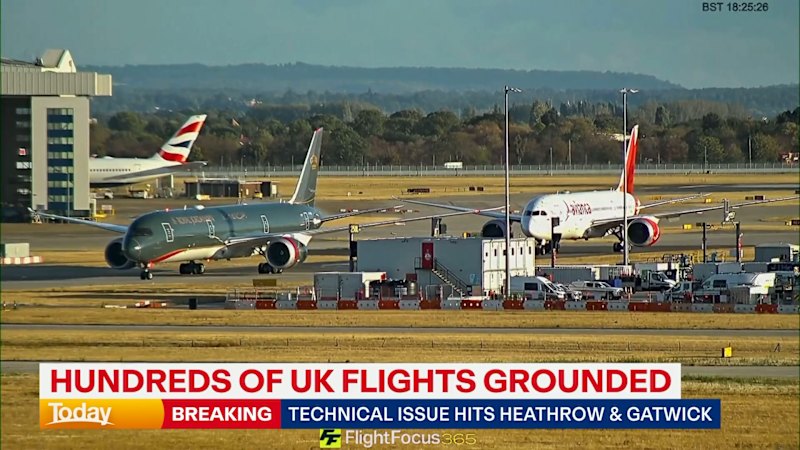
Every single time a technical glitch grounds hundreds of flights across British airspace, the mainstream media runs the exact same lazy script. They point fingers at a rogue flight plan, shake their heads at a software hiccup, and demand more government funding for shiny new screens. They treat these crises like freak weather events. Acts of God. Bad luck.
It is none of those things. It is structural rot. If you found value in this post, you should check out: this related article.
When a single corrupted data point can freeze commercial aviation from Edinburgh to Gatwick, you do not have a high-tech infrastructure problem. You have a catastrophic centralization problem. We have built an air traffic control apparatus that mistakes rigidity for safety, wrapping a half-century-old operational model in duct tape and calling it modernization.
I have spent years watching aviation boards panic over these outages, tossing capital at IT vendors while ignoring the architectural disease rotting the foundation from within. The lazy consensus says we need better redundancy inside the existing monopoly. The truth is that the monopoly itself is the single point of failure. For another look on this development, see the recent update from Travel + Leisure.
The Myth of Complete Automation
Let us look at the core technical excuse trotted out every time the National Air Traffic Services control center hiccups. We are told that the system ingested a flight plan containing duplicate boundary waypoints, panicked, and choked on its own data pipeline.
Think about that for a second. A modern digital architecture designed to route millions of tons of airborne metal across the busiest skies on earth goes down because it cannot handle a duplicate text string. That is not a glitch. That is a design flaw born from bureaucratic procurement cycles that prioritize compliance over resilience.
When organizations buy enterprise software through decades-long government tenders, they reward the lowest common denominator of risk aversion. They buy monolithic systems where a single bad record can poison the well across every sector.
Real engineering distributes trust. The current model centralizes it. Until we break apart the monolithic control blocks and push computation to the edge—treating individual aircraft as autonomous nodes rather than obedient chess pieces on a centralized master board—these delays will not just happen again. They will get worse.
Why More Funding Makes Things Worse
The immediate reflex from industry apologists is simple: throw money at the tech stack. Upgrade the mainframes. Buy faster servers. Hire more consultants.
This is backward. Injecting cash into a flawed architecture only lets you build a more complex, brittle machine. I have seen organizations burn millions on digital transformations that merely automated their existing dysfunction, wrapping a bloated bureaucratic workflow in a prettier user interface.
The UK air traffic control apparatus does not suffer from a lack of budget. It suffers from an absence of market discipline. When you face zero competition, your primary incentive is self-preservation, not operational excellence. If a retail bank's database crashed for twelve hours, executives would face immediate shareholder revolt and regulatory bloodletting. When an air traffic monopoly stalls three hundred flights, passengers get vouchers for stale sandwiches and a vague apology on Twitter, while the organization simply waits for public memory to fade.
The Operational Reality Nobody Wants to Admit
Let us address the human element, because the software is only half the disaster. We treat air traffic controllers like infallible deities until they are overworked, and then we treat them like expensive line items.
The shortage of qualified personnel is a manufactured crisis. Training a controller takes years, but the pipeline is choked by rigid institutional gatekeeping that treats the profession like a medieval guild. We refuse to adopt modern simulation-heavy, AI-assisted training pipelines because it threatens the incumbent power structures within the unions and management alike.
Imagine a scenario where regional airspace management was decentralized, allowing localized private nodes to handle handoffs using decentralized ledger tracking for flight vectors. It sounds radical only to people who have never looked at how modern supply chains solved inventory routing decades ago. Logistics companies figured out distributed routing while aviation was still arguing over paper strip-boards.
Stop Asking for Better Apologies
If you are a frequent flyer, stop accepting the narrative that these outages are unavoidable hiccups in a complex system. They are the entirely predictable result of a calcified system protecting its own obsolescence.
Do not wait for parliament to launch another toothless inquiry. Do not hold your breath for the next corporate white paper on technological resilience. Vote with your schedule, demand open-source accountability for civil infrastructure, and realize that until we shatter the monopoly model of airspace management, every summer holiday will remain one corrupted text file away from total collapse.