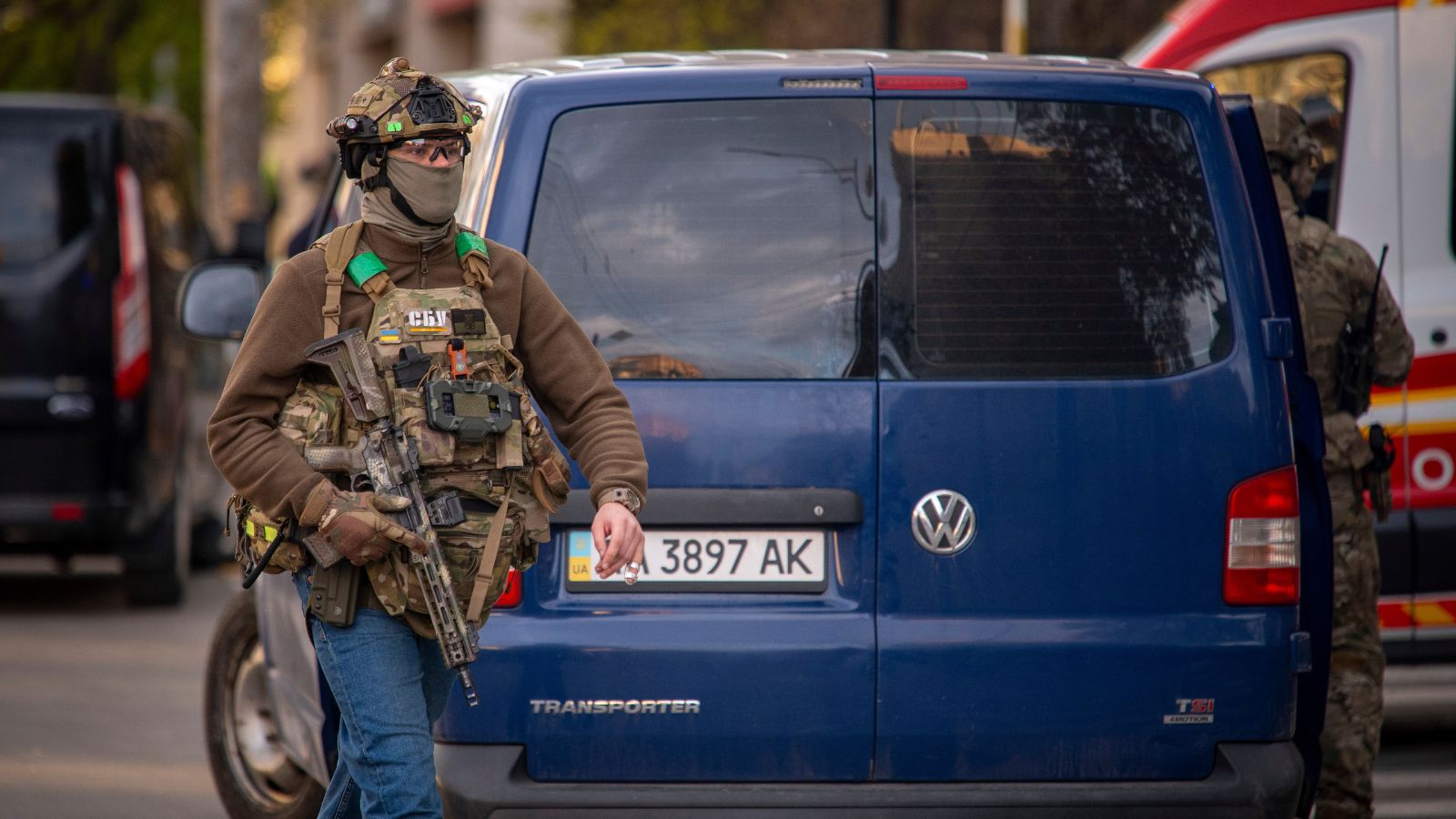
The headlines are predictable. They are also useless. When a gunman opens fire in a Ukrainian city, killing six and taking hostages, the global media machine grinds into its standard gear. We get the body count. We get the grainy cell phone footage. We get the breathless "breaking news" banners that tell us everything about the blood and nothing about the mechanics of the failure.
Mainstream reporting treats these events as "senseless tragedies." Calling a mass shooting "senseless" is the ultimate intellectual cop-out. It suggests these events are lightning strikes—unpredictable, unpreventable acts of god. They aren't. They are the logical conclusion of specific failures in domestic intelligence, urban surveillance architecture, and the crumbling friction of modern law enforcement.
If you’re looking for a digital hug or a moment of silence, close this tab. We’re here to talk about why the current security posture in Eastern Europe is a relic and why your "thoughts and prayers" are actually part of the problem.
The Myth of the Lone Wolf
The media loves the "lone wolf" narrative. It simplifies the story. It makes the perpetrator a statistical anomaly rather than a symptom of a systemic rot. I have spent years analyzing kinetic threats in high-tension zones. I can tell you right now: there is no such thing as a lone wolf.
Every shooter exists within an ecosystem. They leave a trail of digital breadcrumbs, procurement signatures, and behavioral shifts that modern systems are designed to catch but fail to act upon. The competitor reports focus on the gunman’s "sudden" turn to violence. This is a lie. Radicalization or psychological collapse is a slow-motion car crash.
The failure in the Ukraine shooting wasn't just a failure of a beat cop to be on the right corner. It was a failure of the Signal Intelligence (SIGINT) apparatus to filter the noise. In a country currently functioning as a live laboratory for modern warfare, the fact that a domestic shooter can still successfully navigate a public space with a high-capacity firearm is an indictment of the internal security infrastructure.
Your Security Camera is a Paperweight
We are told that "more surveillance" is the answer. Every time a tragedy occurs, the immediate call is for more lenses on the street. This is a fundamental misunderstanding of how security works.
The Ukraine incident proves that passive surveillance is dead weight. If a camera only records a crime so that police can watch the "highlights" later, it hasn't provided security. It has provided evidence for a trial that the victims won't live to see. We need to stop fetishizing the hardware and start looking at the OODA loop (Observe, Orient, Decide, Act).
- Observation: Most municipal cameras are low-resolution, poorly maintained, and unmonitored.
- Orientation: AI-driven behavioral analysis—detecting a drawn weapon or a specific gait associated with concealment—is still treated as a "future tech" luxury.
- Decision/Action: The lag time between a shot being fired and a tactical response team arriving is usually enough time for a shooter to exhaust their ammunition.
In Ukraine, a nation saturated with military-grade hardware, the friction of response remains glacially slow. If we aren't using automated acoustic gunshot detection tied directly to tactical deployment, we aren't serious about stopping these events. We are just curious about filming them.
The Weaponization of the Hostage Scenario
The competitor's coverage focuses on the drama of the hostage-taking. They treat it like a movie climax. In reality, a hostage situation in a mass shooting context is a tactical reset. It is the shooter’s way of extending their "fifteen minutes" and controlling the narrative of their own death.
Most modern mass shootings are "active shooter" events where the goal is maximum lethality in minimum time. When a shooter shifts to taking hostages, it usually indicates a desire for a platform. By reporting on every demand and every minute of the standoff, the media gives the shooter exactly what they want: a megaphone.
We need to stop broadcasting the shooter's "manifesto" or their demands. We are essentially rewarding the slaughter with the one thing these people crave: relevance.
The False Security of Gun Laws in War Zones
There is a lazy debate that always follows these events: gun control. In a country like Ukraine, which is currently flooded with millions of unregistered small arms due to an ongoing invasion, "gun control" is a fantasy. It’s like trying to regulate sand in a desert.
The hard truth that nobody wants to admit is that in high-threat environments, the "monopoly on violence" held by the state is a polite fiction. When the state cannot guarantee the safety of its pedestrians, the burden of security shifts.
The counter-intuitive reality? The Ukraine shooting happened because of a Security Gap, not a gun surplus. The gap exists between the military's focus on the front lines and the civilian police force's inability to manage the blowback of a militarized society. You cannot have a country at war and expect the domestic streets to feel like a Swiss village. The seepage is inevitable.
Stop Asking "Why" and Start Asking "How"
People always ask: "Why did he do it?"
This is a useless question for anyone interested in actual safety. The "why" is for the psychiatrists and the biographers. For those of us in the industry of staying alive, the only question that matters is: "How was he allowed to succeed?"
- How did he transport the weapon through a city that is supposedly on high alert?
- How did he choose the location, and why was it a "soft target" with no immediate response capability?
- How did the communication breakdown between local police and national security allow a six-minute window of unimpeded fire?
When you dismantle the "how," you find that most mass shootings are remarkably low-effort. They succeed because our public spaces are designed for convenience, not resilience. We have sacrificed safety for "openness," a noble sentiment that becomes a death sentence when faced with a motivated actor.
The High Cost of the "Normalcy Bias"
Most victims in the Ukraine shooting likely didn't run when they heard the first shot. Why? Because of Normalcy Bias. The brain tries to interpret the sound of gunfire as something familiar—firecrackers, a car backfiring, construction noise.
This is the "status quo" that kills. We have conditioned the public to be sheep in a world increasingly filled with wolves. We tell people "if you see something, say something," but we don't give them the training to know what "something" actually looks like.
If you want to survive the next ten years of urban life, you need to abandon the idea that the authorities are coming to save you in the first sixty seconds. They aren't. In the Ukraine shooting, those six deaths happened in the time it takes for a 911 operator to say "stay on the line."
The Pivot to Hardened Urbanism
The future of city planning isn't "green spaces" and "walkability." It’s Hardened Urbanism.
We need to rethink how we design public squares. We need "choke points" that aren't just for traffic, but for threat mitigation. We need glass that doesn't shatter, doors that lock remotely through centralized systems, and a public that is actually trained in trauma care and situational awareness.
The competitor's article wants you to feel sad. I want you to feel prepared. The Ukraine shooting wasn't a tragedy that "couldn't have been foreseen." It was a stress test that the city failed.
If we keep looking at these events through the lens of human interest stories, we will keep burying people. It is time to treat urban violence as a systems engineering problem. The shooter is a virus; the city is the host. If the host has no immune system, the virus wins.
Stop mourning the six. Start demanding a world where the seventh shooter never gets the chance to pull the trigger because the system has already identified, isolated, and neutralized them before they even step onto the sidewalk.
The era of reactive security is over. You are either proactive, or you are a target.