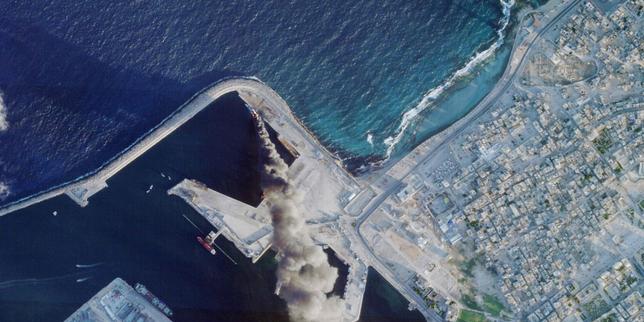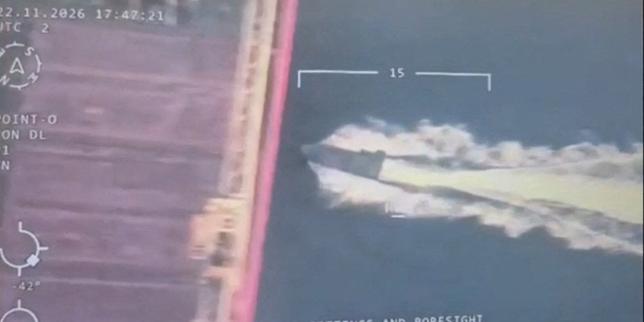
Ukrainian President Volodymyr Zelensky has claimed responsibility for a strike on two Russian vessels off the coast of Libya using uncrewed maritime drones. The operation marks a dramatic geographic expansion of the war in Ukraine, proving that Kyiv’s asymmetric naval capabilities are no longer confined to the Black Sea. By targeting Russian maritime assets in the Mediterranean, Ukraine is directly threatening the logistical lifeline Moscow relies on to sustain its mercenary networks, resource extraction, and geopolitical influence across the African continent.
For more than two years, naval analysts watched Ukraine systematically dismantle Russia’s Black Sea Fleet without possessing a conventional navy of its own. Using explosive-laden uncrewed surface vessels (USVs) like the Magura V5 and Sea Baby, Ukrainian operators forced Moscow’s warships out of Sevastopol and shattered a de facto grain blockade. Now, those same principles of low-cost, long-range maritime disruption have arrived in North Africa.
The strike off Libya is not merely a tactical stunt. It is a calculated strategic blow aimed at the soft underbelly of the Kremlin’s global expeditionary apparatus.
The Strategic Logic of Striking in the Mediterranean
Why Libya, and why now? To understand the significance of an attack thousands of kilometers from the front lines in Donbas, you have to follow the supply lines.
Russia’s military and economic footprint in Africa—formerly managed by the Wagner Group and now consolidated under the Ministry of Defense’s Africa Corps—depends heavily on maritime logistics. While heavy transport aircraft regularly ferry personnel and sensitive equipment from bases in Syria to eastern Libya, bulk cargo tells a different story. Armored vehicles, artillery shells, fuel, and mining equipment move by sea.
The ports of eastern Libya, particularly Tobruk, serve as the primary maritime gateway for Moscow’s operations in the Sahel. Controlled by the Libyan National Army under Field Marshal Khalifa Haftar, a longtime Kremlin partner, Tobruk has seen a steady stream of Russian landing ships and sanctioned cargo vessels docking to unload hardware destined for Mali, Burkina Faso, Niger, and the Central African Republic.
Disrupting that pipeline creates an immediate dilemma for the Russian General Staff.
- Diversion of Air Defense: Every air defense battery or electronic warfare system sent to protect a port in Libya is a system unavailable to defend an oil refinery in Tatarstan or a trench line in Zaporizhzhia.
- Commercial Friction: Russia relies on a "shadow fleet" of civilian-flagged merchant vessels to move military cargo while maintaining plausible deniability. Raising the insurance and physical risk for captains operating in the central Mediterranean complicates chartering these ships.
- Loss of Prestige: Moscow sells itself to African juntas as a decisive security guarantor capable of projecting power anywhere. Having its vessels struck in an allied port shatters that aura of invulnerability.
How Maritime Drones Bridge the Distance
A central question raised by the operation is technical. How do Ukrainian maritime drones reach the coast of Libya?
Operating a standard USV from Odesa to Tobruk would require navigating through the heavily monitored Bosphorus Strait—closed to belligerent warships under the Montreux Convention—and traversing roughly 2,000 nautical miles of open water. Even with auxiliary fuel tanks, a direct transit from Ukrainian-controlled territory faces severe hydrographic and geopolitical hurdles.
Military planners and maritime security experts point to two primary operational methods for executing deep-water drone strikes far from home ports.
Mothership Deployment
The most viable mechanism for long-range maritime drone warfare is the use of a commercial mothership. A disguised merchant vessel, trawler, or chartered cargo ship can carry containerized USVs into international waters near the target zone.
Once within a few hundred kilometers of the Libyan coast, the vessel lowers the drones into the water under the cover of darkness. From there, the operators take over via satellite communications. The mothership quietly steams away into busy Mediterranean shipping lanes, blending into the thousands of vessels transiting the region daily.
Forward Clandestine Staging
A second possibility involves clandestine launch teams operating from friendly or permissive shorelines, or utilizing semi-submersible hulls that are nearly impossible to detect on standard surface search radar.
Modern Ukrainian USVs rely on commercial satellite constellations—such as Starlink or alternative Ku-band networks—for real-time, high-definition video feeds and terminal guidance. Because the operator sits in a command center thousands of miles away, the physical launch point only needs a small crew, basic crane equipment, and a few hours of operational security.
[Command Center in Ukraine]
       │
       ▼ (Satellite Uplink / Low-Latency Telemetry)
[Commercial Mothership in International Waters]
       │
       ▼ (Nighttime Deployment)
[Uncrewed Surface Vessels (USVs)] ──► [Target: Russian Vessels off Libya]
Regardless of the exact launch vector, the physics of the engagement heavily favor the attacker. A maritime drone costs a fraction of a modern anti-ship missile, carries a warhead weighing hundreds of kilograms, and rides so low in the water that traditional shipboard radars struggle to separate its signature from background wave clutter.
The Anatomy of Russia’s Libyan Hub
To grasp what Russia stands to lose in Libya, consider the scale of its buildup in Cyrenaica. Over the past 18 months, open-source intelligence and satellite imagery have documented an unmistakable expansion of Russian infrastructure across eastern and southern Libya.
Moscow is not just passing through; it is digging in.
| Infrastructure Node | Primary Function | Strategic Vulnerability |
|---|---|---|
| Port of Tobruk | Primary sea hub for unloading armored vehicles, trucks, and munitions. | Exposed coastal approach; limited hardened naval defenses. |
| Al-Khadim Air Base | Main logistics and drone hub supporting Haftar’s forces and Africa Corps. | Dependent on maritime fuel and bulk resupply from the coast. |
| Brak al-Shati Air Base | Southern transit point for flights heading into Niger, Mali, and Burkina Faso. | Isolated deep in the desert; entirely reliant on northern supply chains. |
| Jufra Air Base | Central command and heavy airlift staging facility. | High-value concentration of aircraft and fuel depots. |
Without secure sea access through Tobruk, the entire southern air bridge begins to starve. Heavy trucks, spare parts for Mi-24 helicopters, and bulk fuel cannot be economically flown in from Russia indefinitely. The sea route is the artery; the airfields are merely the capillaries.
Escalation Risks and Mediterranean Blowback
While the strategic upside for Kyiv is clear, taking the war into the central Mediterranean carries profound diplomatic and operational risks. Unlike the Black Sea, which is a largely enclosed theater dominated by regional states, the Mediterranean is one of the world’s most crowded commercial arteries.
International shipping lanes carrying liquefied natural gas, container freight, and crude oil pass directly north of Libya. Operating explosive drones in these waters introduces the danger of misidentification or collateral damage to neutral commercial shipping.
European capitals, particularly Rome and Paris, watch any instability off Libya with acute anxiety. Italy relies heavily on energy pipelines running from North Africa and views Libyan coastal stability as directly tied to migration flows across the central Mediterranean. A sustained maritime shooting war off Tobruk could provoke quiet pushback from Western partners worried about spillover effects on European energy security and maritime commerce.
Furthermore, Moscow has established a clear pattern of asymmetric retaliation when its overseas assets are threatened. In the past, Kremlin officials have hinted at arming Western adversaries—such as the Houthi movement in Yemen—with advanced anti-ship missiles or targeting data. Expanding the geographic boundaries of the conflict invites Russia to respond in theaters where Western navies are already stretched thin.
The Gray Zone of Shadow Fleet Warfare
There is also a thorny legal dimension to these strikes. Many of the ships transporting Russian military cargo to Libya do not fly the Russian naval ensign. Instead, they operate under flags of convenience—such as Panama, Liberia, or Cameroon—and are owned by opaque shell companies registered in jurisdictions from Dubai to Hong Kong.
Under the laws of armed conflict, a merchant vessel carrying military contraband or operating under the effective control of an enemy state's armed forces becomes a legitimate military objective. However, proving that status in the court of public opinion requires ironclad intelligence.
If Kyiv strikes a vessel that Moscow claims was carrying civilian humanitarian aid or commercial grain, Russia’s diplomatic machinery immediately goes into overdrive to paint Ukraine as a threat to global maritime security. Zelensky’s decision to publicly claim the strike—accompanied by visual confirmation—is a deliberate effort to preempt that narrative and demonstrate precision targeting against military-linked hulls.
What This Means for Modern Naval Doctrine
Naval planners from Norfolk to Yokosuka are studying the Libyan strike with intense focus. For decades, projecting naval power required billion-dollar destroyers, carrier strike groups, and permanent overseas basing rights.
Ukraine has demonstrated that a nation without a single operational surface warship can project lethal maritime power across multiple seas.
- Geography is no longer sanctuary: Naval bases and anchorage points once considered safely outside the range of a regional adversary are now vulnerable to covertly deployed autonomous systems.
- The cost-exchange ratio is broken: Defending a commercial anchorage against low-profile surface drones requires continuous aerial surveillance, acoustic sensors, physical booms, and rapid-reaction gunboats—an expensive defensive umbrella that few ports outside major naval bases possess.
- Commercial masking blurs the battlespace: When any container ship or fishing trawler could potentially release a swarm of explosive drones, every vessel in a contested sea becomes a suspect.
Russia’s navy spent the last two years learning these lessons the hard way in the waters off Crimea. By refusing to adapt its overseas logistics to the realities of autonomous warfare, Moscow left its Mediterranean lifeline exposed. The smoking hulls off Libya send a clear message to every Russian captain steaming south through the Dardanelles: there are no safe harbors left.