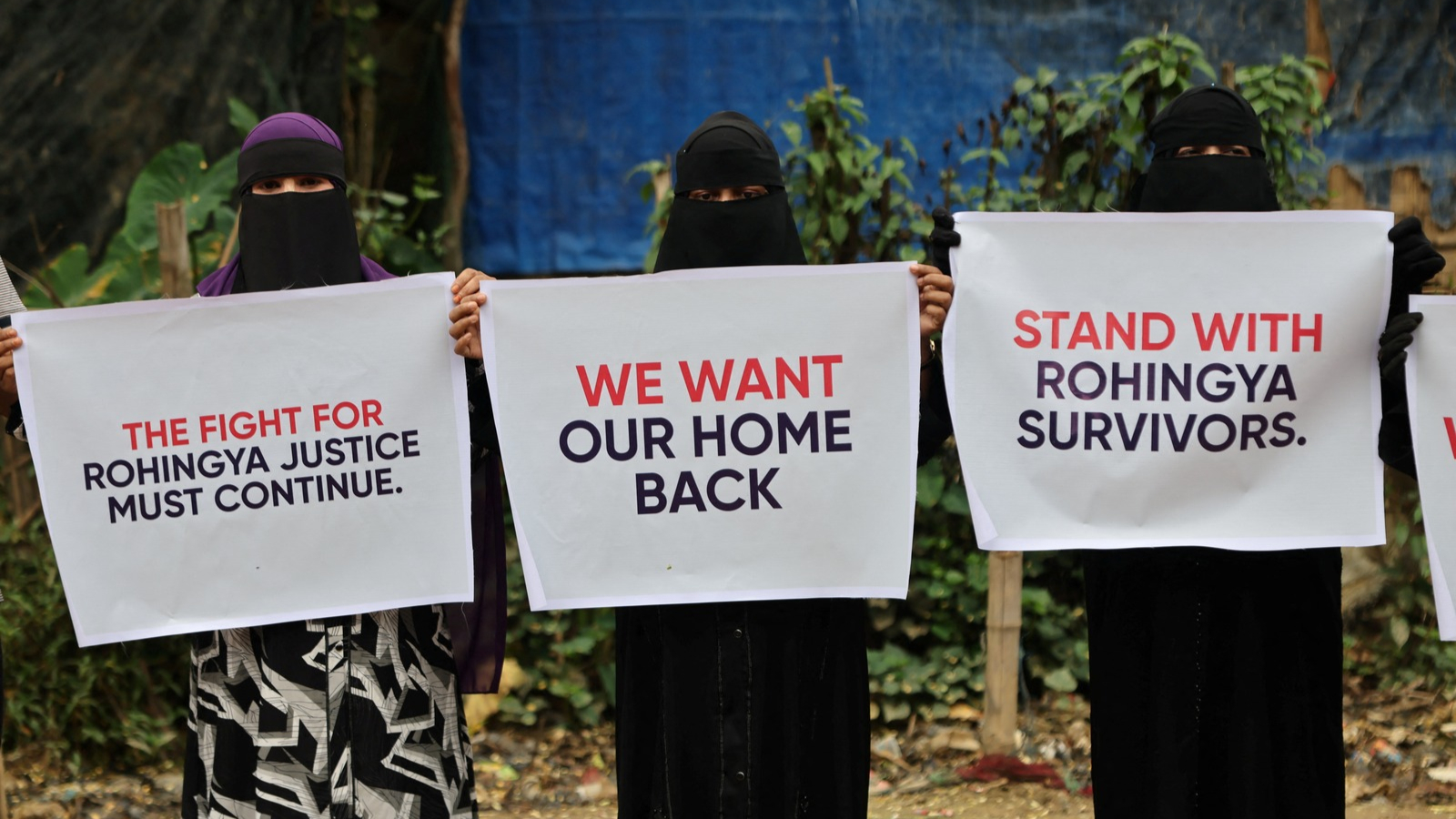
Seven years after hundreds of thousands of people fled burning villages in Rakhine State, the International Court of Justice finally issued its merits judgment on the Rohingya genocide. And if you think this ruling is just another toothless piece of UN paperwork, you're missing how international law actually works.
It took years of procedural delays, military coups, and endless legal wrangling at The Hague to get here. Brought forward by The Gambia in 2019 on behalf of the Organisation of Islamic Cooperation, the case forced the world's highest court to answer a brutal, straightforward question. Did Myanmar's military—the Tatmadaw—violate the 1948 Genocide Convention during its 2017 "clearance operations"?
The court's answer is an unequivocal yes. Judges found that Myanmar breached its obligations under the convention by failing to prevent genocidal acts, failing to punish the perpetrators, and directly carrying out mass killings, systematic sexual violence, and the intentional destruction of living conditions designed to wipe out the Rohingya population.
Honestly, the sheer scale of what happened in August 2017 still feels hard to process. Over 700,000 Rohingya Muslims crossed the border into Bangladesh within weeks, joining hundreds of thousands already displaced from earlier waves of state-sponsored violence. Doctors Without Borders estimated at the time that at least 6,700 Rohingya were killed in the very first month alone, including hundreds of children under the age of five. Whole villages were razed to dirt. Women and girls were subjected to systematic gang rape as a calculated weapon of terror.
Yet for years, Myanmar's leadership denied everything. Even Aung San Suu Kyi, once celebrated globally as a democratic icon, stood before this very court in December 2019 to defend the military, dismissing accounts of mass atrocities as "incomplete and misleading." Two years later, that same military overthrew her government in the February 2021 coup, plunging the entire country into civil war and ironically stripping away whatever thin veneer of civilian legitimacy the junta still possessed in international halls.
Why The Gambia Took Myanmar to the World Court
People often ask why a tiny West African nation thousands of miles away from Southeast Asia led this legal charge. The answer comes down to a specific legal mechanism called erga omnes partes—obligations owed to the international community as a whole.
Because the Rohingya aren't recognized as citizens by Myanmar, they had no state of their own to represent them at the International Court of Justice. The ICJ only hears disputes between sovereign nations. Individual victims can't file a lawsuit there. Neither can human rights groups.
The Gambia stepped into that legal void. Having survived its own brutal dictatorship under Yahya Jammeh, the country's then-Justice Minister Abubacarr Tambadou visited the sprawling refugee camps in Cox's Bazar, Bangladesh, in 2018. He heard survivors recounting identical patterns of arson, mass graves, and sexual violence—stories that echoed the Rwandan genocide he had spent years prosecuting at the UN tribunal in Arusha.
Any country that ratified the 1948 Genocide Convention has the legal standing to hold another signatory accountable, even without a direct territorial link. Myanmar's legal team fought tooth and nail to get the case thrown out on technicalities, arguing The Gambia was merely acting as a proxy for the Organisation of Islamic Cooperation. In July 2022, the ICJ rejected every single one of Myanmar's preliminary objections, clearing the path for the full merits phase that culminated in this landmark decision.
What the UN Court Ruling Actually Means on the Ground
Let's be realistic about what the International Court of Justice can and cannot do. The ICJ doesn't have a police force. Judges in The Hague aren't going to fly to Naypyidaw and slap handcuffs on Senior General Min Aung Hlaing. That's the job of the International Criminal Court, which operates across town and prosecutes individuals rather than states.
So why does this verdict matter so much?
First, it permanently shatters the military junta's historical revisionism. For decades, Burmese generals painted the Rohingya as illegal Bengali immigrants and framed military crackdowns as legitimate counter-terrorism operations against the Arakan Rohingya Salvation Army. That narrative is dead. When the UN's highest judicial body formally establishes genocide as a matter of legal fact, governments, corporations, and international institutions can no longer treat the crisis as an internal security dispute.
Second, ICJ judgments are legally binding and carry immense weight across the entire UN system. Under the UN Charter, the Security Council has the authority to enforce ICJ rulings through sanctions, arms embargoes, or other coercive measures. Even when geopolitical vetoes block immediate Security Council action, the ruling provides rock-solid legal cover for individual nations and regional blocs like the European Union to impose crippling targeted sanctions on junta-controlled enterprises, aviation fuel suppliers, and foreign currency reserves.
Third, the ruling sets a massive precedent for other active genocide cases at the court—most notably South Africa's case against Israel regarding Gaza, and Ukraine's case against Russia. The evidentiary standards the judges applied regarding genocidal intent, particularly how they weighed hate speech by state officials alongside military conduct on the ground, will shape international humanitarian law for generations.
Inside the Evidence That Sealed the Verdict
Proving genocide in a courtroom is notoriously difficult. Prosecutors have to prove not just that mass murder occurred, but that the perpetrators acted with dolus specialis—the specific intent to destroy a national, ethnical, racial, or religious group, in whole or in part. Without a signed memo saying "we intend to commit genocide," judges have to infer that intent from a consistent pattern of conduct.
The Gambia's legal team buried the court in undeniable proof, leaning heavily on findings from the UN Independent International Fact-Finding Mission on Myanmar and the Independent Investigative Mechanism for Myanmar.
The evidence pointed to coordinated, top-down planning rather than rogue soldiers losing control:
- Pre-attack disarmament and isolation: Weeks before the August 2017 sweep, security forces confiscated knives, farm tools, and basic household implements from Rohingya villagers while simultaneously arming and training local ethnic Rakhine militias.
- Identical operational blueprints: Across hundreds of miles of northern Rakhine State, troops followed the exact same sequence—surrounding villages at dawn, firing indiscriminately into fleeing crowds, separating men and boys for execution, herding women into buildings for sexual assault, and burning structures with incendiary devices.
- State-orchestrated dehumanization: Military leaders and state media systematically erased the word "Rohingya" from official vocabulary, referring to them as "fleas," "thorns," or "illegal Bengalis" in public broadcasts and coordinated Facebook disinformation campaigns.
- Destruction of evidence: Satellite imagery analyzed by human rights monitors showed bulldozers leveling entire burned villages within months of the attacks, erasing mass graves and constructing military bases directly over former Rohingya neighborhoods.
When you put those pieces together, the defense's claim of "proportionate counter-insurgency" falls apart completely. You don't need to gang-rape women and burn infants alive to neutralize lightly armed militants.
The Reality Facing Over a Million Refugees Today
While lawyers celebrate a historic victory in the Netherlands, the people at the center of this case are still trapped in limbo. Over 1.2 million Rohingya refugees remain packed into bamboo-and-tarpaulin shelters in Cox's Bazar, Bangladesh—the largest refugee settlement on earth.
Conditions there have deteriorated sharply. International donor fatigue has forced the World Food Programme to slash food rations repeatedly over the last couple of years, leaving families surviving on pennies a day. Crime and forced recruitment by armed factions inside the camps have surged. Young people who grew up behind barbed wire have zero legal right to work, attend local schools, or travel freely.
Meanwhile, back inside Rakhine State, the situation has grown even more chaotic. The Arakan Army, an ethnic Rakhine rebel group fighting against the Myanmar military junta, has seized vast swaths of territory near the Bangladesh border. Tens of thousands of Rohingya still living in Myanmar have found themselves caught in the crossfire—forcibly conscripted by the desperate junta to fight on the front lines against the Arakan Army, while also facing fresh waves of displacement and arson as control of towns shifts hands.
Repatriation right now is an illusion. Sending refugees back to a country ruled by the very military just found guilty of trying to exterminate them would be a death sentence.
How This Verdict Connects to Individual Prosecutions
This ICJ decision doesn't exist in a vacuum. It feeds directly into parallel criminal investigations aimed at putting individual commanders behind bars.
At the International Criminal Court, prosecutors have been investigating crimes against humanity—specifically deportation and persecution—committed against the Rohingya since 2019. Because Bangladesh is an ICC member state and the forced deportation crossed onto Bangladeshi soil, the court established jurisdiction even though Myanmar never ratified the Rome Statute.
At the same time, universal jurisdiction cases are moving forward in national courts, most notably in Argentina, where Burmese Rohingya advocacy groups filed criminal complaints against top military brass and civilian officials. Universal jurisdiction allows domestic courts to prosecute the gravest international crimes regardless of where they occurred or the nationality of the perpetrators.
Every factual finding established by the ICJ judges now serves as authoritative corroboration for these criminal tribunals. Defense lawyers for junta generals can no longer argue that the atrocities didn't happen; they can only try to distance their individual clients from the chain of command.
What You Can Do With This Information
Understanding a landmark international court ruling isn't just an academic exercise—public pressure and sustained attention directly impact whether governments enforce these decisions or let them gather dust.
If you want to support accountability and immediate relief for the Rohingya population, take concrete steps right now:
- Support frontline humanitarian aid directly: Organizations like Médecins Sans Frontières (Doctors Without Borders), UNHCR, and local Rohingya-led mutual aid networks operating inside Cox's Bazar rely on unrestricted private donations to offset severe government funding cuts for food, clean water, and maternal healthcare.
- Track corporate complicity and sanctions enforcement: Follow investigative reporting from groups like Justice For Myanmar, which tracks the global supply chains, insurance providers, and foreign banks still doing business with junta-owned conglomerates. Write to your elected representatives demanding strict enforcement of aviation fuel bans and financial sanctions against Myanmar's military regime.
- Amplify Rohingya-led journalism: Follow outlets run by Rohingya reporters on the ground, such as The Rohingya Post and Rohingya Khobor, so their voices define the narrative rather than external commentators.
The International Court of Justice has finally put the truth on the permanent legal record. Now the burden shifts to world leaders to ensure that a verdict of genocide actually costs the perpetrators something.