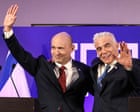
The announcement came late Sunday from a stage in Herzliya, but the shockwaves are still rattling the foundations of the Knesset. Naftali Bennett and Yair Lapid, the two men who previously engineered the only successful heist of Benjamin Netanyahu’s throne in fifteen years, have officially joined forces under a new banner called Together (Beyahad). This is not just a tactical merger for the October 2026 election; it is a desperate, high-stakes gamble to consolidate the fractured center-right and liberal blocs before Netanyahu can finish his latest political resurrection.
By merging Bennett’s hawkish credibility with Lapid’s organized centrist base, the "Together" party aims to solve the math problem that has haunted the Israeli opposition for a decade. Recent polling suggests this joint list could command 38 seats, instantly becoming the largest faction in the Knesset and creating a gravitational pull that Netanyahu’s Likud hasn't faced in years. If you found value in this piece, you should read: this related article.
The Architect and the Ideologue
This alliance is built on a "trust but verify" foundation that seems improbable given their divergent worldviews. Bennett is a religious nationalist who has spent years championing West Bank settlements; Lapid is the secular face of Tel Aviv liberalism who still pays lip service to a two-state solution.
The glue holding them together is the shared conviction that Netanyahu’s focus on personal political survival has compromised the nation's security architecture. Bennett, leading the ticket, provides the "security cover" needed to attract soft-right voters who are tired of the current coalition but terrified of a "leftist" government. For another look on this event, check out the latest coverage from Al Jazeera.
Breaking the Blockade
For years, Netanyahu has successfully campaigned on the "us versus them" narrative, painting any opposition as a gateway for Arab party influence. The Bennett-Lapid strategy seeks to neutralize this by:
- Prioritizing Domestic Reforms: Focusing on ultra-Orthodox military conscription, a firebrand issue that resonates with both secular and nationalist voters.
- Security Hawkism: Out-flanking Netanyahu from the right on issues like the recent Iran ceasefire, which Lapid has branded a "political disaster."
- Professional Governance: Presenting a cabinet of "experts" rather than political appointees to manage the multi-billion dollar post-war reconstruction.
The Gantz Factor and the Missing Middle
While the Bennett-Lapid union is a massive development, it highlights a brutal reality: the opposition remains a house divided. Benny Gantz, once the crown prince of the anti-Netanyahu movement, has seen his popularity crater after his stint in the emergency war cabinet. He currently sits on the sidelines, welcoming the union but refusing to submerge his Blue and White party into it.
Then there is Gadi Eisenkot. The former IDF Chief of Staff is the wild card. He has been invited to join "Together," and his entry would likely provide the final "Zionist majority" credibility the bloc needs to avoid relying on Arab parties for a 61-seat majority. Without Eisenkot—or a massive shift in the Haredi parties—the opposition still faces the same ceiling it hit in 2021.
The Likud Counter-Strike
Netanyahu is not watching this from the sidelines. His machine has already begun a scorched-earth campaign. The Likud messaging is simple: "Beyahad" is just a rebranding of the 2021 "Brotherhood Alliance" that included Mansour Abbas’s Ra’am party.
Netanyahu’s strategic moves include:
- Absorbing the Right: Integrating Gideon Sa’ar’s New Hope party back into Likud to prevent any further leaks to Bennett.
- The Security Narrative: Positioning himself as the only leader capable of managing the Trump administration’s upcoming "Peace through Strength" regional initiatives.
- Threshold Warfare: Aiming to push smaller opposition parties like the Democrats (Yair Golan) below the 3.25% electoral threshold, effectively "wasting" hundreds of thousands of anti-Netanyahu votes.
A Nation in Flux
The Israeli electorate in 2026 is exhausted. The country has endured years of perpetual mobilization, a brutal conflict with Hamas and Hezbollah, and a fragile ceasefire with Iran that 61% of the public rejects. There is a profound paradox at play: while the public largely supports the war’s objectives, they have lost faith in the current government’s ability to deliver a decisive "day after."
Bennett and Lapid are betting that the public’s desire for "normalization" and "sanity" will outweigh their ideological fears. But in the Middle East, a single security incident or a shift in Washington's stance can upend a campaign in hours.
The "Together" party must now prove it is more than just a "Not Bibi" club. It needs to articulate a coherent policy on the Gaza stabilization force and the northern border that doesn't just sound like Likud-lite. If they fail to define themselves by what they are rather than who they oppose, Netanyahu will likely find a way to wedge them apart before the first ballot is even cast.
The campaign for the soul of the country has officially begun, and the margin for error is non-existent.