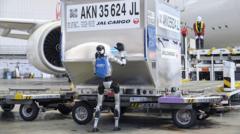
Ground handling operations represent the most volatile variable in airline turnaround performance, characterized by high physical strain, labor shortages, and a zero-tolerance threshold for safety errors. Japan Airlines (JAL) is currently addressing these systemic pressures through pilot programs involving humanoid robotics designed to replicate human kinematic movements in baggage loading and aircraft servicing. This shift is not a pursuit of "innovation" for its own sake, but a calculated response to a structural labor deficit in the Japanese aviation sector, which expects a 30% workforce shortfall by 2030. Success depends on whether these machines can achieve "operational parity"—the ability to match human speed and adaptability while maintaining a lower Total Cost of Ownership (TCO) over a five-year equipment lifecycle.
The Operational Bottleneck of Human Kinematics
Current ground handling is optimized for human physiology, which introduces inherent inefficiencies. Human laborers are subject to fatigue curves, thermal stress during tarmac operations, and musculoskeletal injury risks that inflate insurance premiums and turnover rates. Japan Airlines’ trial of humanoid forms—as opposed to specialized fixed-arm automation—suggests a strategic decision to avoid massive infrastructure overhauls.
By utilizing robots that mirror human dimensions and joint articulation, JAL bypasses the need to redesign aircraft cargo holds or airport aprons. The trade-off is the "Complexity Tax." A humanoid robot requires significantly more sophisticated balance algorithms and sensor fusion than a wheeled cart or a conveyor belt. The trial must prove that the robot’s onboard processing can handle the erratic variables of a live tarmac, such as shifting center-of-gravity in soft-sided luggage and unpredictable wind gusts, without compromising the 45-minute narrow-body turnaround window.
The Three Pillars of Robotic Integration Strategy
To transition from a controlled trial to a fleet-wide deployment, JAL’s strategy must satisfy three distinct performance metrics.
- Kinematic Synchronization: The robot must interface with existing Ground Support Equipment (GSE), such as belt loaders and ULD (Unit Load Device) transporters. If a robot requires specialized "robot-friendly" luggage containers, the capital expenditure (CAPEX) becomes prohibitive.
- Latency of Decision-Making: In baggage handling, a human worker makes split-second decisions regarding weight distribution and spatial Tetris within the cargo hold. A humanoid robot’s value is negated if its computer vision system requires several seconds to "plan" each lift.
- Environmental Resilience: Tarmac temperatures in Tokyo can swing from sub-zero in winter to over 40°C in summer. Actuators and lithium-ion power cells must maintain consistent torque and discharge rates across these extremes to prevent mid-turnaround mechanical failures.
The Cost Function of Autonomous Ground Handling
The financial viability of the JAL humanoid program is determined by the intersection of labor costs and robotic amortization. In a high-wage, labor-scarce economy like Japan, the "break-even" point for a humanoid unit is lower than in developing markets.
$$TCO = (C_{purchase} + C_{maintenance} + C_{energy}) / (L_{years} \times H_{utilization})$$
Where $C_{purchase}$ is the initial acquisition cost, $C_{maintenance}$ covers sensor calibration and hardware repairs, and $H_{utilization}$ represents the hours the robot is active per year. Unlike human staff, robots do not require shift differentials, breaks, or recruitment fees. However, the current cost of high-torque electric actuators and LiDAR sensors remains a significant barrier. JAL is effectively betting on the "Wright’s Law" of robotics: for every doubling of cumulative production, the cost of humanoid units will drop by a fixed percentage, eventually undercutting the rising cost of human labor.
Structural Constraints and Safety Thresholds
The introduction of semi-autonomous machines into a "sterile" airport environment introduces new risk vectors. A 200kg humanoid robot moving in close proximity to an airframe valued at $100 million presents a catastrophic liability risk. One sensor malfunction could result in a fuselage strike, grounding the aircraft for weeks.
To mitigate this, JAL is likely employing a "Human-in-the-Loop" (HITL) supervisory model. In this framework, one human operator monitors a fleet of four to six robots. This maintains the safety oversight required by civil aviation authorities while still achieving a 4:1 labor productivity gain. The technical challenge lies in the handover logic: when a robot encounters an "edge case"—such as an oversized item or a leaking container—it must signal the human supervisor and transition to a safe state within milliseconds.
Displacement vs. Augmentation Logic
Critics often frame these trials as a direct replacement of the workforce, but the data suggests a model of physical augmentation. The heavy-lift requirements of ground handling lead to high attrition rates. By delegating the repetitive, high-impact tasks (lifting 30kg suitcases 400 times per shift) to humanoid units, JAL can reallocate human workers to "exception management" and technical oversight.
This creates a tiered workforce:
- Tier 1: Human supervisors managing robotic fleets and handling complex logistics.
- Tier 2: Autonomous Humanoids performing standardized bulk movement.
- Tier 3: Specialized GSE for high-volume, non-humanoid tasks.
This hierarchy addresses the "Last Meter" problem of automation. While global logistics use automated sorters for 95% of a package's journey, the final meter—placing that package into a non-standardized space like an airplane's belly—has remained stubbornly manual. Humanoid robots represent the first credible attempt to automate this specific, high-friction node.
Technical Limitations and the Path to Deployment
The JAL trials currently face three primary technical bottlenecks that distinguish a "successful demo" from a "viable product."
- Battery Density: Current power-to-weight ratios often limit humanoid operation to 2-4 hours before requiring a recharge. A 24-hour airport operation requires either rapid battery swapping or a significantly larger fleet to account for charging downtime.
- Tactile Feedback: Safely handling delicate luggage requires "Force Torque" sensing. If a robot applies the same pressure to a hard-shell suitcase as it does to a soft duffel bag, cargo damage claims will spike.
- Navigation in Dynamic Environments: Static obstacles are easy to map. Moving obstacles—fuel trucks, catering vehicles, and hurrying crew—require the robot to predict trajectories in real-time.
The strategic play for Japan Airlines is to standardize the "Ground Handling Operating System." By being an early adopter, they are not just buying hardware; they are accumulating the datasets necessary to train the neural networks that will eventually run these robots. The first airline to master the data-driven "playbook" for robotic turnarounds will possess a proprietary operational advantage that is far harder to replicate than simply buying the same machines three years later.
The transition to humanoid ground handlers is inevitable not because the technology is perfect, but because the human labor supply is collapsing. The airlines that fail to integrate these systems now will find themselves unable to staff their hubs by the end of the decade, regardless of passenger demand. JAL is currently building the infrastructure for a post-labor aviation economy, where the tarmac is a synchronized, multi-agent robotic environment.
Move toward a "Hardware-as-a-Service" (HaaS) procurement model for the next phase of trials. Rather than bearing the full CAPEX and obsolescence risk of humanoid units, JAL should negotiate contracts based on "Successful Bags Moved" or "Turnaround Minutes Achieved." This shifts the burden of maintenance and software updates to the robotics manufacturer while allowing JAL to focus on integrating the data streams into their core dispatch and scheduling software.