Luxury retail operates on a fundamental economic paradox: brands sell extreme margin protection through strict return policies, yet enforce those policies in jurisdictions governed by rigid statutory consumer rights. When Harrods refused a £4,550 refund on a Cartier bracelet and subsequently absorbed a £5,131 court-ordered payout, the department store demonstrated a textbook failure in dispute resolution economics. The resulting 12.77% financial penalty—comprising £581 in court fees, statutory interest, and ancillary costs above the original purchase price—represents only the visible layer of operational loss. Under the UK Consumer Rights Act 2015, the burden of proof during the first six months post-purchase sits squarely on the merchant, rendering internal store return policies legally subordinate to statutory fault thresholds.
The Structural Friction Between Store Policy and Statutory Law
Retailers frequently conflate their commercial return policies with statutory consumer protections. Commercial return policies govern discretionary returns—instances where a buyer experiences remorse, selects an incorrect size, or simply changes their mind. Within this domain, luxury houses and multi-brand department stores exercise broad autonomy, routinely restricting returns to store credit, imposing narrow 14-to-30-day windows, or rejecting items once security tags are detached.
Statutory rights operate on an entirely separate legal plane. Under the UK Consumer Rights Act 2015, goods must be of satisfactory quality, fit for a particular purpose, and as described. When a physical defect, mechanical failure, or premature structural wear manifests, the retailer's discretionary policy ceases to govern the transaction.
The mechanism driving the Harrods-Cartier dispute centers on the statutory reversal of the burden of proof. Within the initial six-month window following delivery, any fault that emerges is legally presumed to have existed at the time of purchase. To legally deny a refund or repair during this period, the merchant cannot simply assert that the customer caused the damage through misuse. The merchant must provide affirmative, objective evidence—typically via independent metallurgical, gemological, or mechanical testing—proving that the item conformed to statutory quality standards at the point of sale and failed exclusively due to external trauma or user negligence.
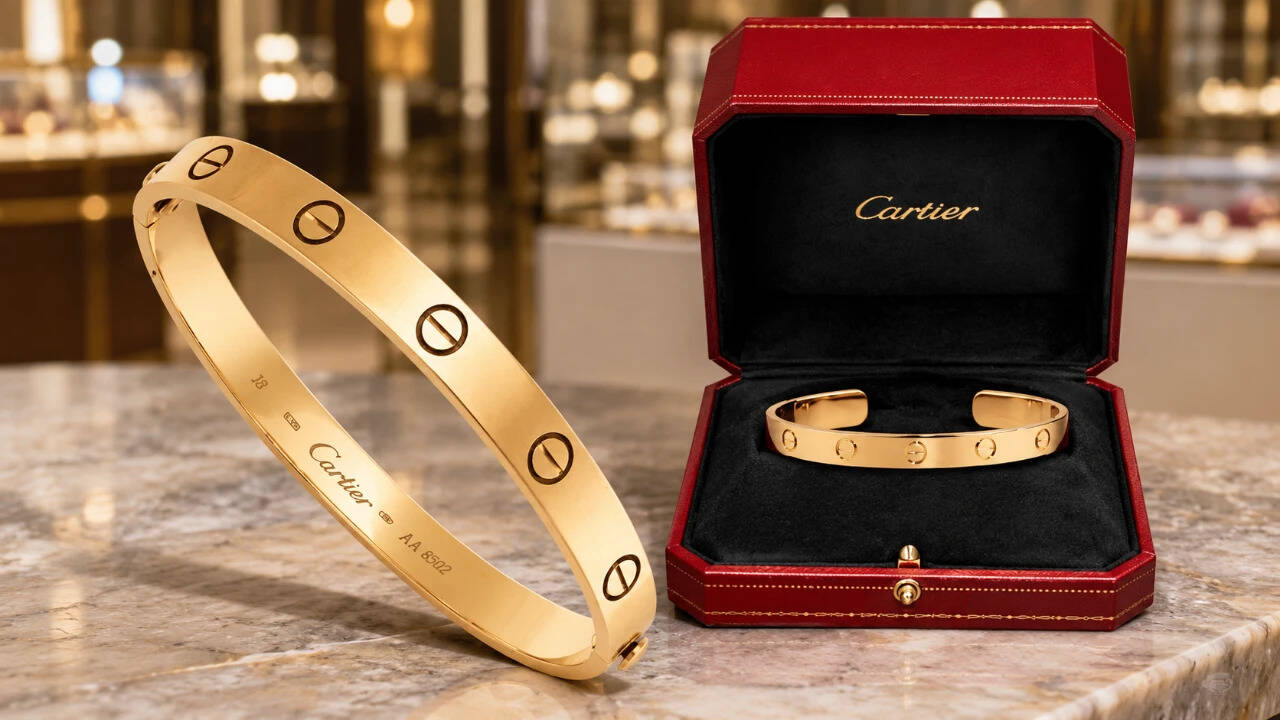
High-end jewelry presents a unique vulnerability under this framework. Items like the Cartier Love bracelet or Juste un Clou rely on precision-engineered locking mechanisms and high-purity gold alloys that are inherently softer than industrial metals. When a clasp fails or a hinge loosens within months of acquisition, the retailer's boutique staff often default to a visual inspection protocol. Visual inspection detects surface scratches, which staff interpret as evidence of impact or misuse. In a county court setting, however, surface wear on a worn piece of jewelry does not establish causation for a mechanical clasp failure. Without forensic proof linking an external impact directly to the internal mechanism's failure, the retailer's defense collapses.
The Dispute Escalation Cost Function
To understand why defending a £4,550 claim in small claims court is mathematically irrational for a tier-one luxury retailer, one must model the total cost function of a litigated consumer dispute. The visible payout of £5,131 reflects a direct cash outflow, but the true enterprise cost encompasses four distinct variables:
- Direct Financial Liability ($L_d$): The principal refund amount (£4,550) plus statutory interest (typically calculated at 8% per annum under Section 69 of the County Courts Act 1984) and court filing/hearing fees (£581 combined).
- Internal Legal and Administrative Overhead ($O_i$): The fully loaded hourly cost of customer relations managers, compliance officers, and in-house legal counsel reviewing correspondence, drafting particulars of defense, and compiling evidentiary bundles. Even in the Small Claims Track, where legal representation costs are generally non-recoverable by the winning party, the internal labor required to prepare a defense easily exceeds £1,500 to £2,500 in corporate payroll allocation.
- Opportunity Cost of Brand Equity ($E_b$): Luxury retail relies on asymmetrical goodwill. Customers paying £4,550 for a single accessory expect frictionless post-sale support as an implicit component of the retail markup. When a dispute transitions from a private customer service desk to a public court judgment, the brand suffers asymmetric reputational damage. Search engine indexing of legal defeats permanently associates the retailer's brand name with adversarial customer treatment.
- Supplier Chargeback Friction ($S_c$): In a department store concession or wholesale model, Harrods acts as the merchant of record, meaning statutory liability attaches to Harrods rather than Cartier (Richemont). If Harrods fails to secure a Return Merchandise Authorization (RMA) from the parent brand before rejecting the customer's claim, Harrods absorbs 100% of the principal loss if the court rules against them, whereas an early negotiated settlement might have allowed Harrods to pass the defective unit back to Richemont's workshop under wholesale warranty agreements.
When $L_d + O_i + E_b + S_c$ is evaluated against the baseline cost of an immediate refund—where the retailer recovers a physical asset that can be refurbished, melted, or credited by the manufacturer—litigating a sub-£10,000 consumer claim yields a strictly negative expected value.
Mapping the Decision Matrix: Concession vs. Litigation
Retail operations teams often lack a quantitative triage framework to separate defensible claims from high-risk statutory liabilities. Frontline boutique managers are frequently incentivized on net sales retention and shrinkage reduction, creating a principal-agent problem. A store manager who refuses a £4,550 refund protects their monthly P&L statement in the short term, pushing the eventual £5,131 legal loss onto a centralized corporate legal budget six to twelve months later.
Eliminating this structural misalignment requires replacing subjective frontline discretion with a deterministic dispute triage matrix governed by three variables:
1. Temporal Proximity to Purchase
- 0 to 30 Days (Short-Term Right to Reject): Under UK law, the consumer holds an absolute right to reject faulty goods for a full refund. The retailer has zero right to insist on a repair or replacement. Any refusal in this window without immediate, irrefutable proof of intentional damage guarantees a court loss.
- 31 Days to 6 Months (The Presumption Window): The retailer gets one opportunity to repair or replace the item. If the repair fails, takes an unreasonable time, or causes significant inconvenience, the consumer triggers the final right to reject for a full refund (with no deduction for use permitted within the first six months).
- Beyond 6 Months (Reversed Burden): The burden of proof shifts to the consumer. The consumer must now fund an independent expert report to prove the defect was inherent. Litigation risk drops precipitously for the retailer in this tier.
2. Asset Recoverability and Salvage Value
In luxury jewelry, a rejected £4,550 bracelet does not represent a total capital write-off. The intrinsic scrap value of 18k gold, combined with the brand's internal refurbishment capabilities, means the net inventory loss on an accepted return is a fraction of the retail price—often less than 25% of the gross transaction value once retail gross margins (typically 50% to 65% in branded luxury jewelry) are accounted for. Refusing the return converts a ~£1,200 net inventory cost into a £5,131 unrecoverable cash judgment plus legal overhead.
3. Evidentiary Thresholds
Before a dispute escalates past the customer relations team to formal pre-action protocol letters, the retailer must audit its evidentiary file. Does the file contain dated, high-resolution macro photography from the moment of intake? Does it include a written technical assessment from a certified horologist or goldsmith explicitly ruling out manufacturing defects? If the file relies solely on sales associate notes stating "customer bent the clasp," the claim fails the evidentiary threshold for court defense.
The Structural Vulnerability of Concession Retail Models
The Harrods-Cartier dynamic highlights an operational fault line unique to luxury department stores. Unlike mono-brand boutiques owned directly by conglomerates like LVMH or Richemont, department stores operate through complex concession agreements, joint ventures, or wholesale buying arrangements.
When a customer purchases a Cartier bracelet inside Harrods, the privity of contract exists between the customer and Harrods. Legally, Cartier is a third party to the retail transaction. However, operationally, Harrods staff often defer technical quality assessments to Cartier's internal after-sales service centers.
This creates an accountability vacuum:
- Cartier's technicians evaluate the piece against internal manufacturing tolerances. If they determine the damage falls outside their strict warranty parameters, they issue a paid repair quote to the boutique.
- Harrods staff relay this paid repair quote to the customer as a final verdict, treating the manufacturer's internal warranty decision as synonymous with UK consumer law.
- The customer rejects the paid repair, cites the Consumer Rights Act 2015, and initiates a claim via Money Claim Online (MCOL).
- Harrods is now forced to defend a statutory claim in court using a brief, non-forensic rejection note generated by Cartier's workshop—a document drafted for internal warranty administration, not to withstand cross-examination by a district judge.
Unless the department store aligns its concession agreements so that the brand partner indemnifies the host retailer for all statutory consumer judgments—or grants the host retailer unilateral authority to issue statutory refunds within the six-month presumption window without losing wholesale credit—the department store remains trapped between brand partner rigidity and statutory consumer enforcement.
Operational Protocol for High-Ticket Dispute Resolution
To prevent negative-sum legal outcomes, luxury retail executives must decouple frontline sales incentives from post-sale statutory claims and institute an automated escalation circuit breaker.
First, strip boutique managers of the authority to issue final rejections on fault-based claims within the first 180 days of purchase. Any dispute involving a functional or structural defect on an item exceeding £1,000 must route immediately to a centralized Consumer Compliance Unit within 48 hours of customer contact.
Second, establish a mandatory Expected Value (EV) gate prior to filing a defense in small claims court. Require legal counsel to calculate the true net cost of settlement—defined as the retail refund minus the wholesale cost of goods sold and salvage recovery—against the fully loaded cost of litigation. If the retailer lacks an independent, court-compliant forensic report proving user-inflicted damage, mandate an immediate commercial settlement before the court issues a Notice of Allocation.
Third, renegotiate multi-brand concession and wholesale contracts to mirror statutory timelines. Supplier agreements must explicitly stipulate that any item returned by a consumer under the statutory six-month presumption of fault is automatically accepted by the brand owner for wholesale credit unless the brand owner provides a forensic technical report capable of prevailing in a small claims tribunal. By shifting the evidentiary burden back onto the manufacturer who controls the production quality, the retailer eliminates the legal arbitrage that turned a £4,550 bracelet into a £5,131 liability.