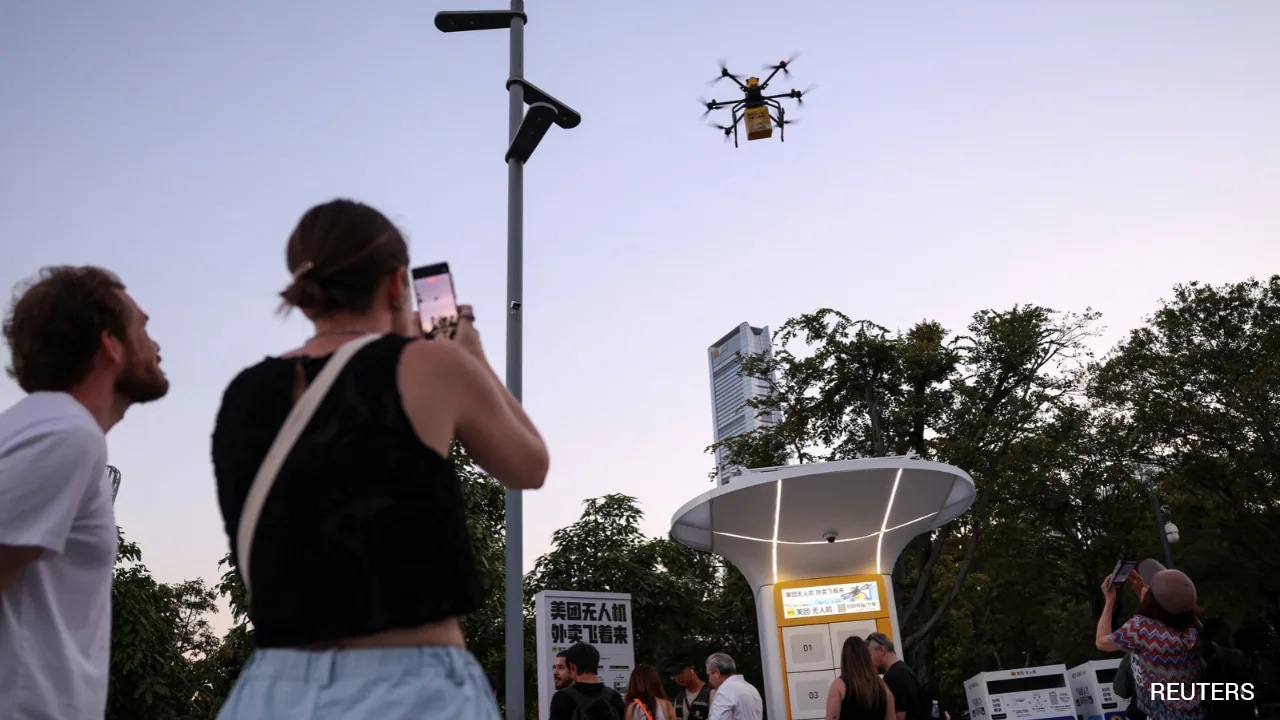
Municipal authorities in Shenzhen have instituted temporary bans on vehicle horns and commercial delivery drones to secure the urban environment ahead of the Asia-Pacific Economic Cooperation (APEC) summit. While surface-level reporting frames these restrictions as routine civic housekeeping, they represent a live stress test of low-altitude economy governance and multi-modal urban security. By shutting down autonomous aerial logistics and enforcing strict acoustic baselines, city planners are revealing the structural vulnerabilities that emerge when dense commercial automation collides with sovereign diplomatic protocols.
To understand the operational impact of these measures, one must analyze how modern smart cities balance continuous logistical throughput against zero-failure security mandates. Shenzhen is not merely a host city; it is the primary proving ground for China’s commercial unmanned aerial vehicle (UAV) sector and electric vehicle (EV) infrastructure. Suspending these systems requires dismantling deeply integrated supply chains and rerouting millions of daily micro-transactions.
The Architecture of Diplomatic Urban Lockdown
High-level multilateral summits like APEC require host municipalities to transition from open, efficiency-optimized networks to closed, security-optimized perimeters. This transition operates across three distinct layers of urban infrastructure:
- The Electromagnetic and Airspace Layer: Low-altitude airspace (typically defined as altitudes below 1,000 meters) is cleared of all non-state actors. This eliminates kinetic threats, unauthorized surveillance, and radio-frequency (RF) interference that could disrupt secure diplomatic communications.
- The Acoustic and Sensory Layer: Vehicle horn bans and construction halts establish a controlled ambient noise floor. From a security engineering perspective, reducing urban acoustic clutter improves the signal-to-noise ratio for directional acoustic gunshot detection systems and perimeter monitoring arrays.
- The Terrestrial Transit Layer: Roadway corridors are segmented into diplomatic lanes and civilian spillover zones, altering traffic flow algorithms and public transit schedules.
In standard urban environments, these layers operate independently. During a summit, municipal command centers synchronize them under a single unified command structure. The immediate consequence is a sharp drop in logistical elasticity. Systems built for just-in-time delivery suddenly face hard physical and regulatory walls.
Deconstructing the Grounding of the Low-Altitude Economy
Shenzhen’s commercial drone network is the most advanced urban aerial logistics grid globally. Companies such as Meituan and SF Express operate hundreds of automated routes, delivering food, medical supplies, and high-value parcels directly to residential lockers and commercial rooftops. Grounding this fleet exposes the friction between hyper-local automation and centralized airspace control.
Why Geofencing Fails as a Partial Measure
A common misconception is that drone operators can simply geofence restricted zones around summit venues while maintaining operations elsewhere in the city. In practice, partial geofencing introduces unacceptable operational risks during high-security events:
- Command-and-Control (C2) Link Saturation: High-density security deployments rely heavily on electronic warfare (EW) countermeasures, including localized GPS spoofing and broad-spectrum RF jamming, to neutralize rogue UAVs. Commercial delivery drones operating miles away can suffer collateral signal degradation, triggering automated "return-to-home" or emergency landing protocols in populated areas.
- Radar and Sensor Clutter: Air defense and low-altitude radar networks tracking hundreds of legitimate commercial flights face severe cognitive and computational overload. Clearing the sky entirely ensures that any radar return below 1,000 meters is immediately classified as an anomaly requiring interception.
- Visual Line-of-Sight (VLOS) Ambiguity: Ground security personnel cannot visually distinguish between a commercial delivery quadcopter carrying lunch and a modified payload-bearing drone. Blanket prohibition removes the burden of real-time visual identification from perimeter guards.
The Supply Chain Rerouting Penalty
When aerial nodes go dark, delivery volume does not vanish; it compresses onto the terrestrial road network. Drone logistics exist specifically to bypass last-mile road congestion and vertical transit bottlenecks in high-rise districts.
Forcing these parcels back onto electric scooters and delivery vans creates a localized capacity shock. Dispatch algorithms must recalculate thousands of routes without the aerial shortcut, increasing delivery latency and concentrating two-wheeled courier traffic on secondary streets. For perishable goods and time-sensitive medical deliveries, the loss of the vertical transit layer degrades service reliability across the entire metropolitan core.
Acoustic Governance and Traffic Flow Dynamics
Banning vehicle horns in a megacity of over 17 million residents appears on the surface to be an aesthetic measure aimed at projecting civic order to international delegates. In reality, acoustic restrictions interact directly with driver behavior, traffic enforcement infrastructure, and electric vehicle acoustics.
The EV Acoustic Paradox
Shenzhen has achieved near-total electrification of its public bus and taxi fleets, alongside high private EV adoption. Internal combustion engine (ICE) vehicles produce continuous mechanical noise that alerts pedestrians and cyclists to their presence. Electric vehicles operating at low speeds generate minimal mechanical sound, making drivers disproportionately reliant on horns to navigate dense, multi-use urban streets shared with e-bikes.
When authorities prohibit horn usage, they remove a primary collision-avoidance mechanism for low-speed urban driving. Drivers must compensate by reducing average vehicle speeds and increasing following distances. The secondary effect is a measurable decrease in intersection throughput, as drivers hesitate longer before executing merges or turns in congested zones.
Automated Acoustic Enforcement
Enforcing a city-wide horn ban relies on acoustic camera arrays—networks of directional microphones paired with optical license plate recognition (ALPR) cameras. These systems triangulate the sound pressure wave of a horn blast to a specific lane and vehicle within milliseconds, automatically issuing citations.
This enforcement mechanism highlights the broader architecture of Chinese smart-city governance. The same sensor networks used to optimize traffic signal timing and monitor environmental noise pollution are repurposed into real-time behavioral compliance engines. The limitation of this approach lies in edge-case false positives; emergency braking maneuvers or unavoidable hazard warnings still trigger automated penalties, forcing drivers to choose between physical safety and administrative fines.
The Cost Function of Municipal Prestige
Hosting an international summit forces a municipality to accept an asymmetric economic trade-off. The city absorbs immediate, quantifiable operational losses in exchange for long-term geopolitical and reputational returns.
We can model this trade-off through three primary cost vectors:
- Direct Commercial Disruption: Lost revenue for drone logistics operators, delayed e-commerce fulfillment, and increased fuel or battery consumption for rerouted ground fleets.
- Enforcement Overhead: The deployment of specialized personnel, mobile radar units, RF monitoring stations, and acoustic sensor calibration across the metropolitan area.
- Opportunity Cost of Infrastructure: The diversion of municipal engineering teams from routine grid maintenance and commercial expansion to summit-specific security hardening.
For technology firms headquartered in Shenzhen, this temporary shutdown serves a secondary purpose: it functions as a mandatory operational audit. Logistics companies must prove their systems can execute a clean, zero-incident stand-down and restart without losing fleet telemetry or corrupting dispatch databases. In heavily regulated sectors, demonstrating compliance capability during state-mandated blackouts is a prerequisite for securing future airspace expansion permits.
Strategic Implications for Urban Automation
The Shenzhen APEC restrictions establish a clear operational precedent for global cities integrating autonomous systems into public infrastructure. As urban air mobility (UAM), autonomous ground vehicles, and smart-grid sensors scale, municipal resilience can no longer be measured solely by peak uptime.
Urban planners and enterprise logistics operators must build graceful degradation protocols directly into their operational playbooks:
- For Logistics Operators: Do not design last-mile networks around uninterrupted airspace access. Maintain dormant ground-routing capacity and pre-negotiated micro-fulfillment staging areas that can absorb 100% of aerial volume within a 12-hour notice window.
- For Municipal Planners: Establish standardized APIs between city security command centers and commercial autonomous fleets. Manual shutdowns via regulatory decrees are slow and prone to miscommunication; automated airspace-clearing protocols will become mandatory as drone density increases.
- For Technology Investors: Factor regulatory force majeure into unit-economics models for urban automation. Any business model dependent on continuous access to public airspace or spectrum in major metropolitan hubs faces structural downtime risk tied to geopolitical and civic calendars.
The true benchmark of a mature smart city is not how fast its autonomous systems run under ideal conditions, but how cleanly they shut down when sovereign security demands absolute control.