Washington just told Kyiv to stop blowing up Russian shopping warehouses. Europe immediately called the Pentagon's logic "quite stupid".
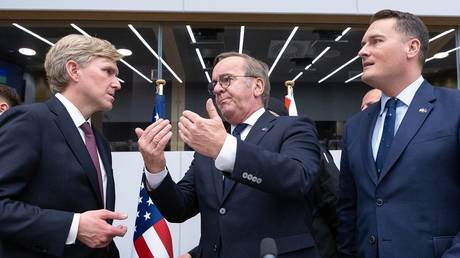
That's not an exaggeration or a leaked memo from some mid-level staffer. On November 17, 2026, at NATO headquarters in Brussels, U.S. Under Secretary of War for Policy Elbridge Colby stood before the 37th meeting of the Ukraine Defense Contact Group and publicly criticized Ukraine's long-range strike campaign inside Russia. He called them "spectacle" strikes designed to inflict pain on Russian civilians rather than win battles. Within hours, German Defense Minister Boris Pistorius and British Defense Secretary Wes Streeting dismantled Colby's argument in front of the press. You might also find this similar coverage insightful: Stop Mistaking Royal Photo Ops for Real UK-India Geopolitics.
If you've been following the war closely, this clash didn't come out of nowhere. It exposes a widening fracture inside the Western alliance over how Ukraine is allowed to fight, what actually breaks Moscow's war machine, and who gets to set the rules when Washington is no longer footing the bill.
What Actually Happened at the Brussels NATO Meeting
Let's look at what Colby actually said, because the exact wording matters. As discussed in recent coverage by The Guardian, the effects are worth noting.
Addressing allies at the Ramstein-format meeting in Brussels, Colby argued that while public attention fixates on "the spectacle of deep strikes designed to incur pain on the Russian population," the Pentagon's assessment is blunt. Those attacks haven't pushed Moscow closer to a negotiated settlement. They haven't slowed Russian troops grinding forward on the front lines.
Colby went further. He singled out Ukrainian drone strikes against Wildberries—Russia's largest online retailer, basically the Russian equivalent of Amazon—as prime examples of counterproductive targeting. According to Colby, hitting commercial logistics hubs has likely hardened Russian public resolve and increased the Kremlin's willingness to escalate. He also warned that in a pure contest of deep strikes, the balance of advantage still favors Moscow.
His prescription was clear. Stop chasing splashy headlines hundreds of miles inside Russia. Focus Western support and Ukrainian drone production on the front lines and mid-range interdiction—cutting off Russian troop supplies right behind the trenches.
The pushback was instant and remarkably unfiltered.
German Defense Minister Boris Pistorius didn't bother with diplomatic softening. Calling U.S. criticism of Ukrainian deep strikes "quite a stupid thing," Pistorius argued that Western leaders should spend their energy condemning Russia's nightly terror bombardments of Ukrainian heating, water, and electrical grids rather than lecturing Kyiv over legitimate strikes on non-civilian targets.
British Defense Secretary Wes Streeting, who co-chaired the gathering alongside Pistorius, backed Germany's stance without hesitation. "It's not for us to tell Ukraine how to fight their war," Streeting told reporters, adding that Ukraine's deep-strike campaign has visibly degraded Putin's war machine, bought time, and saved Ukrainian lives.
Why Ukraine Has Been Hitting Wildberries Warehouses
To understand why a retail giant became the centerpiece of a Pentagon rebuke, you have to look at what happened across Russia between July and November 2026.
Starting on July 18, 2026, Ukrainian long-range drones launched a systematic campaign against Russia's commercial logistics network. Over the next several weeks, drones struck dozens of massive distribution hubs belonging to Wildberries and rival e-commerce platform Ozon. We aren't talking about small neighborhood post offices. Major hubs in Elektrostal and Koledino near Moscow, Aleksin in Tula Oblast, Krasnodar, and Kotovsk were gutted by massive fires. One strike hit a Wildberries depot in Yekaterinburg, more than 2,000 kilometers from the Ukrainian border. By late August, independent Russian outlet Agentstvo reported that Ukrainian strikes had knocked out eight of Wildberries' ten largest logistics centers, wiping out over 81 percent of their combined warehouse space.
On paper, hitting an e-commerce company looks like economic warfare aimed at everyday shoppers. That's certainly how Colby framed it in Brussels.
Kyiv sees it differently, and honestly, the supply-chain evidence backs up why Ukraine put these warehouses in its crosshairs. In wartime Russia, commercial marketplaces aren't strictly civilian. Russian soldiers, volunteer networks, and military units routinely use platforms like Wildberries and Ozon to order tactical gear, drone components, thermal optics, radios, and field equipment delivered straight to logistics hubs near the front. Ukrainian officials contend these warehouses serve as dual-use supply arteries for the Russian military.
There's also a broader strategic logic behind Kyiv's 2026 deep-strike surge. Throughout the year, Ukraine launched more long-range strikes than in the rest of the war combined, targeting oil refineries, airfields, missile units, and logistics centers. When your cities are being pounded every night and your front-line infantry is outnumbered, forcing Moscow to stretch its air defenses across eleven time zones isn't just about "spectacle". Every air defense battery guarding a warehouse near Moscow or an oil refinery in Ryazan is a battery that isn't shooting down Ukrainian drones over Donbas.
The Elephant in the Room Money and Leverage
Here is the part most surface-level news summaries miss. Why did European ministers feel comfortable calling a senior Pentagon official's strategy "stupid" to his face?
Follow the money.
Under President Donald Trump, the United States stopped directly funding new weapons deliveries to Ukraine. Instead, Washington shifted to a model where European allies and Canada pay for additional military packages, including purchasing American-made weapons through programs like PURL. At the very same November 17 Brussels meeting where Colby delivered his lecture, Berlin announced that Germany and Norway were funding a new package featuring U.S. Patriot interceptors, with Germany alone putting up $300 million. Meanwhile, the European Union has been advancing an additional 45 billion euro support package.
When Washington was writing blank checks, Pentagon restrictions carried absolute authority. Now that Europe is paying the tab and Ukraine is building its own long-range drones domestically, the Pentagon's moral and financial leverage has shrunk dramatically. You can't stop paying for the ammunition and still expect to micromanage the target list.
That tension bled directly into another contentious issue at the Brussels meeting—satellite communications. Allies pressed Colby on restrictions affecting Ukraine's access to SpaceX's Starshield network. President Volodymyr Zelensky has warned that limitations on Starshield are actively hindering Ukraine's ability to intercept incoming Russian drones and protect its energy grid heading into winter. Streeting publicly underscored that reliable Starlink and Starshield service is a matter of life and death. Colby dodged specifics after the meeting, repeating only that U.S. policy is aligned around front-line defense and mid-range strikes.
Does the Pentagon Have a Point About Escalation
It would be a mistake to dismiss Colby's warning completely just because Pistorius landed a good soundbite.
Military analysts have debated the effectiveness of strategic bombardment for a century, from the Blitz over London to Allied bombing campaigns in World War II. History shows that hitting infrastructure tied to daily civilian life rarely causes a population to rise up and overthrow its government. More often, it fuels resentment against the attacker and lets state propaganda rally citizens around the flag. In Russia, where the Kremlin controls almost every major television network, burning shopping warehouses are easy to spin as proof that Ukraine is attacking ordinary Russian families.
Colby's second point—resource allocation—also deserves serious scrutiny. Long-range strike drones aren't free. Every deep-strike drone built to fly 1,500 kilometers into Russia consumes electronics, warheads, engineering hours, and launch crews that could otherwise produce tactical FPV drones or mid-range strike systems hammering Russian artillery and supply trucks 30 kilometers behind the front. If Russian infantry are still taking ground in eastern Ukraine while warehouses burn near Moscow, Pentagon planners will naturally ask whether Kyiv is trading tactical survival for strategic theater.
Yet Washington's argument collapses on one glaring flaw. It assumes Russia needs an excuse to escalate.
Moscow has spent years systematically trying to freeze Ukrainian civilians in the dark every winter. Just weeks before the Brussels summit, in mid-October 2026, Russian missile strikes knocked out power to 600,000 people and killed civilians in Kyiv right after Washington claimed an "energy ceasefire" was in the works. Telling Ukraine to avoid hurting Russian commercial morale while Russia obliterates Ukrainian power plants strikes most Europeans—and virtually all Ukrainians—as absurdly one-sided.
What This Split Means for Ukraine's Strategy
Kyiv isn't backing down. Right after the Brussels meeting, Ukrainian officials signaled plans to double drone supplies and triple deep strikes. Because these long-range drones are domestically produced rather than donated by Washington, the Pentagon has no legal veto over where they fly.
For readers trying to track where this conflict heads through the winter of 2026 and into 2027, watch three concrete indicators rather than diplomatic speeches.
First, track whether Ukrainian deep strikes shift back toward pure energy and military targets—like the Ryazan oil refinery and military airfields—or continue hitting commercial logistics hubs like Wildberries and Ozon. If warehouse strikes taper off while refinery attacks surge, it means Kyiv quietly took Washington's warning to heart without admitting it publicly.
Second, watch how fast European funding translates into actual air defense deliveries. The $300 million German-Norwegian Patriot package and proposed EU funds will test whether Europe can truly replace direct U.S. military aid on the battlefield.
Third, keep a close eye on Starshield and intelligence-sharing friction. Even without paying for weapons, Washington still controls critical satellite networks and early-warning intelligence. If the White House uses technical restrictions to enforce its preference for a purely defensive, front-line war, Kyiv's ability to defend its skies could suffer regardless of how loudly London and Berlin protest.