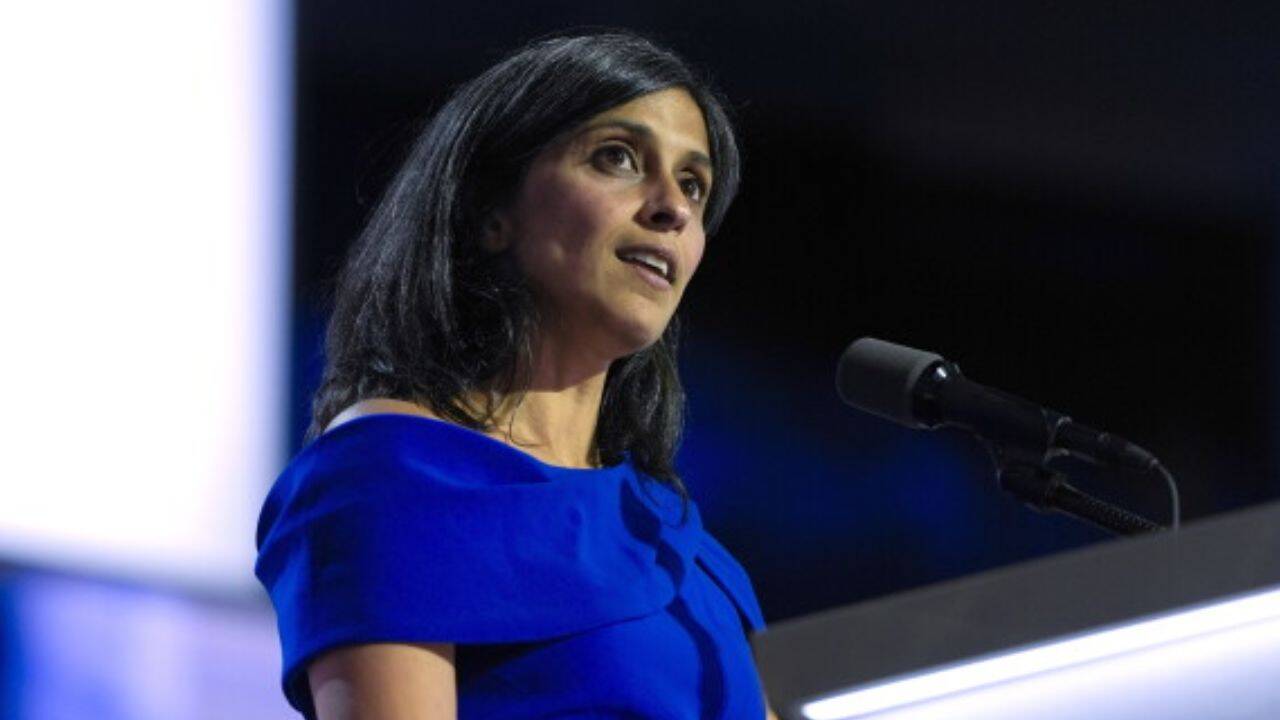
The math of modern domestic life rarely accounts for the fourth child. When public figures step into the spotlight, their personal choices inevitably become flashpoints for broader cultural anxieties. Recently, Usha Vance opened up about the quiet hesitation she experienced before expanding her household to four children, noting how complete her family already felt. That hesitation is not merely a personal anecdote. It is a window into the unspoken economic, psychological, and logistical tipping point that faces contemporary parents who dare to defy the sub-replacement fertility rates sweeping the developed world.
Family structures are shrinking globally. Yet, a subset of high-achieving professionals and political figures continue to buck the trend, choosing larger broods against a backdrop of institutional friction. To understand why someone like Usha Vance would pause before taking that final leap requires examining the collision between modern career demands, the soaring cost of child-rearing, and the psychological weight of tipping a balanced household into chaos.
The Arithmetic of the Fourth Child
Most parents operate on a linear model of domestic scaling. One child is a shock to the system. Two children introduce man-to-man defense. Three children transition a household into zone coverage.
Four children break the math entirely.
Standard infrastructure ceases to function. Standard vehicles no longer fit standard car seats. Housing costs escalate dramatically because the real estate market is engineered for the nuclear baseline of two parents and two or three bedrooms. Usha Vance’s hesitation captures the precise moment a mother calculates these invisible friction points.
Consider the logistical reality. Every subsequent child after three exhibits diminishing returns on existing infrastructure. You cannot hand down clothes indefinitely. You cannot rely on standard ticketing, standard reservations, or standard scheduling. The margin for error shrinks to zero.
When a woman operating at the highest levels of legal scholarship or public visibility contemplates adding that fourth member, she is looking at a profound restructuring of her daily bandwidth. The hesitation is rational. It is an acknowledgment that the margin between thriving and surviving in a large family is razor-thin.
Career Friction and the Elite Dilemma
For high-achieving women, the professional penalty for large families remains steep, regardless of socioeconomic status or political affiliation. Usha Vance navigated elite academic institutions and demanding legal clerkships before her husband's political rise thrust her into an entirely different kind of scrutiny.
The professional world operates on a relentless cadence. Billable hours, court appearances, and corporate strategy do not pause for morning sickness or infant sleep regressions. When a woman reaches the pinnacle of her profession, the decision to step away—even temporarily—carries a heavy opportunity cost.
Society often treats large families among the elite with a mixture of fascination and suspicion. Critics on one side view traditional family structures through a political lens, while critics on the other demand ideological conformity based on fertility choices. Beneath these public projections lies a far simpler, messier human truth. Professional women balancing intense careers must weigh the absolute finiteness of their time against the demands of nurturing multiple human beings from infancy to independence.
The hesitation Usha Vance described speaks directly to the exhaustion of holding two competing worlds together. You cannot outsource the foundational emotional labor of parenting. Every child added to the roster demands an exponential increase in emotional presence. For a working mother, that means cutting into the only remaining reservoir: sleep, personal sanity, or professional ambition.
The Cultural Anxiety Around Family Size
Why does the public care how many children a political spouse has? Because fertility has become a proxy war for competing visions of the future.
In an era of demographic decline across the United States, Europe, and East Asia, birth rates are plummeting below replacement levels. Economists sound alarms about shrinking labor pools and unsustainable entitlement programs. Cultural commentators fret over the atomization of society. Against this macro-level panic, individual choices regarding family size are hyper-politicized.
When a prominent public figure has four children, cultural observers project their own anxieties onto the nursery. To some, it is a statement of demographic defiance. To others, it is an impossible standard out of reach for average citizens crushed by housing costs and stagnant wages.
Usha Vance's admission of hesitation punctures the glossy perfection often associated with large families in political media. By admitting she hesitated, she normalizes the doubt. She strips away the political narrative and exposes the raw, universal friction of modern parenting. Deciding to bring another life into the world should involve hesitation. It requires confronting the reality that you are fundamentally altering the ecosystem of your home.
The Emotional Calculus of Completion
The phrase Usha Vance used—"my family felt so complete"—touches on the most elusive aspect of family planning. How do you know when you are done?
For many, the number is arbitrary. For others, it is dictated by biology, economics, or sheer exhaustion. But the feeling of completion is psychological. It is the quiet realization that the empty spaces at the dinner table are filled, that the chaotic symphony of childhood has reached its optimal arrangement.
Adding a fourth child when you already feel complete requires a leap of faith against the evidence of your own contentment. Why disrupt a functioning ecosystem? Why court chaos when peace is finally within reach?
The answer lies in the unpredictable nature of love and family dynamics. The child who was initially met with hesitation often becomes the emotional anchor of the household later on. Human beings are remarkably adept at expanding their capacity for attachment, even when their logistical capacity is maxed out.
The conversation sparked by Usha Vance's reflection goes beyond politics or celebrity culture. It exposes the quiet negotiations happening behind closed doors in millions of homes. It highlights the tension between what we can logically manage and what we ultimately choose to embrace, reminding us that the most significant life transformations rarely begin with certainty. They begin with a pause, a deep breath, and a willingness to step into the unknown.