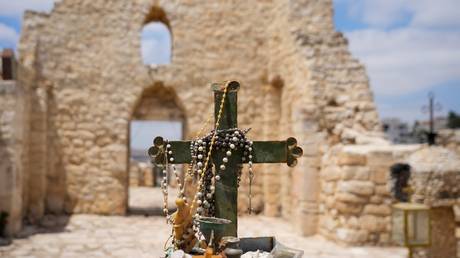
The iron key in Elias’s pocket is heavy, smooth from a century of thumbs pressing against its bit. It doesn't just open a door; it holds back a tide. For six generations, his family has lived within a stone’s throw of the Holy Sepulchre, in a house where the walls are thick enough to swallow the sound of the modern world. But lately, the walls feel thinner. The air in the Christian Quarter of Jerusalem has changed. It tastes of dust and urgency.
Elias is a hypothetical man, but his anxiety is a cold, documented reality. He represents a community that has survived empires, crusades, and plagues, only to find itself staring at a new kind of erasure. This isn't a story about religion alone. It is a story about the physical ground beneath a people’s feet—and how quickly that ground can be remapped until the people standing on it simply disappear.
When the head of a major NGO recently warned that Israeli settlement expansion in East Jerusalem could spell the "end" for Holy Land Christians, the world heard a political soundbite. But for those living in the shadow of the limestone arches, it wasn't politics. It was a property deed. It was a crane. It was the slow, methodical silencing of a bell that has rung since the Byzantines.
The Mathematics of Displacement
To understand the stakes, you have to look past the incense and the icons. You have to look at the maps.
Jerusalem is a city of invisible lines. Since 1967, the expansion of Israeli settlements in East Jerusalem has been a steady drumbeat. For the Christian community, which now makes up less than 2% of the population in the Holy Land, the pressure is asymmetrical. It isn't just about big housing developments on the outskirts; it is about the "micro-settlement" within the Old City itself.
Consider the New Imperial Hotel and the Petra Hotel. These aren't just buildings. They are the gateway to the Christian Quarter. When extremist settler organizations acquire these strategic properties through complex, disputed legal maneuvers, the heart of the community is pierced. Suddenly, the path pilgrims take to reach the most sacred sites in Christendom is lined with a different flag. The demographic gravity shifts.
When a hotel becomes a settlement, the neighborhood doesn't just change its "vibe." It changes its infrastructure. Security cameras multiply. Armed guards appear on rooftops. For a family like Elias’s, the simple act of walking to the bakery becomes a navigation of checkpoints and stares.
Pressure. Constant, low-grade pressure.
The Exodus of the Living Stones
The term "Living Stones" is often used to describe the indigenous Christians of the Middle East. It’s a beautiful metaphor, suggesting they are the vital, breathing part of the ancient architecture. But stones can be crushed.
The crisis isn't always a sudden eviction. Usually, it’s a slow bleed. It’s the realization that your children have no future here because they cannot get a permit to build an extra room for a growing family. It’s the rising cost of living driven by a lopsided economy. It’s the feeling of being a guest in your own ancestral home.
Logic dictates that when life becomes untenable, people move. They take their degrees, their crafts, and their children to Amman, London, or Detroit. And as they leave, the "Living Stones" are replaced by silent, literal stones—monuments and museums that tell a story of the past while the present is hollowed out.
If the settlements continue to tighten their grip around the Old City and the Mount of Olives, the Christian presence risks becoming a "Disney-fied" version of itself. You’ll have the churches, yes. You’ll have the priests to perform the rites. But the vibrant, local community—the scouts, the schoolteachers, the tailors—will be gone. A church without a congregation is just a tomb.
The Invisible Stakes
Why does this matter to someone sitting thousands of miles away?
Because the Holy Land is the world’s most delicate ecosystem of shared history. For centuries, a fragile status quo has governed how different faiths interact, move, and exist in these few square miles. Settlements don't just add houses; they subtract balance. They are an ideological assertion of "mine" in a city that has always survived best when it belonged to "us."
The NGO warnings focus on the "E1" corridor—a strip of land between East Jerusalem and the Ma’ale Adumim settlement. If built upon, this would effectively bisect the West Bank and cut off Jerusalem from its Palestinian hinterland. For Christians in Bethlehem, just five miles away, Jerusalem would become a distant planet.
Imagine being a father in Bethlehem. Your church is in Jerusalem. Your grandmother is in a hospital in Jerusalem. But a wall, a settlement, and a permit system stand between you. The physical separation creates a psychological chasm. Over time, the connection frays. The identity of the "Holy Land Christian" breaks into isolated pockets, too small to sustain themselves, too weary to resist the urge to migrate.
The Sound of Silence
Elias stands on his roof at dusk. From here, he can see the cranes. They look like prehistoric birds, pecking away at the skyline, rearranging the geometry of his world.
He hears the Muezzin's call to prayer from a nearby minaret. He hears the chanting of Jewish worshippers at the Western Wall. And then, he hears the bells of the Holy Sepulchre. It is a polyphony—a chaotic, beautiful, ancient argument of sounds.
But what happens when one of those voices grows too thin to be heard?
The end of Holy Land Christians wouldn't be a single, cataclysmic event. It would be a quiet disappearance. It would be the closing of a small grocery store because the owner's son moved to Chile. It would be the turning of a family home into a boutique hotel for tourists who don't know the name of the people who lived there for four hundred years.
The threat of settlements isn't just about who lives in which house. It’s about the erasure of a pluralistic reality. It’s about the transformation of a living city into a nationalist trophy.
The warning has been issued. The maps are being redrawn. The keys are getting heavier in the pockets of those who remain.
If the bells stop ringing, it won't be because the metal broke. It will be because there was no one left who knew how to pull the rope.