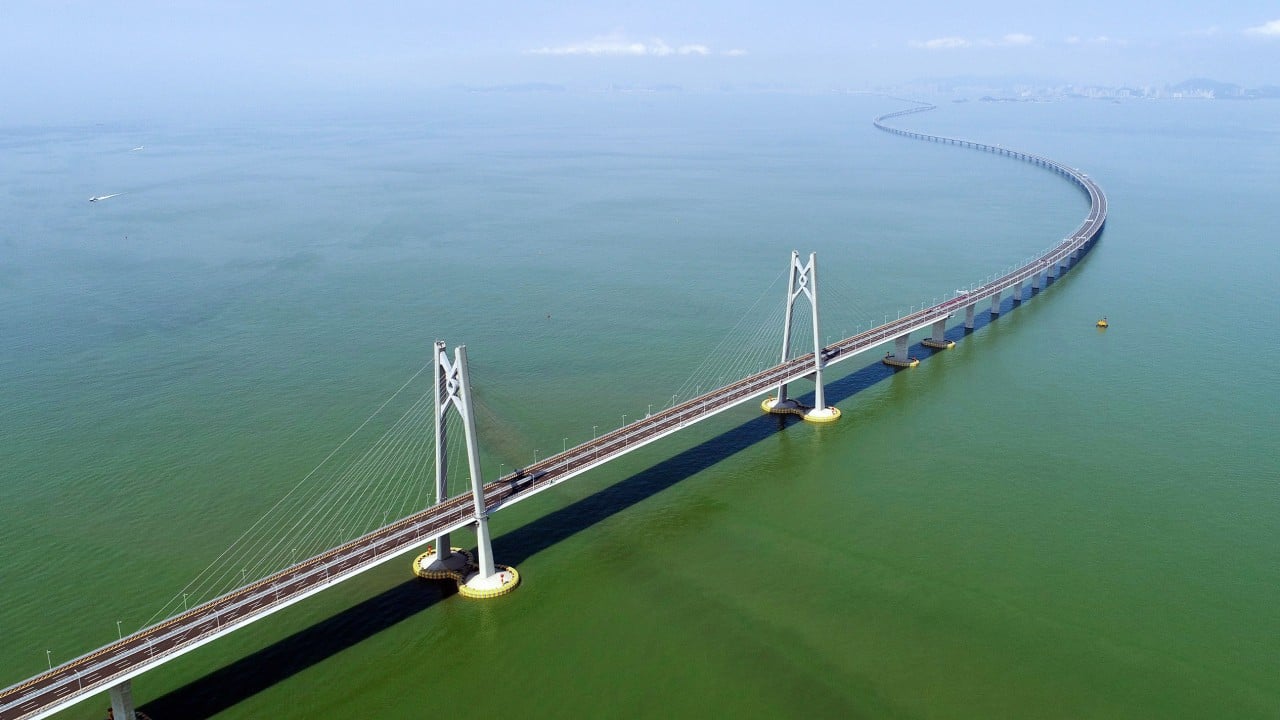
The horizon out near the Pearl River Delta rarely offers a clean line. It is a gray smudge where industrial haze bleeds into the South China Sea, sliced through by monumental engineering. For miles, drivers sweep across suspension spans and plunge into subterranean tubes, crossing the Hong Kong Zhuhai Macao Bridge—the longest sea-crossing bridge on earth. To the commuter, it is a marvel of modern steel. To anyone standing on its wind-scoured shoulders at midnight, it is a high-altitude precipice suspended between two different worlds.
Then, the radio crackles.
A passenger is missing.
Not a container ship slipping its moorings. Not a stray pallet of cargo. A person. Out there, somewhere beneath the cavernous arches of the mega bridge, a life has slipped through the geometry of concrete and international waters.
I know the weight of that gray water. I have stood on the decks of ferries plying these exact shipping lanes, watching the whitecaps froth against the hull, feeling the deceptive vastness of an ocean that looks calm from a distance but churns with invisible undercurrents. When you look down from a high vantage point at sea, distance plays cruel tricks on the eye. Heights distort scale. A human form against the vast canvas of the sea is nothing more than a punctuation mark, easily missed, swiftly swallowed.
Search operations do not begin with sirens. They begin with silence.
The immediate protocol is a desperate scramble of coordinates and jurisdiction. The Hong Kong-Zhuhai-Macao Bridge is a bureaucratic labyrinth as much as a physical one. Spanning boundaries that separate Hong Kong, Guangdong, and Macao, an incident here immediately triggers a complex choreography between maritime rescue services, marine police, and aviation units.
Consider what happens next: the call comes in, and time fractures.
Coast guard vessels pivot in the dark, their searchlights slicing long, sterile cones across the choppy surface. Helicopters thrum overhead, rotor wash whipping the dark water into a frenzy of spray. Every second counts, yet every second stretches like rubber. The core facts are stark and terrifyingly brief. A person went overboard or disappeared from a vehicle on the structure. A search is underway. That is what the news bulletins flash across screens in high-rise apartments across Kowloon and Central.
But statistics do not bleed.
Behind the breaking alert lies a sequence of fragmented moments. A car pulling over to the emergency lane. A door opening to the howling maritime wind. A sudden, irreversible decision or a tragic, careless slip. The bridge stands as a monument to human ambition, designed to conquer distance and unite populations in a seamless commute. Yet, vulnerability clings to its towering pylons like salt crust.
We build colossal structures to master our environment, forgetting how small we remain within it.
When a passenger vanishes off a mega bridge, the investigation immediately confronts the paradox of modern surveillance. These spans are choked with high-definition cameras, automated license plate readers, and security sensors. Every inch is watched. And yet, blind spots exist. The human element always finds the gap between the lens and the dark.
Marine rescue coordinators lean over glowing monitors, tracking vessel traffic service logs and thermal imaging feeds. They look for anomalies in the water, a floating signature, a thermal trace against the cold tide. Tidal currents in these waters are notoriously fickle, driven by the discharge of the Pearl River and pushed by the South China Sea winds. A body or a struggling swimmer does not stay put. They drift. They become part of the relentless flow.
This is where expertise meets the cold reality of maritime search and rescue. The survival window in open water is brutally narrow, dictated by water temperature, wind chill, and the sheer physical exhaustion of treading water against an indifferent tide. Hypothermia does not wait for bureaucratic clearance. It sets in quietly, numbing limbs, slowing breath, pulling a person under long before the search grid is fully mapped.
People often ask how someone could simply vanish from a heavily monitored engineering marvel. The answer is both simple and deeply unsettling. Scale. The Hong Kong Zhuhai Macao Bridge stretches over fifty kilometers. It is a horizon unto itself. When you stand on it, you are isolated by altitude and noise. The roar of heavy freight trucks masks everything else. A person can step away from a vehicle, and to the rest of the world, they simply cease to exist within seconds.
The search teams press on through the night, cutting through the swells, their radios broadcasting updates that grow heavier with every passing hour. Hope does not vanish all at once; it erodes. It chips away with every sector cleared, with every empty square mile of ocean logged as negative.
By morning, the sun will rise over the delta, burning through the smog to reveal a bustling artery of global commerce. Cargo ships will glide beneath the spans. Commuters will sip coffee in buses racing above the waves, entirely unaware of the ghost ship ghosts sweeping the waters below them.
The bridge remains. The traffic flows. But out on the water, the search continues, a quiet testament to the enduring weight of a single, missing human life against the deafening roar of progress.


