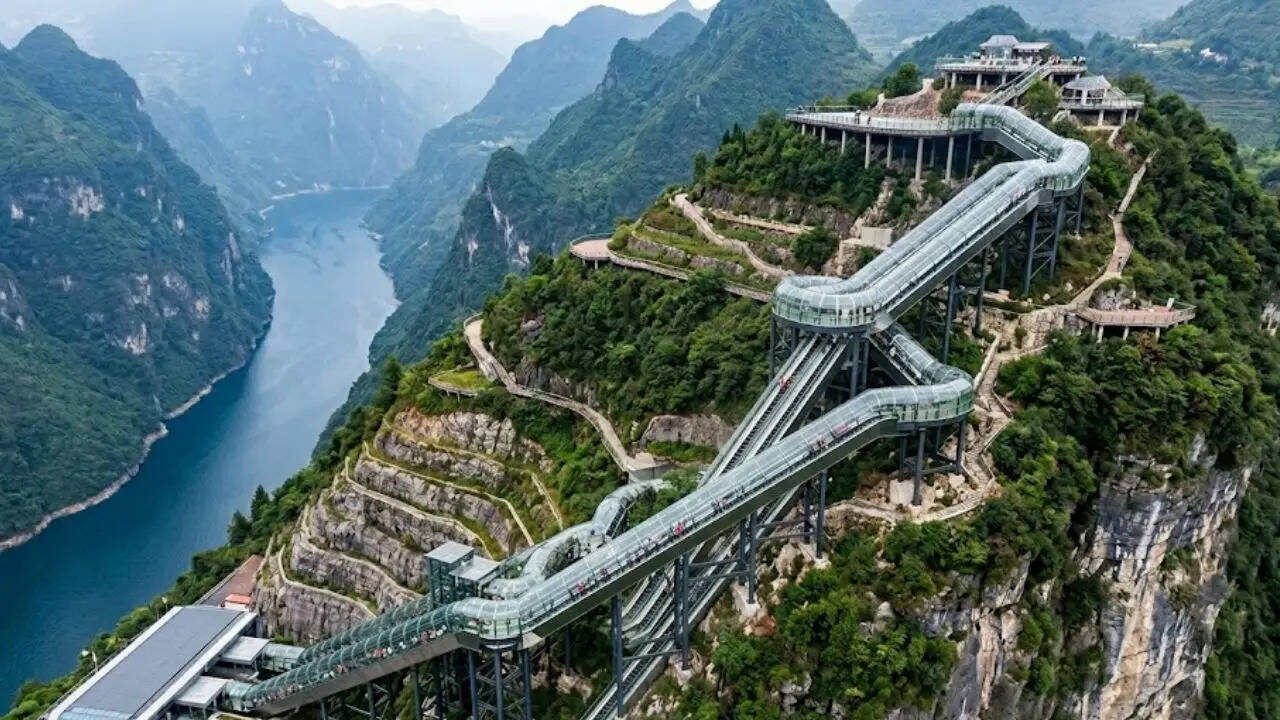
The Tianshan "Sky Ladder" in China’s Hunan Province represents a shift from traditional scenic hiking to high-throughput vertical logistics. Spanning 905 meters in length and ascending a vertical rise equivalent to an 80-story building, this infrastructure project is a case study in managing human flow through extreme terrain. While public discourse focuses on the novelty of a mountain-side escalator, the true value lies in its role as a bottleneck-removal system for high-density tourism.
The Kinematic Efficiency of Continuous Motion
Traditional mountain transport relies on discrete systems: cable cars, funnels, or shuttle buses. These systems are limited by "batch processing"—passengers must wait for a vehicle to arrive, load, and depart. This creates high variance in wait times and periodic surges in crowd density.
The Tianshan escalator operates on a continuous motion principle. By providing a constant stream of available "slots" (steps), the system eliminates the queuing variance found in cable car stations. To calculate the theoretical capacity ($C$) of such a system, one must consider the step width, speed, and safety spacing:
$$C = \frac{v \cdot 3600}{d} \cdot n$$
Where:
- $v$ is the velocity in meters per second.
- $d$ is the depth of each step.
- $n$ is the number of passengers per step (usually capped at 1 or 1.5 for safety in outdoor environments).
At a standard speed of 0.5 meters per second, the Sky Ladder provides a relentless throughput that a fleet of buses cannot match. This transforms the mountain from a series of congested viewpoints into a fluid, high-velocity transit corridor.
Structural Integrity in High-Gradient Environments
The engineering challenges of a 905-meter escalator are primarily related to tension management and environmental exposure. In a standard indoor escalator, the weight of the step chain is manageable. On a mountain slope, gravity exerts a massive axial load on the drive system.
The Problem of Chain Elongation
Over a 905-meter run, the cumulative weight of the steel steps and the chain itself creates significant tensile stress. Engineers solve this by segmenting the climb. The Sky Ladder is not a single continuous belt; it is a series of 16 interconnected stages. This segmentation serves three purposes:
- Distributed Load: Each motor only manages the weight of its specific section.
- Redundancy: If one segment requires maintenance, the entire system does not necessarily fail, provided there is a pedestrian bypass.
- Thermal Expansion: Outdoor steel structures expand and contract. Segmented joints absorb this movement without warping the guide rails.
Environmental Hardening
The Tianshan range is subject to high humidity, heavy rainfall, and freezing temperatures. Standard escalator components would succumb to oxidation or mechanical seizure within months. The Sky Ladder utilizes specialized drainage channels integrated into the truss structure to divert rainwater away from the electrical components. Furthermore, the use of high-friction, weather-resistant materials on the handrails and steps is a prerequisite for safety when the system operates at a 30-degree incline in wet conditions.
The Economic Logic of the 20-Minute Ascent
The primary value proposition of the escalator is the compression of time. A physical climb of 80 stories (approximately 240 to 300 meters of vertical gain) typically requires 60 to 90 minutes for a person of average fitness, accounting for fatigue-induced pauses. The escalator reduces this to 20 minutes, regardless of the user's physical condition.
This 70% reduction in transit time has a direct impact on the site’s "dwell time" economics. By moving visitors through the ascent phase faster, the facility can increase its total daily capacity.
- Total Daily Throughput: By reducing the time spent in transit, the site can accommodate more "cycles" of tourists within a 10-hour operating window.
- Monetization of Energy: Physical exhaustion is a deterrent to spending. A tourist who arrives at the summit fresh and energized is more likely to engage with secondary services (photography, food, retail) than one who arrives in a state of physical distress.
- Accessibility Expansion: The system broadens the demographic reach of the site. It converts a "difficult hike" into a "scenic experience," capturing segments of the market—seniors and families with small children—that were previously excluded from high-altitude views.
The Mechanical Cost of Verticality
While the benefits are clear, the operational expenditure (OPEX) of such a system is substantial. Vertical transport is an energy-intensive endeavor. Unlike a funicular, where a descending car can partially counterweight an ascending one, an escalator must overcome gravity through raw motor power.
The energy consumption ($P$) of each segment can be modeled as:
$$P = \frac{(m_l + m_s) \cdot g \cdot v \cdot \sin(\theta)}{\eta}$$
Where:
- $m_l$ is the live load (passengers).
- $m_s$ is the dead load (steps and chain).
- $g$ is the gravitational constant.
- $\theta$ is the angle of inclination.
- $\eta$ is the mechanical efficiency of the drive.
The "dead load" of the escalator remains constant whether one person or fifty people are on it. This means the system is least efficient during low-traffic periods. Sophisticated sensors are used to implement a "sleep mode," slowing the motor to a crawl when no passengers are detected, thereby reducing wear and power consumption.
Risk Vectors and Mitigation
Any system of this scale introduces specific failure modes that require rigorous management.
- The "Slinky" Effect: If a segment stops abruptly due to an emergency brake, the momentum of passengers can cause a pile-up. The control software must synchronize deceleration across all 16 segments to prevent localized crowding at the transition points.
- Debris Infiltration: In a mountain environment, stones, leaves, and twigs frequently land on the steps. If these enter the "comb plate" (the interface where the steps disappear into the floor), they can cause a mechanical jam. High-frequency cleaning and specialized brushes on the side skirts are necessary to maintain uptime.
- Human Behavior: The 20-minute duration creates a psychological challenge. Unlike a 30-second mall escalator ride, 20 minutes on a moving belt can lead to boredom-induced lapse in safety awareness. Constant audio-visual reminders and physical barriers are required to ensure passengers remain standing and holding the rails.
Strategic Integration of Infrastructure
The Tianshan Sky Ladder is not merely a transport tool; it is a strategic asset that dictates the flow of the entire Hunan tourism corridor. By solving the verticality problem, the developers have shifted the bottleneck from "the climb" to "the summit."
Future developments in this space will likely focus on regenerative braking—capturing energy from descending escalators to power ascending ones—and the integration of AR-enhanced viewing stations along the 20-minute transit path to further monetize the transit time itself. The goal is to transform the "wait" into the "product."
To optimize a site with this technology, operators must prioritize "synchronized throughput." The capacity of the descent mechanism (whether it be another escalator, a slide, or a bus) must be perfectly calibrated to the 20-minute delivery rate of the Sky Ladder. Failure to do so will simply move the congestion from the bottom of the mountain to the top, neutralizing the efficiency gains of the hardware. Success in high-altitude tourism now depends as much on industrial engineering as it does on natural beauty.