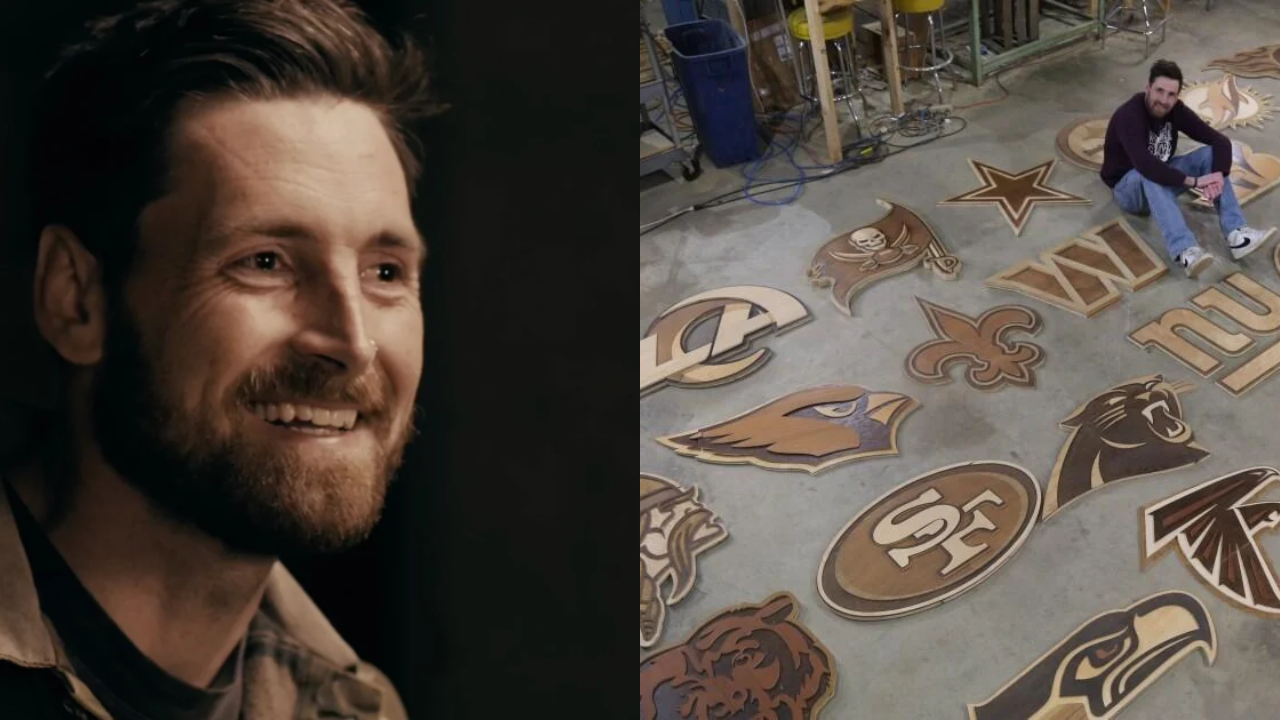
Everybody loves a feel-good viral story until someone has to pay the electric bill.
Right now, local news outlets and social media feeds are tripping over themselves to applaud a Wisconsin woodworker who spent 700 hours turning discarded roadside pallets and scrap timber into all 32 NFL team logos. The headlines follow the exact same lazy script: Man finds trash, applies grit, creates sports magic. The comment sections are flooded with people asking where they can buy one and praising his old-school work ethic.
Here is the cold water nobody wants to drink: spending 700 hours on a single project using reclaimed scrap is not a triumph of craftsmanship. It is a cautionary tale in terrible unit economics, hidden material costs, and walking straight into an intellectual property buzzsaw.
I have spent over a decade consulting for custom fabrication shops, boutique furniture makers, and independent makers trying to turn viral hobbies into real livelihoods. I have watched dozens of talented builders bankrupt themselves chasing this exact type of internet applause. They confuse "viral attention" with "viable business," and they treat their own labor as if it costs zero dollars an hour.
Let’s dismantle the romantic myth of the 700-hour roadside wood project—and look at what actually happens when you strip away the nostalgia and run the real numbers.
The Lie of "Free" Roadside Wood
The hook of the story relies on a seductive premise: the raw materials were free. Trash turned into treasure. Zero overhead.
Anyone who has actually run reclaimed lumber through a workshop knows that "free" wood is the most expensive wood you can possibly source.
When you buy kiln-dried, surfaced-four-sides (S4S) hardwood from a reputable lumber mill, you pay for predictability. You know the moisture content sits around 6% to 8%. You know the boards are flat, square, and free of hidden hardware. You take the board off the rack, put it on your miter saw, and start building.
Roadside scrap and discarded pallets are the exact opposite. Before you make a single decorative cut on a Green Bay Packers "G" or a Dallas Cowboys star, you are paying a massive tax in prep time and ruined tooling:
- The Nail Tax: Reclaimed wood hides rusted brads, staples, and broken screws deep inside the grain. One missed piece of metal will chip a $120 carbide-tipped saw blade or chew up a set of helical planer inserts in a tenth of a second.
- The Milling Penalty: Roadside timber is cupped, bowed, twisted, and saturated with ambient moisture. Bringing rough, uneven scrap to a uniform thickness requires hours of jointing, planing, and sticker-stacking to let the wood acclimate so it doesn't warp and tear itself apart three months after you glue it up.
- Chemical Roulette: Pallets left on the side of the road aren't always heat-treated (stamped "HT"). Many are fumigated with methyl bromide or soaked in spilled industrial solvents, hydraulic fluid, and road salt. Sanding that down without a P100 respirator and commercial dust extraction isn't rustic—it's toxic.
When you factor in blade replacements, sandpaper consumption, electricity, glue, finishes, and the sheer hours spent denailing and milling, that "free" wood costs more per board foot than cabinet-grade walnut.
The Brutal Math of 700 Hours
Let’s look at the number everyone is celebrating: 700 hours.
Divide 700 hours by 32 logos. That averages out to 21.875 hours per team logo.
To put that in perspective, 700 hours is 17.5 full-time, 40-hour workweeks. That is over four months of full-time labor dedicated to a single collection.
Now, put a price tag on that time. In the United States, a skilled finish carpenter or custom woodworker needs to bill between $50 and $85 per hour just to cover shop overhead, insurance, tool depreciation, taxes, and a modest middle-class wage.
Let's be generous and value his labor at the absolute floor of skilled trade work: $40 an hour.
- 700 hours × $40/hour = $28,000 in labor alone.
- Add $1,500 in consumables (glue, stains, clear coats, sandpaper, saw blades, router bits, electricity).
- Total baseline cost to produce the set: $29,500.
- Cost per individual logo just to break even: $921.88.
Now ask yourself a brutally honest question: how many people commenting "Shut up and take my money!" on a Facebook post are actually going to wire $950 plus $120 in freight shipping for a rustic Chicago Bears wall hanging?
Almost none.
I’ve seen this movie play out dozens of times. A maker goes viral. Their inbox explodes with 4,000 messages asking, "How much for a Chiefs one?" The maker quotes $800—which barely covers their time—and 99.8% of those enthusiastic commenters vanish into thin air because they expected it to cost $75 at HomeGoods.
If the builder drops the price to $250 to actually move inventory, they are effectively paying themselves $10.70 an hour before taxes and expenses. You can make more money flipping burgers in Wisconsin without risking a kickback injury on a table saw.
The 800-Pound Gorilla: NFL Trademark Law
Even if a wealthy collector stepped forward tomorrow and offered $50,000 for the entire 32-piece collection, the builder couldn't legally cash the check.
The NFL is arguably the most aggressive protector of intellectual property on planet Earth. Every single one of those 32 logos—the shield, the typography, the specific colorways, the silhouettes—is a federally registered trademark owned by NFL Properties LLC.
There is a persistent, dangerous myth among garage makers and Etsy sellers that if you make something by hand out of reclaimed materials, it qualifies as "folk art" or "transformative use."
That is completely false.
Under the Lanham Act (15 U.S.C. § 1051 et seq.), trademark infringement occurs the moment you use a protected mark in commerce in a way that creates a likelihood of confusion regarding sponsorship, affiliation, or endorsement. Making a logo out of barn wood instead of injection-molded plastic does not make it transformative. If you sell it, raffle it off, or even use it as promotional bait to drive traffic to a commercial woodworking page, you are infringing.
Imagine a scenario where this Wisconsin woodworker decides to capitalize on his viral fame by opening custom orders for five logos a month. Within weeks, an automated brand-protection crawler flags his listings. He receives a cease-and-desist letter demanding he surrender all inventory, hand over every dollar of gross revenue, and pay statutory damages.
You can make all 32 NFL logos for your own basement wall. You can give them away to your buddies as birthday gifts. The second you attach a price tag to them, you aren't an entrepreneur—you are an unlicensed manufacturer operating in the crosshairs of a multi-billion-dollar legal department.
The Trap of "Sweat Equity" Worship
Why do media outlets love stories like this so much? Because hustle culture has trained us to measure value by suffering rather than efficiency.
If a guy spent 700 hours digging a trench with a teaspoon instead of renting a mini-excavator for $300 for a single afternoon, we wouldn't call him an inspiring visionary. We would question his judgment. Yet in the maker space, wasting hundreds of hours doing manual scroll-saw work that a $4,000 CNC router could cut with higher precision in 18 minutes is treated as a badge of honor.
Here is the nuance the feel-good articles miss: there is a massive difference between a therapeutic hobby and a scalable craft.
If this Wisconsin builder spent 700 hours in his garage because he loves the smell of sawdust, enjoys listening to sports radio while sanding, and wanted a monumental personal challenge to keep his hands busy during a brutal Midwest winter, good for him. As a personal hobby, the return on investment is measured in mental clarity, pride, and a killer man-cave centerpiece. On those terms, it is an unqualified success.
The problem starts when onlookers—and sometimes the makers themselves—mistake a labor-of-love hobby for a business blueprint.
How Real Makers Turn Scrap Into Profit
If you are a woodworker, metalworker, or artisan watching this story and wondering how to actually make money without working yourself into an early grave, you have to invert the entire approach.
1. Stop Building Custom One-Offs From Scratch
Profit in woodworking comes from batching and jigs. If you spend 20 hours figuring out the geometry, angles, and stain formulas for one piece, you must build 50 of them at the exact same time to amortize that setup cost. Cut all 50 bases at once. Mill all 400 accent strips in one afternoon. Spray finish in a single batch. What takes 22 hours for one unit drops to 45 minutes per unit at scale.
2. Ditch Trademarked Logos for Original Geometry
Never build your livelihood on someone else's intellectual property. The makers clearing six figures in custom wall art aren't copying sports logos; they are building original topographic lake maps, custom architectural acoustic panels, mid-century geometric headboards, and bespoke river tables. You own the design, you control the pricing, and nobody can shut down your storefront overnight.
3. Price for Margin, Not Hourly Survival
Stop calculating prices based on "how much did the wood cost me?" Price based on value, scarcity, and overhead. If your material cost is $30 and it takes you four hours to build, a $150 price tag will starve you. You need to target a minimum 60% to 70% gross margin after accounting for every minute of labor, shop rent, insurance, and marketing. If the market won't pay what the piece needs to cost, change the product—don't slash your own wages.
4. Use Tech to Do the Grunt Work
Purists love to sneer at CNC routers and laser cutters, claiming they "aren't real woodworking." Meanwhile, the shops using CNCs to handle rough-cutting and repetitive joinery are profitable, debt-free, and spending their time on high-value hand-finishing rather than destroying their wrists on a scroll saw. Let machines do the repetitive labor; save human hands for the details machines can't replicate.
The Real Takeaway
To be clear, there is a downside to looking at every creative endeavor through a cold financial lens. If everyone optimized strictly for profit margins and efficiency, nobody would ever build a ship in a bottle, restore a rusted-out 1968 Mustang that costs twice what it's worth, or spend four months piecing together 32 football logos out of roadside pallets. The world needs people who do absurdly difficult things simply because they want to see if they can pull it off.
Just don't confuse a passion project with a paycheck.
Admire the patience. Respect the persistence. Marvel at the finished wall. Just keep your wallet in your pocket and never, ever try to replicate those 700 hours if you actually need to make a living.