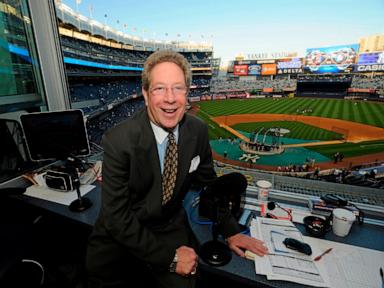
The static comes first. It is a thin, scratching hiss that mimics the sound of a needle on a record or the wind whipping across a parking lot in Flushing. Then, a voice cuts through the haze—baritone, operatic, and impossibly theatrical. It sounds like velvet soaked in bourbon and history. For sixty years, that sound was the signal that the day’s labor had ended and the evening’s drama had begun.
John Sterling didn’t just call baseball games. He curated a private universe for millions of people who never met him but knew the exact timbre of his joy. When news broke that he had passed away at 87, it wasn't just the loss of a broadcaster. It was the silencing of a rhythmic pulse that had beaten through 5,061 consecutive games.
Think about that number. Five thousand. Sixty-one.
It is a figure that defies the frailty of the human body. It ignores the common cold, the death of relatives, the exhaustion of cross-country flights, and the simple, universal urge to just stay in bed on a rainy Tuesday in May. For decades, Sterling was the most reliable thing in New York City—more dependable than the subway, more consistent than the weather, and more permanent than the skyline.
The Architecture of a Home Run
To understand why Sterling mattered, you have to look past the box scores. You have to look at the way a city breathes.
On a sweltering July night, a delivery driver is idling in a double-parked van on 161st Street. A grandmother is sitting on a fire escape in Washington Heights with a small transistor radio perched on her knee. A hedge fund manager is stuck in a town car on the FDR Drive. They are all tuned to the same frequency. They are all waiting for the moment when the air leaves Sterling’s lungs in a violent, melodic burst.
"It is high! It is far! It is gone!"
It was a scripted liturgy. Every player had a catchphrase, a personalized verbal trophy. "Bernie goes boom!" "The Melkman delivers!" "A-Bomb from A-Rod!" To the critics—and there were many—these calls were over-the-top, occasionally inaccurate, and shamelessly "homerish." They missed the point. Sterling wasn't a stenographer. He was an entertainer. He understood that baseball is a long, often boring slog punctuated by moments of electric grace. His job was to bridge the boredom with personality.
He was the last of the grandstanders. He belonged to an era of broadcasting where the men behind the mic were as famous as the men at the plate. He didn't use a laptop. He didn't obsess over launch angles or exit velocity or the cold, hard mathematics of Sabermetrics. He used his eyes, his gut, and a flair for the dramatic that felt like it belonged in a Broadway playhouse rather than a concrete stadium.
The Invisible Stakes of a Long Season
Baseball is the only sport that mirrors the actual pace of life. It happens every day. It is a grind. Because of this, the broadcaster becomes a member of the family. You spend more time with John Sterling in a summer than you do with your own cousins.
When he missed a few games toward the end of his career due to illness, the silence was deafening. It felt like a gear had slipped in the city's clockwork. When he finally retired in April of 2024, citing the heavy toll of travel and the simple reality of being 85 years old, there was a collective realization that a specific kind of magic was vanishing.
We often think of sports as a series of highlights. We remember the walk-off hits and the championship rings. But the "invisible stakes" of Sterling’s career were found in the 4th inning of a blowout loss in August. Those are the moments when a broadcaster earns their keep. He had to keep you listening when the game was terrible. He did it by telling stories, by singing snatches of show tunes, and by being a curmudgeon about the "modern game" in a way that felt like your grandfather complaining about the price of eggs.
He was a link to a lost world. Sterling grew up in an era when the radio was the centerpiece of the American living room. He carried that sensibility into the digital age. Even as fans began watching games on high-definition smartphones, they would often mute the television and turn on the radio. They wanted the picture from the screen but the soul from the speakers.
The Man Behind the Baritone
Behind the grandiosity was a man who lived for the work. John Sterling didn't have a traditional family life in his later years; the New York Yankees were his family. The stadium was his home. The players were his brothers and sons.
There is a specific kind of loneliness that comes with being a traveling broadcaster. It is a life of hotel rooms, airport security, and midnight meals in cities you don't recognize. Sterling embraced it. He thrived on the routine. He once famously said that he never got tired of the travel because he was "going to the ballpark."
That simplicity is rare. Most of us spend our lives looking for the exit, waiting for the weekend, or planning for the next thing. Sterling was always exactly where he wanted to be. He was a man who found his purpose in a three-and-two count and a cold breeze blowing out toward right field.
His mistakes were part of the charm. Sometimes he’d call a fly ball a home run, only to have to correct himself when the outfielder caught it at the track. "I am sorry," he would say, his voice dripping with genuine sheepishness. "I put it in the seats."
Those errors humanized the legend. In an age of polished, robotic, corporate-approved broadcasting, Sterling was wonderfully, flagrantly human. He was a reminder that it’s okay to be wrong if you are being passionate. He was a reminder that the joy of the game is more important than the precision of the data.
The Final Out
When a person like John Sterling dies, we mourn the man, but we also mourn ourselves. We mourn the versions of us that sat in the backseat of a car in 1996 listening to him scream as the Yankees won their first World Series in a generation. We mourn the quiet nights in the kitchen when his voice was the only company we had.
He represented a continuity that is increasingly hard to find. The world changes. Players are traded. Stadiums are torn down and replaced with glass-and-steel monstrosities. But for thirty-six years, if you turned the dial to the right spot, John Sterling was there.
He was the narrator of our summers.
The silence that follows his passing isn't just the absence of noise. It is the end of a long, beautiful sentence that started in the late eighties and didn't stop until the very last out. The "Yankees win! Theeeeeee Yankees win!" call won't echo through the stadium speakers anymore, but it doesn't need to. It is already etched into the limestone of the city itself.
Imagine a kid today, picking up a ball for the first time. They won’t know the man, but they will eventually hear the recordings. They will hear that booming voice and realize that baseball isn't just a game of stats and strikes. It is a story. It is a theater. And every once in a while, it requires a master storyteller to make us believe that a ball flying into the night sky is the most important thing in the world.
The sun has set on the Bronx. The stadium lights are dimmed. The microphone is unplugged. But somewhere, in a corner of the collective memory of every New Yorker, the "Master of the Mic" is still leaning back, checking his scorecard, and getting ready for the first pitch.
"The pitch... swung on and drilled!"
The rest is just echoes.