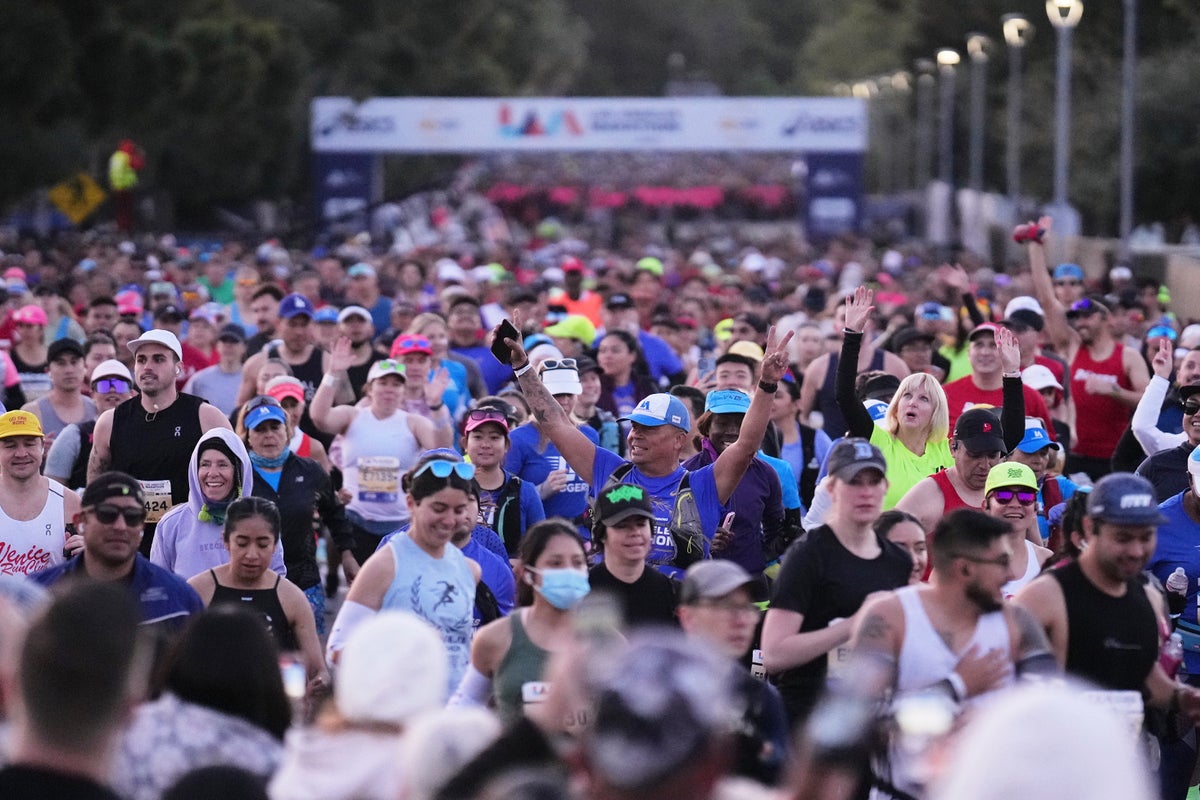
The asphalt of Santa Monica Boulevard is a relentless heat sink. By the time a runner hits the eighteenth mile of the Los Angeles Marathon, the glitter of Hollywood has long since faded into a blur of salt-crusted eyelashes and the rhythmic, agonizing slap of rubber on concrete. This is where the physics of the human body begins to argue with the ambition of the human soul. The glycogen stores in the liver are gone. The "wall" isn't a metaphor; it is a physiological shutdown where the brain begins to scream for the one thing the race forbids: stopping.
Historically, the rules were binary. You finish the 26.2 miles, or you are a "DNF"—Did Not Finish. You get the heavy piece of die-cast metal around your neck, or you get a lonely Uber ride back to the start line. Meanwhile, you can explore related stories here: The Dog Power Revolution On Colorado Slopes.
But Los Angeles is shifting the geography of achievement.
In a move that has sent tremors through the traditionalist running community, race organizers have introduced a "finisher" medal for those who cross the 18-mile mark but cannot, or choose not to, reach the final tape. It is a decision that sits at the uncomfortable intersection of inclusivity and the brutal meritocracy of endurance sports. To understand why this matters, you have to look past the trophy case and into the staggering lungs of a person who has never called themselves an athlete. To understand the full picture, we recommend the detailed article by Yahoo Sports.
The Ghost of the Marathon Traditionalist
Imagine a runner named Elias. He has run twenty-four marathons. He keeps his medals in a glass shadowbox, and to him, each one represents a specific kind of suffering survived. For Elias, the 26.2-mile distance is sacred. It is a fixed constant, a distance defined by a Greek messenger who ran from a battlefield to Athens and promptly died.
To Elias, giving a medal at mile eighteen feels like a dilution of the blood-equity required to be called a marathoner. He argues that the struggle is the point. If you remove the risk of failure, you remove the value of the success. If everyone gets a piece of the glory at the three-quarter mark, does the finish line even exist?
This perspective is rooted in a rigid, vertical view of excellence. It assumes that the only story worth telling is the one that reaches the end. But the streets of L.A. tell a different story.
The Invisible Stake of the Eighteen-Mile Mark
Consider another runner. Let’s call her Sarah. Sarah is forty-two, a mother of three, and six months ago, she couldn't run to the end of her block without gasping. She signed up for the marathon not to win, but to reclaim a body that felt like it no longer belonged to her.
Training for a marathon isn't just about the race day; it’s about the four hundred miles of lonely pre-dawn runs that preceded it. It’s about the lost sleep, the iced knees, and the quiet discipline of showing up when the world is still dark.
By mile eighteen, Sarah has already accomplished something miraculous. She has moved her body further than 99% of the population will ever move theirs in a single day. But in the old world, if her iliotibial band snaps or her heart rate spikes into a dangerous zone at mile nineteen, she leaves with nothing but a bruised ego and a sense of shame.
The L.A. Marathon’s new policy acknowledges a hard truth: eighteen miles is still a hell of a long way to run.
By providing a medal at this juncture, the race is attempting to capture the "middle-distance" hero. They are shifting the narrative from a pass-fail exam to a spectrum of human effort. It acknowledges that for some, eighteen miles is their Everest.
The Biology of the Breaking Point
There is a reason the eighteen-mile mark was chosen. It isn't arbitrary. In the world of exercise physiology, this is often where "bonking" occurs.
$Glycogen \rightarrow Glucose \rightarrow Energy$
When the body runs out of stored carbohydrates, it begins to metabolize fat, which is a far slower and more taxing process. The brain, sensing a crisis, sends signals of extreme fatigue to force the body to slow down. This is a survival mechanism.
In the past, runners would push through this "wall" at the risk of serious injury—rhabdomyolysis, severe dehydration, or cardiac stress. By offering a dignified "off-ramp" at mile eighteen, the L.A. Marathon is subtly addressing a public health concern. It gives runners permission to listen to their bodies. It says: "You have done enough. You have proven your point. You can stop now without being a failure."
A Business of Belonging
Critics will say this is the "participation trophy" culture reaching its logical, absurd conclusion. They argue that sports are meant to be exclusionary—that the medal is a paycheck, and you shouldn't get paid if you don't finish the job.
But the business of marathons has changed. These events are no longer just for the elite Kenyans and the wiry club runners. They are massive civic festivals. They are fueled by the entry fees of thousands of "back-of-the-pack" walkers and joggers who are there for the experience, not the podium.
If a race director can make those thousands of people feel seen—if they can validate the agonizing effort of thirty thousand steps—they ensure the longevity of the sport. They transform a grueling ordeal into a community milestone.
The invisible stakes here aren't about the metal itself. No one actually thinks an eighteen-mile medal is the same as a 26.2-mile medal. They are weighted differently, designed differently, and recorded differently. The stake is the "why." Why do we run? If we run only for the external validation of a finish line, then the critics are right. But if we run to test the limits of our own private horizons, then the eighteen-mile medal is simply a marker of a horizon reached.
The Weight of the Metal
The controversy usually comes from those who haven't felt the specific despair of a mid-race injury. It comes from those who haven't seen a runner sobbing on a curb because their calf muscle turned into a knot of fire six miles short of the goal.
Does the new medal devalue the marathon? Only if you believe that another person's recognition takes something away from your own.
The man who finishes in two hours and ten minutes is not running the same race as the woman who finishes in six hours. Their pain is different. Their triumphs are different. One is racing the clock; the other is racing the person they used to be.
L.A. is a city built on illusions, but there is nothing illusory about eighteen miles on foot. It is a distance that commands respect. If the traditionalists want to protect the sanctity of the marathon, they can do so by running all 26.2 miles and wearing their medals with pride. But for the person who gave everything they had and ran out of road at the eighteen-mile mark, that smaller piece of metal isn't a trophy of defeat.
It is a receipt for the courage it took to start.
The sun will still set over the Pacific. The elite runners will still break tapes and hearts. The distance remains as long as it ever was. But now, when the humidity rises and the legs turn to lead, there is a hand reaching out in the middle of the struggle. It is a recognition that the middle of the journey is often the hardest place to be, and sometimes, the most important thing we can do is acknowledge the distance already traveled.
The finish line is moving, not because we are getting weaker, but because we are finally beginning to understand how many different ways there are to win.
The medal is cold, heavy, and smells of salt. To some, it is a consolation prize. To others, it is the first time they have ever been told that their best was actually enough.