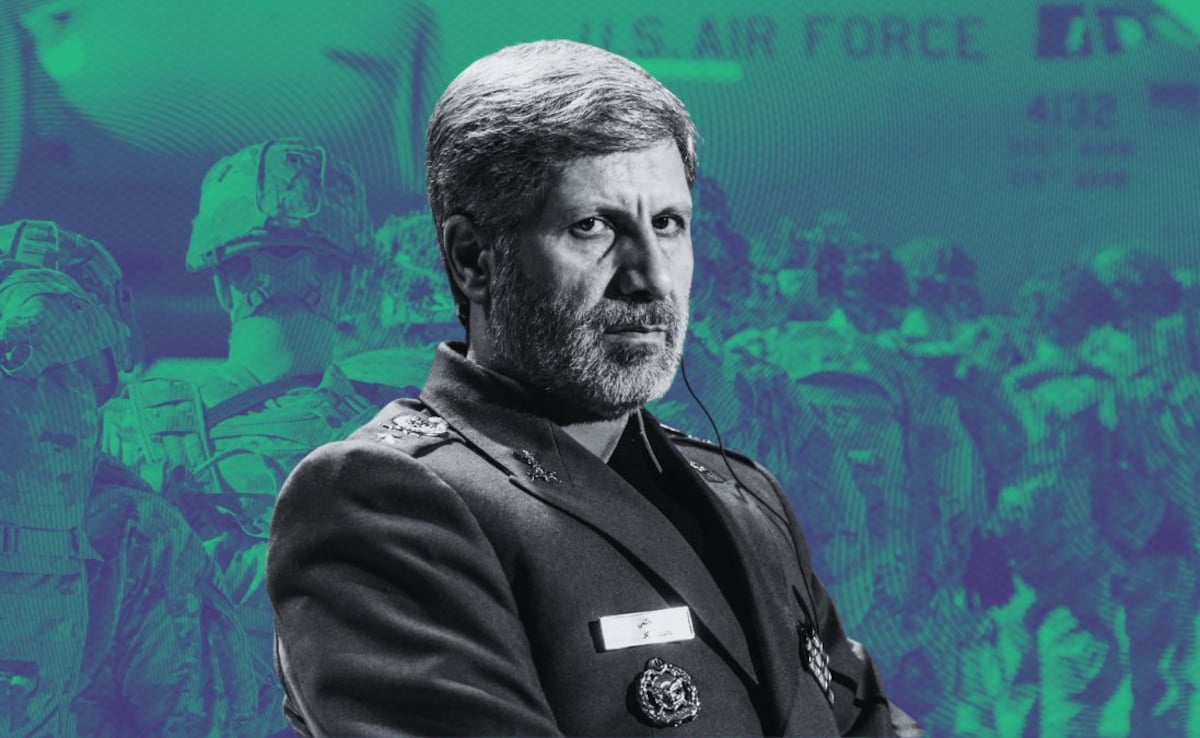
The headlines are screaming about Iranian commanders promising a bloodbath for U.S. soldiers. Pundits are shivering over the "inevitability" of a ground invasion. It makes for great television and even better clickbait. But if you actually understand the mechanics of modern kinetic warfare, you know these threats aren't a strategic roadmap. They are a confession of weakness.
The lazy consensus suggests that a ground invasion is a symmetrical meat grinder where bravado wins. It isn't. The moment an adversary starts talking about "no survivors" before a single boot has hit the mud, they aren't planning a defense. They are begging for a deterrent they can’t actually enforce.
The Asymmetric Delusion
Most analysts treat Middle Eastern theater threats as if we are still living in 1914. They imagine lines of infantry charging into machine-gun fire. This is a fundamental misunderstanding of the current kill chain. In 2026, the distance between "seeing" and "destroying" has shrunk to near-zero.
When a commander in Tehran claims no American will survive a ground incursion, they are ignoring the reality of the Over-the-Horizon (OTH) strike capability. You don’t win a ground war by being "tougher" or more willing to die. You win it by managing the electromagnetic spectrum and maintaining a superior data link.
The Iranian military doctrine relies heavily on "swarm" tactics and proxy saturation. It’s a smart play on paper. But it assumes the U.S. military is still interested in holding territory the old-fashioned way. We aren't. Modern intervention is about surgical decapitation of infrastructure, not planting flags in every village. The "no survivors" rhetoric assumes a static, localized fight. It fails to account for the fact that if a ground invasion actually happens, the "ground" has already been sanitized by weeks of multi-domain suppression.
The Logistics of Empty Threats
I’ve spent years watching defense contractors and military planners navigate these cycles of escalation. The pattern is always the same. The loudest threats come from the side with the most fragile logistics.
Consider the Internal Security vs. External Defense paradox. Iran’s military structure is split between the regular army (Artesh) and the Revolutionary Guard (IRGC). This isn't a "synergy" of forces; it’s a built-in mechanism to prevent a coup. A military that is terrified of its own shadow cannot effectively execute a scorched-earth defense against a superpower.
When they say "no soldier should survive," they are speaking to their own internal factions. It’s a desperate attempt to maintain legitimacy in the eyes of the hardliners.
- The Reality of Interception: Any massive mobilization of Iranian ground forces is visible from space hours before it moves.
- The Precision Gap: While Iran has made strides in drone tech, their kinetic precision remains miles behind the sensor-to-shooter loops utilized by Western forces.
- The Economic Anchor: You can’t fight a "total war" when your currency is in a tailspin and your youth population is looking for the exit.
Stop Asking if Invasion is Coming
The question "When will the ground invasion start?" is the wrong question. It’s a 20th-century question. The right question is: "Why would anyone bother with a ground invasion?"
Invasion is expensive. Occupation is a nightmare. The goal of modern warfare is Integrated Deterrence. If the U.S. wanted to neutralize the threat mentioned in these headlines, it wouldn't send 50,000 soldiers into a mountain range. It would simply turn off the lights.
We are talking about the total destruction of the power grid, the banking servers, and the command-and-control nodes via cyber and electronic warfare. By the time a "ground invasion" would theoretically occur, there would be no organized military left to fulfill the "no survivors" promise.
The Myth of the Unstoppable Martyr
There is a romanticized notion in Western media that an adversary's willingness to die makes them unbeatable. This is a fallacy. Willingness to die is not a substitute for a functioning air defense system.
The Iranian military knows this. Their "commanders" know this. The bravado is a mask for a deep, systemic anxiety about their own obsolescence. They are betting on American risk aversion. They think that by threatening a high body count, they can paralyze D.C. decision-makers.
But here is the nuance everyone misses: This rhetoric actually accelerates the development of autonomous systems. Every time a foreign commander threatens a "meat grinder," they provide the perfect budget justification for the Pentagon to replace human soldiers with UGVs (Unmanned Ground Vehicles) and lethal autonomous swarms.
If you want to ensure American soldiers survive, you don't stay home. You remove the "human" element from the first wave of contact. The very threats meant to scare the U.S. away are instead forcing the evolution of a style of warfare that makes Iranian defensive strategies completely irrelevant.
The Price of My Perspective
I’ll be the first to admit the downside of this cold-blooded analysis. By viewing the conflict through the lens of pure technical and logistical superiority, we risk underestimating the "black swan" of human desperation. A cornered regime doesn't always act logically.
However, betting on "willpower" against "payload" is a losing man's game. The history of the last thirty years of conflict proves that high-intensity, conventional forces—when actually unleashed—do not get bogged down in the way the "no survivor" narrative suggests. The "bogging down" only happens when politicians try to build a nation out of the rubble.
If the mission is "destruction of the enemy's ability to wage war," the U.S. wins in forty-eight hours. If the mission is "winning hearts and minds," the U.S. loses before the first shot. Iranian commanders are counting on us choosing the latter.
The Logistics of the "No Survivor" Claim
Let's get technical for a moment. To ensure "no survivors" among an invading force, you need:
- Persistent Intelligence, Surveillance, and Reconnaissance (ISR): You have to know where they are. Iran's satellite capability is rudimentary.
- Air Superiority: Or at least contested airspace. Without this, your "ground" forces are just target practice for A-10s and F-35s.
- Advanced Medical Evacuation (MEDEVAC): Ironically, to kill everyone else, you have to keep your own guys alive long enough to keep shooting. Iran’s field medicine is decades behind.
When you strip away the propaganda, the "Ground Invasion" threat is a paper tiger built on the hope that the American public is too tired of war to check the math.
The Digital Frontline
While everyone is looking at the borders, the real "invasion" has been happening in the servers for years. The IRGC has invested heavily in cyber capabilities, realizing that they can't win a physical fight. This is where the actual danger lies—not in some glorious mountain defense, but in a quiet line of code that targets a water treatment plant in Ohio.
The commanders' talk of "blood and soil" is a distraction from the fact that they are losing the digital arms race. They want you focused on the "meat grinder" because it feels visceral and scary. They don't want you focused on the fact that their entire command structure relies on hardware they can't manufacture themselves.
Brutal Honesty
Stop reading the headlines about "vows of revenge." They are templates. They have been saying the same thing since 1979. Every time a high-ranking official is neutralized, the script is the same: "Crushing response," "Harsh revenge," "No survivors."
And then? Nothing.
Or, more accurately, a small, calibrated strike designed to save face without triggering a total collapse of the regime. The commanders aren't suicidal. They like their villas, their power, and their lives. They know that a "no survivor" scenario for Americans would result in a "no regime" scenario for themselves.
The threat is a negotiation tactic, not a tactical reality.
If you want to understand the future of this conflict, stop listening to what the commanders say to the cameras. Look at what they do with their money. They aren't buying more body bags for Americans; they are buying more server uptime and trying to figure out how to keep their own people from revolting.
War isn't about who is willing to die the most. It's about who has the better sensors. And right now, the guys making the threats are blind.
Stop falling for the theater of the "meat grinder." The era of the mass-infantry invasion ended while you weren't looking. The next war won't be a bloodbath; it will be a blackout.



