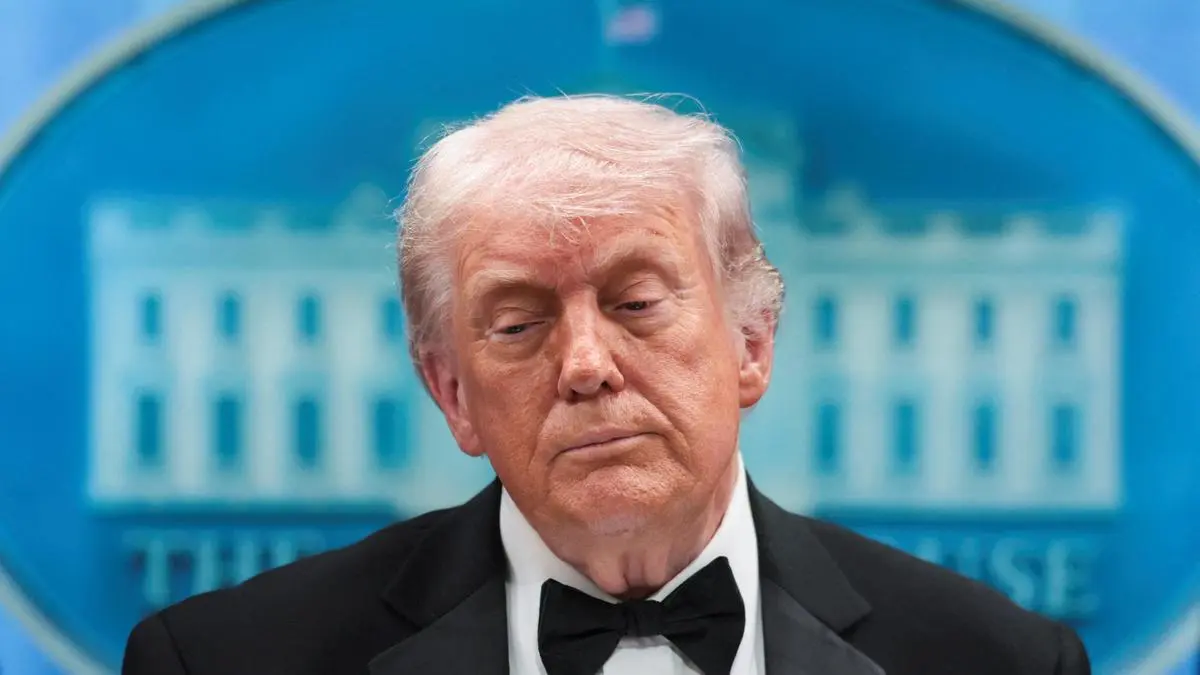
The media is obsessed with a deadline that doesn’t exist in any practical reality. Pundits are currently hyperventilating over the War Powers Resolution, claiming that Donald Trump is barreling toward a legal brick wall regarding hostilities with Iran. They paint a picture of a constitutional crisis where the clock hits zero, the law snaps shut, and the Commander-in-Chief is forced to retreat with his tail between his legs.
It’s a fantasy. Don't forget to check out our recent article on this related article.
The "impending deadline" is a legal fiction maintained by people who prefer reading textbooks to observing how power actually functions in Washington. If you’re waiting for the law to "end" a war, you haven't been paying attention to the last eighty years of American history. The War Powers Act of 1973 is the most ignored piece of major legislation in the United States, and treating its deadlines as hard stops isn't just naive—it’s dangerous analysis.
The 60 Day Myth
The core of the "deadline" argument rests on Section 5(b) of the War Powers Resolution. It dictates that the President must terminate any use of U.S. Armed Forces within 60 days unless Congress declares war, specifically authorizes the use of force, or extends the period. To read more about the history of this, Al Jazeera offers an informative breakdown.
Here is the reality: No President, Democrat or Republican, has ever accepted that this clock is legally binding. From Nixon to Biden, the executive branch has viewed the War Powers Act as an unconstitutional encroachment on the President's authority as Commander-in-Chief.
When people ask, "What happens if Trump ignores the deadline?" they are asking the wrong question. He won't "ignore" it in the sense of a teenager skipping detention. He will simply deny that the clock has started.
Executive branch lawyers are masters of linguistic gymnastics. They don't see "hostilities"; they see "targeted kinetic actions" or "limited defensive strikes." If the bombs are falling but no boots are on the ground, the White House legal counsel will argue the statute doesn't even apply. We saw this play out in 2011 with the Obama administration’s intervention in Libya. The 60-day mark passed, the missiles kept flying, and the administration’s response was essentially a shrug. They argued that because U.S. troops weren't in "active exchanges of fire," the War Powers Resolution was irrelevant.
If Trump follows that blueprint—and he will—the deadline is a ghost.
The Power of the Purse is a Rusty Knife
The standard counter-argument is that Congress holds the "power of the purse." The theory is that if the President defies the deadline, Congress will simply stop the checks.
I’ve spent enough time around DC budget battles to tell you that defunding an active military operation is a political suicide mission that almost no one in the Senate has the stomach for. Imagine the optics: A President tells the public he is "protecting American interests from Iranian aggression," and the following week, a Congressperson introduces a bill to cut off fuel and ammunition for the sailors and pilots in the Persian Gulf.
The "support our troops" rhetoric is a political shield that makes the power of the purse virtually unusable during active conflict. Even during the height of the Vietnam War or the darkest days of the Iraq surge, Congress struggled to actually turn off the lights. In the current polarized environment, a Republican-controlled or even a split Congress isn't going to pull the plug on a sitting President while the drums of war are beating. They will grumble, they will hold hearings, and they will ultimately pass the defense appropriation bill.
Why the Courts Won't Save the Critics
Whenever there is a dispute between the President and Congress over war, the "Legalist" crowd looks to the Supreme Court. They imagine a landmark ruling that finally defines the limits of executive power.
That ruling is never coming.
The judiciary treats war powers like a radioactive hot potato. They rely on the "political question doctrine." This is a legal "get out of jail free" card that allows courts to say, "This is a disagreement between the two other branches of government, and we have no business meddling in it."
Unless Congress takes a formal, unified step—like passing a specific law that the President then vetoes and they override—the courts stay on the sidelines. And since getting a two-thirds majority in both houses to override a veto on a foreign policy matter is nearly impossible in 2026, the President wins by default.
[Image of the three branches of the US government]
The Intelligence Loophole
One nuance the "deadline" articles always miss is the distinction between Title 10 (Military) and Title 50 (Intelligence) operations. The War Powers Resolution applies to the "U.S. Armed Forces." It does not explicitly cover the CIA or covert paramilitary operations.
If a President wants to stay "at war" without triggering the 60-day clock, they shift the burden to the intelligence community. They use drones, proxies, and "advise and assist" missions that technically fall outside the definition of "hostilities" used by the 1973 act. We are currently seeing the most sophisticated version of this in history. You can devastate a nation’s infrastructure and decapitate its leadership without ever deploying a single battalion of infantry.
By the time the public realizes a war is happening, the 60-day clock is usually irrelevant because the strategic objectives have already been achieved—or the situation has evolved into a "gray zone" conflict that the law wasn't built to handle.
The Cost of the Illusion
The danger of focusing on these imaginary deadlines is that it creates a false sense of security. It makes the public believe there is an automatic "off switch" for military escalation. There isn't.
Relying on the War Powers Resolution to restrain a President is like trying to stop a freight train with a "Yield" sign. The only real check on a President’s war-making ability is political will and the threat of impeachment. Given the current state of American politics, neither of those is a credible deterrent for a President who believes a conflict with Iran is in his (or the country's) best interest.
We are operating in a post-statute era of foreign policy. The rules written in the wake of Vietnam were designed for a world of clear declarations and mass mobilizations. They are useless in an age of cyber warfare, precision strikes, and executive dominance.
If the missiles start flying toward Tehran, don't look at your watch. Don't count down sixty days. There is no referee coming to blow the whistle.
Stop asking what happens when the deadline passes. Start asking who is going to stop him from ignoring it entirely, because history proves the law won't do it for you.