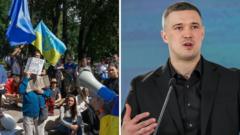
Conventional wisdom loves a neat narrative. The lazy consensus dominating international media insists that holding democratic votes while shells fall on cities is sheer institutional suicide. Commentators nod sagely, repeating the line that martial law must freeze time itself until the last gun falls silent. They treat democracy like fragile porcelain that must be locked in a velvet box until peace arrives.
They are dead wrong.
When former defense minister Mykhailo Fedorov stepped in front of a camera to demand a mechanism for wartime polling, he did not start a crisis. He exposed one that was already rotting the floorboards from within. The narrative that ballots and bullets cannot coexist is a convenient excuse for administrative stagnation, centralized gatekeeping, and unchecked executive creep.
The Myth of the Frozen Republic
Let us dispense with the fairy tale that suspending civic choice preserves unity. True national resilience comes from accountability, not blind obedience. When power consolidates entirely under the banner of an indefinite emergency, the line between defending the state and protecting an administration blurs dangerously.
Look at the structural mechanics. Ukraine faces an open-ended conflict with no expiration date. Pretending that political life can be placed on pause indefinitely assumes this war will wrap up neatly next Tuesday. It will not. Locking down the political sphere for years on end does not shield a nation from external aggression; it suffocates the internal vitality required to outlast that aggression.
Critics shriek about logistical impossibilities. How do you poll millions of displaced refugees across Europe? How do you ballot soldiers in active trench lines under drone surveillance? These are real hurdles, but treating them as insurmountable walls is intellectually lazy. Modern states manage distributed logistics on a massive scale. If a nation can coordinate complex electronic governance, decentralized supply chains, and advanced drone warfare under fire, it can engineer a secure mechanism for civic expression.
Accountability as a Strategic Weapon
Corruption in peacetime is a crime. In wartime, it is a lethal operational vulnerability. When governance becomes opaque, procurement failures and administrative bottlenecks hide behind national security stamps. Fedorov’s pivot into open political opposition is not merely a personal feud born from an abrupt dismissal; it is a systemic challenge to the idea that executive loyalty matters more than brutal competence.
Imagine a scenario where leadership is forced to justify its strategy to a mobilized electorate every few years, even while hostilities rage. The quality of governance would transform overnight. Leaders would have to answer why certain reforms stall, why transparency takes a backseat, and why internal gatekeepers retain their posts despite repeated failures. Accountability sharpens strategy. It does not weaken it.
The pushback against this idea usually comes from comfortable capitals far from the front lines, where analysts treat a sovereign democracy like a abstract board game. They fear disruption. They prefer the predictable inertia of a wartime status quo because disruption makes them nervous. But nations fighting for their right to exist cannot afford the luxury of unquestioned stagnation.
The Cost of Delay
Postponing civic renewal under the guise of unity creates a pressure cooker. When legitimate political competition is suppressed, public frustration does not vanish—it metastasizes into cynicism, street protests, and institutional paralysis. Denying people a voice in how their country is run while asking them to die for it creates a profound moral contradiction.
Democracy is not a luxury item you unpack when the skies are clear. It is the very engine of the European future Ukraine is bleeding to secure. If the political architecture cannot bend to accommodate the will of its citizens during a long war, then the architecture itself is already failing.
The debate over political renewal during crisis is uncomfortable, messy, and loud. Good. Clean consensus is a myth for the naive.
Watch the full address on the ousted defense minister's wartime election call
This broadcast provides direct context on the exact framing and tone that triggered the current political realignment in Kyiv.
http://googleusercontent.com/youtube_content/1