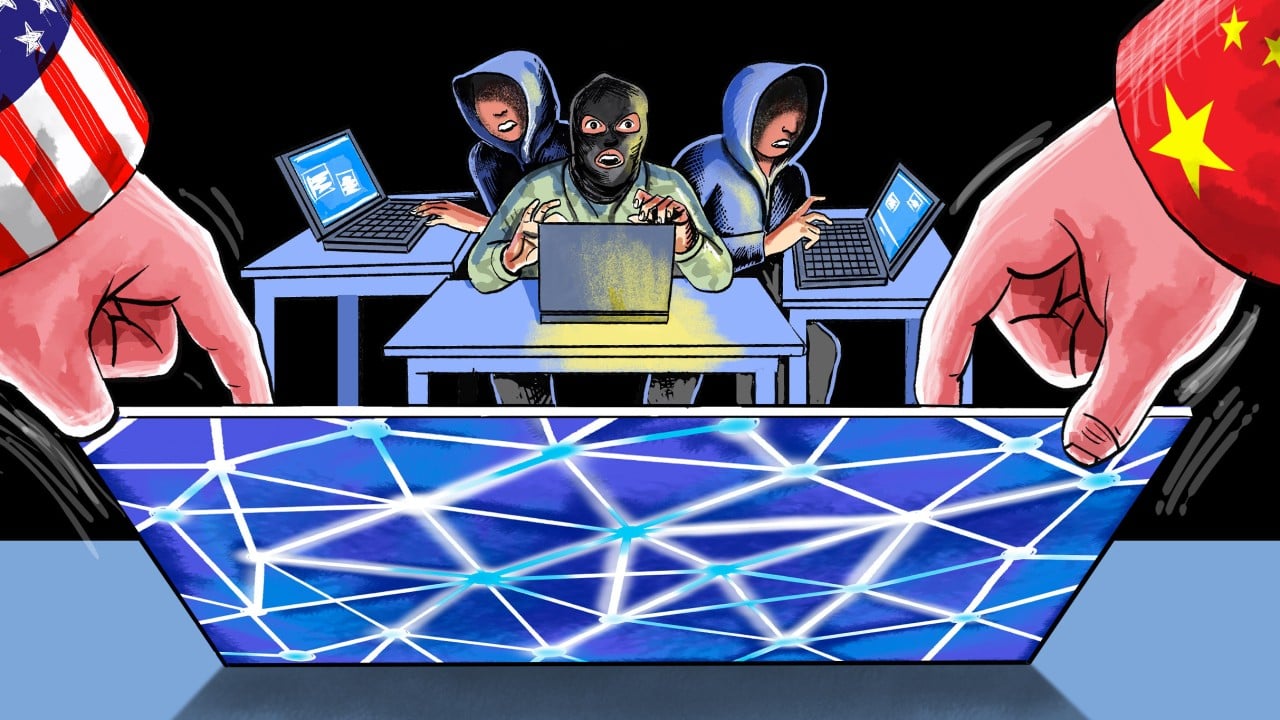
The multibillion-dollar scam industry operating out of Cambodia and Southeast Asia represents a systemic failure of international policing that the United States cannot solve through sanctions or unilateral pressure. To dismantle the industrial-scale human trafficking and financial fraud networks currently bleeding global victims dry, the U.S. must pivot toward a gritty, pragmatic cooperation with China. While the instinct in D.C. is to treat the Mekong region as a chessboard for geopolitical containment, the reality on the ground is that Beijing holds the unique keys to the logistics, telecommunications, and financial pipelines these criminal syndicates utilize. Without a shared enforcement strategy, the "scamdemic" will only continue to mutate.
The Infrastructure of the Scam Compound
The scale of these operations is staggering. We are no longer looking at small rooms of hackers; we are looking at fortified mini-cities. These compounds, often located in Special Economic Zones (SEZs) like those in Sihanoukville or along the Thai-Myanmar border, function as sovereign entities. They possess their own security forces, high-speed fiber optics, and luxury amenities designed to keep the "management" comfortable while the "workers"—thousands of trafficked individuals—are held in debt bondage.
The genius of this criminal model lies in its hybridization. It blends traditional Triad-style human trafficking with high-level fintech exploitation. These groups use sophisticated "pig butchering" (Sha Zhu Pan) scripts to build long-term psychological rapport with victims before draining their life savings through fraudulent crypto platforms. The money doesn't just vanish; it moves through a complex web of "mule" accounts and unregulated exchanges that are frequently tied back to Chinese-speaking organized crime networks.
The Limits of Western Sanctions
Washington’s primary tool for influence in Cambodia has been the stick. Sanctions on high-level officials and the withdrawal of trade preferences are intended to force the Cambodian government to clean up its act. However, this approach ignores the financial vacuum. When the U.S. retreats or imposes penalties, it inadvertently pushes local elites closer to the very criminal elements that provide the "gray" capital keeping these provinces afloat.
Sanctions do nothing to stop the flow of people or data. They don't cut the internet cables or shut down the bank accounts. In fact, by isolating these regions from legitimate Western investment, the U.S. effectively hands the keys to the underground economy.
Why China Is the Indispensable Partner
Critics of cooperation argue that China is responsible for the crisis because many of the kingpins are Chinese nationals. This is true. However, it is precisely why China is the only power capable of ending it. Beijing has the biometric data, the family leverage over the perpetrators, and the technical control over the payment apps—Alipay and WeChat Pay—that are often used in the initial stages of money laundering.
The Repatriation Factor
China has already demonstrated its capability to disrupt these networks when it feels its own national interests are threatened. In 2023, after massive public outcry regarding Chinese nationals being trafficked into Myanmar, Beijing exerted immense pressure on local juntas and ethnic armed groups. The result was the handover of tens of thousands of suspects.
The U.S. lacks this specific brand of coercive diplomacy in the region. If the U.S. wants to protect its citizens from losing their retirements to these scams, it must find a way to align its interests with China’s desire for domestic stability and the protection of its "Belt and Road" image. Both superpowers have a mutual enemy in a criminal class that operates above the law and outside the traditional banking system.
The Cryptocurrency Blind Spot
A major hurdle in stopping these gangs is the shift toward stablecoins. Tether (USDT) has become the unofficial currency of the Mekong scam zones. It offers the speed of the internet with the anonymity of cash, allowing syndicates to move hundreds of millions of dollars across borders in seconds.
While the U.S. Treasury can track public blockchains, it struggles to freeze assets once they enter the "gray" exchanges operating out of Southeast Asia or Russia. China, having banned crypto domestically, has developed aggressive, if controversial, methods for tracing these flows. A joint task force focusing on the intersection of crypto-laundering and Southeast Asian "casinos" would be more effective than any single-country legislation. This isn't about liking the partner; it's about using the only tools that actually work.
The Sovereignty Trap in Phnom Penh
Cambodia’s leadership finds itself in a delicate position. The scam compounds bring in massive amounts of capital and high-spending residents to areas like Sihanoukville that were otherwise ghost towns following the 2019 ban on online gambling. For a veteran journalist watching this play out, it is clear that the Cambodian government will not move against these interests unless they are presented with a unified front.
When the U.S. and China send conflicting messages, the syndicates thrive in the gaps. They play one side against the other, claiming to be "pro-China" to avoid local heat, or "private businesses" to avoid Western scrutiny. If Washington and Beijing were to agree on a set of minimum standards for SEZ oversight, the Cambodian government would have no choice but to comply.
Moving Beyond Blame
The rhetoric of "blame" is a luxury we can no longer afford. Every day spent in diplomatic stalemates is a day where more people are lured into modern-day slavery and more families are financially ruined. The U.S. must accept that in the Mekong, it is a secondary power when it comes to boots-on-the-ground enforcement.
To win, the U.S. should propose a "Trans-Pacific Anti-Fraud Initiative" that focuses strictly on the mechanics of the crime:
- Intelligence sharing on the specific digital signatures used by scam apps.
- Coordinated pressure on regional internet service providers to cut off known compound blocks.
- Joint legal frameworks for the repatriation of victims, regardless of their nationality.
This is not a call for a grand alliance or a softening on other geopolitical issues like Taiwan or the South China Sea. It is a call for a surgical, functional partnership to excise a cancer that is eating both societies from the inside.
The High Cost of Inaction
If the status quo holds, the scam industry will evolve. We are already seeing the integration of artificial intelligence—deepfake audio and video—making these scams nearly impossible for the average person to detect. The compounds are also diversifying, moving into human organ trafficking and illegal wildlife trade.
The Mekong scamblocks are the ultimate proof that in a connected world, a lawless zone anywhere is a threat to security everywhere. The U.S. can continue to issue reports and level sanctions that are ignored, or it can engage with the only other player on the board with the power to actually pull the plug.
The criminals aren't waiting for the next diplomatic summit. They are scaling. They are innovating. They are winning.
Stop treating a massive criminal enterprise like a diplomatic disagreement. Follow the money, use the leverage available, and recognize that in the fight against a borderless digital threat, your rival's tools might be the only ones that can hit the target.