Cold.
It was the kind of damp, bone-searching November chill that slips beneath wool coats and settles directly into the marrow of your ribs, turning every breath into a ghostly plume against the floodlights of Szucha Avenue. Outside the neoclassical facade of Poland’s Constitutional Tribunal in Warsaw, the air did not merely carry the scent of winter rain and diesel exhaust; it carried the sharp, metallic tang of pepper spray and the low, percussive thrum of thousands of boots stamping against wet cobblestones to keep the circulation alive. Discover more on a similar issue: this related article.
To read standard wire reports—like the dry French dispatches summarizing a nuit de heurts devant le Tribunal constitutionnel—is to encounter a sterile choreography of riot shields, police cordons, and legalistic jargon. According to contemporary news accounts from European press agencies and Polish broadcasters covering the crises surrounding the Tribunal, clashes erupted after nightfall when demonstrators gathered to protest sweeping judicial overhauls and contested rulings affecting fundamental civil liberties. Police deployed tear gas and physical barriers; protesters waved white-and-red flags and chanted slogans demanding judicial independence; arrests were made before dawn.
Those are the facts. They are accurate, verified, and entirely bloodless. Further journalism by NPR delves into comparable views on this issue.
What wire dispatches rarely capture is the quiet terror of watching the referee walk off the pitch in the middle of the match, tear off his striped shirt, and join one of the teams.
The Architecture of a Broken Promise
To understand why ordinary people—teachers, software engineers, retired doctors, university students—stood nose-to-nose with riot police outside a courthouse in central Warsaw, you have to understand what that limestone building represents in the Polish imagination.
Imagine, for a moment, a hypothetical character named Marek, a forty-two-year-old civil engineer from Kraków who has never thrown a stone in his life and considers a heated zoning board meeting to be high drama. Marek grew up in the shadow of the 1989 transition, raised on the promise that Poland had traded the arbitrary whims of party apparatchiks for the steady, predictable shelter of European constitutionalism. For Marek, the Constitutional Tribunal was never an abstract debating society for legal scholars. It was the circuit breaker in the basement of the house. When politicians overloaded the wiring—when a parliament drunk on its own majority tried to pass a law that violated basic rights—the Tribunal was supposed to trip the switch and keep the house from burning down.
Consider what happens when the circuit breaker is deliberately fused shut.
Between 2015 and the subsequent years of escalating constitutional crisis, Poland’s governing Law and Justice (PiS) party systematically reshaped the judiciary, beginning with a fierce dispute over the appointment of judges to the Constitutional Tribunal itself. Legal analysts at the Venice Commission—the Council of Europe’s advisory body on constitutional matters—along with the European Court of Justice, repeatedly warned that packing the court with loyalists and refusing to publish inconvenient rulings paralyzed the Tribunal’s ability to act as an independent check on executive power. Defenders of the government’s reforms, including PiS leaders and allied jurists, countered that the post-communist judiciary had become an unaccountable, self-perpetuating caste resistant to democratic oversight, arguing that parliament had a mandate from voters to make the courts answerable to the nation.
Both arguments echoed across television studios in Warsaw. Out on Szucha Avenue, however, legal theory collided with human flesh.
The Night the Sirens Replaced the Gavel
By nine o'clock in the evening, the crowd outside the Tribunal had swelled from a scattered vigil into a dense, pulsing wall of humanity.
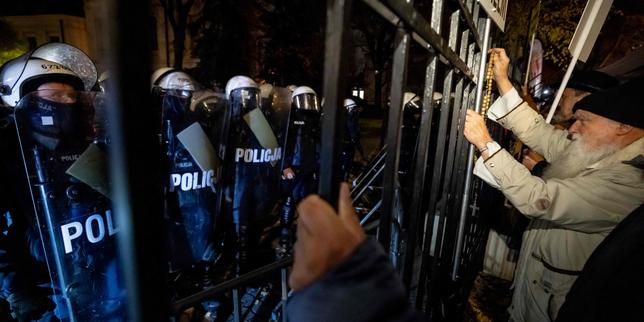
I remember the sound first—not the shouting, which came later, but the strange, rhythmic clatter of house keys being shaken in the air by thousands of hands at once. It sounded like a sudden hailstorm striking a tin roof. Above the crowd, handheld flares bled crimson smoke into the mist, illuminating faces taut with exhaustion and defiance. Behind the steel barricades, rows of riot officers stood motionless in black helmets and polycarbonate visors, their reflections fractured in the puddles pooling along the asphalt.
"We aren't here for a political party," a woman beside me shouted over the din, pulling a knitted scarf tighter around her throat. She was a high school history teacher from Łódź who had taken a three-hour train ride after grading papers. "If they own the judges, then the constitution is just expensive wallpaper."
Around ten-thirty, the atmosphere snapped.
According to eyewitness testimonies and video footage reviewed by independent Polish media outlets such as OKO.press and TVN24, pockets of protesters attempted to push past the metal barriers toward the entrance of the Tribunal, while police units moved in to clear the roadway. Within seconds, the rhythmic chanting dissolved into chaos. Canisters hissed. A thick, acrid cloud of pepper spray rolled low across the pavement, stinging eyes and triggering violent coughing fits across the front lines. Scuffles broke out near the perimeter as officers tackled demonstrators onto the wet stone, zip-tying wrists while camera flashes popped like lightning in the dark.
To witness a clash outside a constitutional court is to experience a peculiar kind of vertigo. Normally, street protests petition the state to change a policy—raise a wage, stop a pipeline, lower a tax. Here, people were fighting in the mud for the survival of the very referee meant to keep them off the streets in the first place.
Why a Courtroom Fight Becomes Everyone’s Emergency
It is easy, from the comfort of an armchair hundreds of miles away, to mistake a constitutional crisis for an inside-baseball quarrel among lawyers. Who appoints which judge? Which chamber hears disciplinary cases? What does Article 188 of the Polish Constitution actually say?
Let’s strip away the Latin and use a simpler picture.
Think of a marriage where one spouse insists on rewriting the prenuptial agreement every Tuesday, and whenever the other spouse objects, the first spouse appoints their own brother-in-law to act as the impartial mediator. How long before trust evaporates completely? Now scale that dynamic up to thirty-eight million citizens.
When a constitutional court loses perceived independence, the shockwaves do not stop at the courthouse steps. They travel directly into hospital rooms, classrooms, and family dinner tables. In October 2020, when the restructured Constitutional Tribunal issued a landmark ruling declaring that abortions due to severe fetal abnormalities were unconstitutional—effectively imposing a near-total ban on pregnancy terminations in Poland—hundreds of thousands of women and men poured into the streets across dozens of cities. Critics of the ruling, including human rights organizations like Amnesty International and opposition lawmakers, argued that the government had used a compliant court to enact sweeping social restrictions it feared pushing through ordinary parliamentary debate. Supporters of the decision, including conservative lawmakers and anti-abortion advocates, hailed it as a courageous defense of constitutional protections for unborn life.
Regardless of where one stood on the moral question, the procedural reality was unmistakable: the streets had become the only parliament left where dissent felt audible.
That is the invisible cost of institutional erosion. You do not notice the foundation cracking while the sun is shining and the economy is growing. You notice it at midnight, in November, when a mother and a riot policeman—two citizens who probably shop at the same grocery chains and cheer for the same national football team—are shoved against a steel barricade because neither trusts the building behind them to tell the truth.
The Exhaustion of Living Without a Net
There is a particular fatigue that settles over a society when rules become negotiable.
During those nights in Warsaw, the confusion was almost as heavy as the anger. Journalists scrambled to verify which rulings were legally binding under European Union law and which were considered void by international tribunals. Small business owners worried aloud whether freezes on billions of euros in EU recovery funds—triggered by Brussels’ rule-of-law disputes with Warsaw—would stall infrastructure projects and raise borrowing costs. Even conversations over coffee acquired a cautious, sideways glance, as neighbors tried to gauge each other’s loyalties before speaking freely.
I will admit something that commentators rarely confess: watching a democracy test its own guardrails is deeply disorienting. There is no single dramatic moment when a siren blares to announce that the rule of law has expired. Instead, it happens through a thousand technical amendments, late-night parliamentary sessions, and disputed judicial appointments—each one plausible enough on paper to make you wonder if you are overreacting, right up until the night tear gas drifts across Szucha Avenue.
Historical patterns across Central Europe offer a sobering reminder of how fragile institutional trust truly is. After decades of authoritarian rule ended in 1989, Poland became the poster child for post-communist democratic consolidation, entering NATO in 1999 and the European Union in 2004. Yet political scientists have long observed that young democracies often build impressive formal institutions faster than they cultivate the unwritten norms—restraint, mutual forbearance, respect for losing—that keep those institutions breathing. Without those norms, a constitution becomes a weapon rather than a shield.
Dawn on Szucha Avenue
By three in the morning, the main crowd had dispersed into the side streets leading toward Łazienki Park, leaving behind trampled cardboard signs, empty water bottles, and the lingering bite of chemical spray in the cold air.
Municipal street sweepers arrived before sunrise, their amber hazard lights rotating silently against the pale stone of the Constitutional Tribunal. A handful of demonstrators remained huddled near the corner, sharing thermoses of hot tea, their faces streaked with dried tears from the gas and red from the wind. Across the street, two young police officers leaned against their van, helmets tucked under their arms, looking every bit as drained as the people they had been ordered to hold back three hours earlier.
Nobody looked victorious. Nobody looked safe.
Later that morning, the headlines would reduce the night to numbers: how many officers deployed, how many protesters detained, which political leader blamed whom at the morning press conference. Those summaries would be neat, balanced, and easy to skim over breakfast.
Yet on the wet pavement outside the courthouse, a single white-and-red paper flag lay pressed flat into the cobblestones by the tire track of a police van, its edges already dissolving into the November rain.