The rejection of an Easter truce in Ukraine is not merely a diplomatic failure but a calculated tactical maneuver. While Volodymyr Zelensky frames the Russian refusal as a moral vacuum, the reality on the ground suggests a much grimmer logic. Moscow did not simply ignore the request for a ceasefire; it integrated the holiday into its psychological warfare strategy. By choosing escalation over a temporary pause, the Kremlin signaled that it no longer views religious milestones as diplomatic off-ramps, but as windows of opportunity to press a flagging defense.
This isn't just about the optics of "Easter escalation." It is about the total erosion of the informal rules of engagement that once governed Eastern European conflicts. In previous years, even during the height of the Donbas conflict post-2014, "bread truces" and "holiday silences" provided brief, if fragile, respites. Those days are gone. Now, the religious calendar serves as a backdrop for intensified shelling, a move designed to shatter Ukrainian morale during what should be a period of national reflection and spiritual sanctuary.
The Strategic Value of Refusing Peace
Military analysts often look for the "why" in the timing of offensives. In this case, the "why" is rooted in momentum. Russia’s refusal to halt the violence during Orthodox Easter stems from a fear that any pause allows Ukraine to regroup, refortify, and integrate Western hardware arriving at the front.
A ceasefire is never just a ceasefire. It is a logistical window. For Ukraine, four days of quiet would mean the ability to rotate exhausted brigades out of the meat grinder of the eastern front without the constant threat of drone strikes or thermobaric artillery. For Russia, denying that pause keeps the pressure constant, forcing Ukrainian command to keep their men in the mud under a relentless sun of incoming fire. The Kremlin viewed the request for a truce not as a humanitarian gesture, but as a tactical "ask" that they had no incentive to grant.
The cruelty is the point. By striking harder during a period of high cultural and religious significance, the invading forces aim to project an image of unstoppable inevitability. They want to show that nothing—not even the most sacred date on the Orthodox calendar—will slow the machine.
The Broken Cross of Orthodox Diplomacy
The failure of the ceasefire also highlights the deep, perhaps irreparable, schism within Global Orthodoxy. Traditionally, the Church might have acted as a backchannel for such negotiations. Instead, we see the Moscow Patriarchate providing a theological shield for the invasion, effectively neutralizing the Church’s role as a peacemaker.
When the religious leadership in Moscow justifies the conflict as a "metaphysical struggle," the concept of an Easter truce becomes an oxymoron in their eyes. You do not pause a holy war for a holiday. This internal logic makes any appeal from Kyiv or the Vatican fall on deaf ears. Zelensky’s rhetoric focuses on the "spirit of Easter," but he is negotiating with a regime that has successfully co-opted that spirit to fuel nationalistic fervor.
The Shelling of the Sanctuary
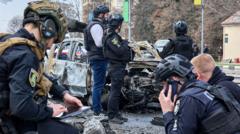
Reports from the front lines during these "escalation" periods show a pattern of targeting civilian infrastructure that doubles as communal gathering points. It is a grim reality. On Easter Sunday, the risk to civilians increases because the social fabric of Ukraine demands that people gather. The Russian military knows this. Targeting a railway station or a bread line on a normal Tuesday is a war crime; doing it on Easter Sunday is an act of psychological terror intended to prove that no space, physical or temporal, is safe.
This is the "Easter escalation" in its rawest form. It is the transformation of a holy day into a high-value target window.
Logistic Realities Over Moral Outrage
While the international community expresses horror at the lack of a truce, the cold math of the war of attrition dictates the Kremlin's path. We are currently seeing a race against time. The ground is drying, the "rasputitsa" mud season is ending, and the window for heavy armor maneuvers is opening.
- Ammunition Depletion: Constant pressure prevents Ukraine from stockpiling shells for a counter-offensive.
- Psychological Fatigue: Breaking the spirit of a population during its most important holiday has long-term effects on national resilience.
- Resource Diversion: Emergency services and air defense must be on high alert during festivals, stretching resources that could be used elsewhere.
Russia’s command structure likely calculated that the negative press of "attacking on Easter" is a small price to pay for the tactical advantage of keeping Ukrainian forces pinned. In the halls of the Kremlin, the condemnation of the West is a background noise they have long since learned to ignore. They are betting that the world’s attention span is short, but the impact of a lost tactical position is permanent.
The Myth of the Humanitarian Corridor
Part of Zelensky’s frustration stems from the repeated collapse of humanitarian corridors, which were supposed to be the centerpiece of an Easter pause. History shows us that these corridors are often used as traps or as a means of forced deportation. By refusing a formal ceasefire, Russia avoids even the pretense of facilitating civilian escape.
This is a stark departure from the early 20th-century norms of warfare. Even in the trenches of World War I, there were moments where the human element overcame the military objective. In the current conflict, the human element has been systematically purged from the decision-making process. The drones don't care about the date, and neither do the men operating them from miles behind the line.
A New Era of Total War
We must stop expecting "civilized" pauses in a conflict that has moved into the realm of total war. The rejection of the Easter truce is a signal that the Kremlin no longer cares about the "hearts and minds" of the Ukrainian people. They have moved past the stage of trying to win over the population and are now fully committed to a strategy of exhaustion.
If the Russian military is willing to shell cathedrals and ignore the holiest days of its own faith, there is no red line left to cross. The international community’s reliance on moral pressure is a tool that has lost its edge. Moscow views these appeals as a sign of Western weakness—an attempt to use "soft" values to compensate for a lack of "hard" military intervention.
The Futility of Moral Appeals
The West continues to treat this as a conflict that can be tempered by international norms. It cannot. The Easter escalation proves that the only language the current Russian leadership respects is the language of parity. Until the cost of attacking on a holiday exceeds the benefit of the tactical gain, the attacks will continue.
Zelensky’s pleas, while powerful in the court of public opinion, do little to change the trajectory of a missile. The reality is that the "Easter escalation" was not a choice between peace and war, but a choice between a pause and a perceived victory. For a regime that has staked its entire future on the outcome of this invasion, the choice was always going to be more fire.
The Front Line as a Permanent State
As the holiday passes and the smoke clears from the latest rounds of shelling, the takeaway for the Ukrainian military is clear: there are no breaks. The concept of "off-time" or "sacred time" has been abolished. Every day is a day to fight, and every night is a night to defend. This realization changes the psychology of the soldier. It hardens the resolve, but it also deepens the trauma.
The Russian strategy of "Easter escalation" has effectively killed the possibility of future truces. If a ceasefire cannot be reached for the most significant event in the shared religious culture of both nations, it will not be reached for anything else. We are entering a phase of the war where the only end will be a total collapse of one side or a forced settlement that neither side wants.
The bells of the churches in Kyiv may still ring, but they now compete with the sirens. That is the world the Kremlin has chosen to build. The rejection of the truce was not an oversight; it was a declaration of intent. The war will not stop for God, and it certainly will not stop for man.
Expect the intensity of the conflict to rise as the weather improves. The "Easter escalation" was merely the opening move of a larger summer campaign. The silence that many hoped for was replaced by the thunder of 152mm howitzers, and that thunder is unlikely to fade anytime soon. Prepare for a long, hot summer where the only calendar that matters is the one marked by the arrival of new weapon systems and the tally of lost villages.
Arming Ukraine to the point where an escalation becomes too costly for Russia is the only diplomatic lever left. Everything else is just noise.