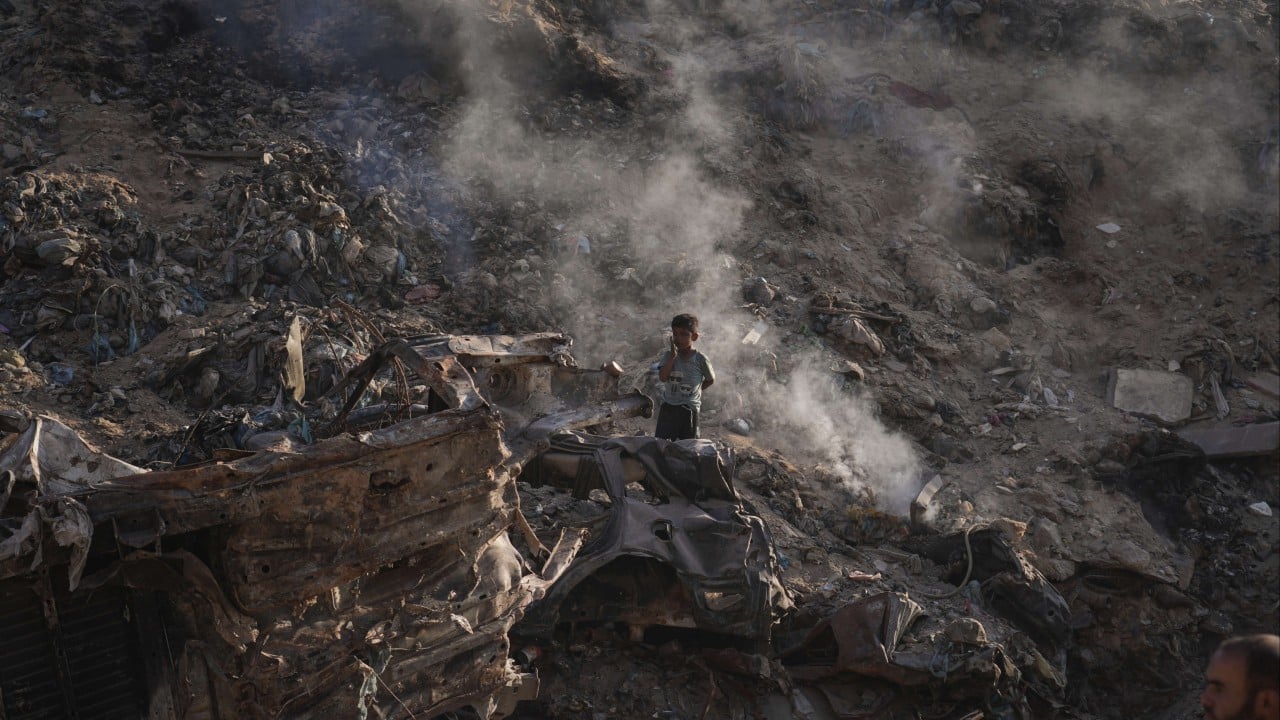
The sound of a home collapsing is not a clean, cinematic snap. It is a slow, grinding roar that begins in the foundations and ends with a cloud of gray grit that stays in the throat for days. When the dust settles, the silence that follows is heavy, thick, and absolute.
For decades, international bodies have attempted to capture this silence in pages of bond paper, bound in neat blue folders and stamped with the insignias of the United Nations. They use words like "systemic displacement," "unlawful coercion," and "jurisdictional encroachment." But a report cannot smell the scorched concrete. It cannot feel the heat of a midday sun baking a family’s exposed mattresses on the side of a dirt road.
To understand the reality of the crisis gripping the Palestinian territories, we have to look past the dense, bureaucratic vernacular of global oversight. We have to look at the geometry of a life under total restriction.
The Shrinking Room
Consider a hypothetical man named Tariq. He is not a statistic, though his life is governed by them. Tariq lives in a small village in the West Bank, a place surrounded by olive groves that his grandfather planted. In the language of international treaties, his home sits in Area C—a designation that places over 60 percent of the West Bank under direct Israeli civil and military control.
To Tariq, Area C is not a letter on a map. It is a wall that breathes.
Every morning, he wakes up to a reality where expansion is a crime. If his family grows, he cannot build an extra bedroom. The permits required to pour a simple slab of concrete are rejected nearly 99 percent of the time by authorities. To build without one is to invite the bulldozers. So, his family packs tighter into the existing rooms. The walls feel closer every year.
Meanwhile, just three hundred yards away on the next hilltop, a different reality unfolds. White stucco villas with red-tiled roofs rise almost overnight, connected by smooth, asphalt ribbons of settler-only highways. Water flows into their swimming pools through blue pipes, while Tariq’s village must purchase water from mobile tanks at exorbitant rates because they are denied connection to the main grid.
This is the structural violence of the ordinary. It does not always announce itself with gunfire. It announces itself with a letter pinned to a front door, written in a language the homeowner can barely read, stating that their ancestral property now belongs to a military firing zone.
The numbers backing this up are staggering, buried deep within global human rights audits. Thousands of structures demolished. Thousands of people displaced in a relentless, quiet tide. It is a process of subtraction.
The Anatomy of an Open Sky
Seven hundred square miles. Two million people.
If the West Bank is a story of fragmented pockets, the Gaza Strip is a masterclass in containment. Before the skies darkened with the intensity of recent warfare, the baseline of existence in Gaza was already a testament to human endurance under artificial constraints.
Think of a young woman named Maya. She is a graphic designer, twenty-four years old, brilliant, and quick-witted. She has never left the Gaza Strip. Her entire world is a coastal sliver of land that you could drive across in less than an hour if the roads were clear and the borders were open.
Maya’s life is timed by the hum of generators. For years, the electricity grid in Gaza provided only four to eight hours of power a day. Imagine running a business, preserving food, or performing surgery when the current is a luxury, not a utility. The UN reports documented this as an "infrastructure deficit." Maya calls it the theft of time.
Then came the total blockade, turning a chronic crisis into an acute catastrophe.
When international observers write about the "unprecedented collapse of food security," they are describing a kitchen table. They are describing Maya’s mother skipping meals so her younger siblings can eat a single piece of flatbread dipped in thyme. The grocery stores are not just empty; they are irrelevant because there is no money left to buy what little remains on the shelves.
The psychological weight of this isolation is a physical entity. It sits on the chest. The sky above Gaza is beautiful, opening up to the Mediterranean Sea, but it is an illusion of freedom. The fishing boats cannot venture past a fluctuating, heavily patrolled nautical boundary. The drones overhead provide a permanent, mechanical soundtrack to every childhood memory.
The Language of the Unseen
The greatest flaw in standard journalism is the tendency to treat these two regions as separate, isolated tragedies. They are distinct in their suffering, yes, but they are bound by the same underlying architecture of control.
When the UN Human Rights Office releases an assessment detailing the "wholesale unraveling of the rule of law," it is pointing to a profound double standard. In the West Bank, two communities live under two entirely different legal systems on the exact same dirt. An Israeli settler who commits an infraction is subject to Israeli civil law, with all its protections and due process. A Palestinian neighbor who commits the identical infraction is dragged before a military court, where the conviction rate hovers near 100 percent.
This is not a mistake in the machine. It is the machine’s intended output.
The complexity of these legal frameworks often deters the casual observer. It is easy to look at the Middle East and see only an ancient, intractable feud fueled by tribal hatreds. That narrative is comfortable because it absolves the rest of the world of responsibility. It suggests that nothing can be done.
But when you read the actual findings, the myth of the ancient feud dissolves. What remains is a highly modern, bureaucratic apparatus designed to maximize land control while minimizing the presence of the people who inhabited it for generations. It is a matter of administrative law, checkpoints, biometric cameras, and zoning regulations.
It is dry. It is clinical. And it is devastating.
The Horizon
There is a specific kind of weariness that settles into the eyes of elders in places like Hebron and Jenin. It is the exhaustion of someone who has spent fifty years proving they exist. They hold up old, yellowing Ottoman land deeds, British mandate tax receipts, and keys to houses that no longer stand.
They carry these artifacts not out of a blind fixation on the past, but because the present offers them no solid ground to stand on.
The international community watches this unfold, publishing its quarterly ledgers of grief. The reports are essential; they provide the baseline of undeniable fact required to challenge the propaganda of the powerful. They prove that the hunger is manufactured, that the displacement is intentional, and that the silence is enforced.
But those facts must be translated into the language of human blood and bone.
They must be understood through the eyes of Tariq, watching the olive trees burn, or Maya, sitting in the dark, listening to the horizon fracture. The tragedy is not just that these conditions exist. The tragedy is that we have become accustomed to reading about them in the past tense, as if they are history, while they are being actively written into the earth today.
The grit remains in the air. The dust has not settled. It merely waits for the next wall to fall.