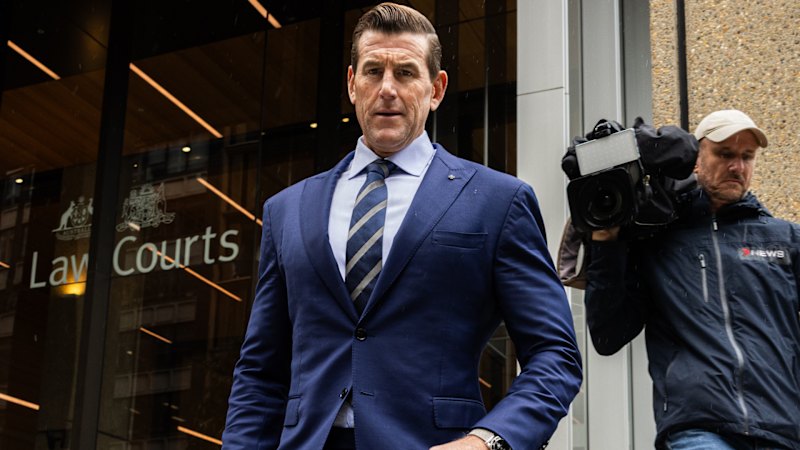
The dawn used to belong to him. For years, Ben Roberts-Smith owned the early hours, those quiet, cold moments before the world wakes up, the kind of stillness that precedes a raid in the high mountains of Uruzgan. Back then, the weight he carried was literal. Body armor. A weapon. The heavy expectations of a nation looking for a hero to personify the grit of the Anzac spirit. But as the sun rose over a quiet street recently, the weight had shifted. It was no longer made of ceramic plates and steel. It was made of paper, legal filings, and the slow, grinding machinery of a justice system that finally caught up.
He was once the most decorated soldier in the country. A Victoria Cross recipient. A man whose face was etched into the public consciousness as the ultimate warrior. Now, the image is different. It is the image of a man facing the consequences of a fall so steep it defies easy description. The arrest of Ben Roberts-Smith isn’t just a headline about a high-profile veteran. It is the final shattering of a glass pedestal we built for him, and perhaps, a reckoning for the culture that demanded he exist in the first place.
The Ghost in the Courtroom
To understand how a man goes from the cover of magazines to the back of a police vehicle, you have to look at the silence that preceded the noise. For a long time, there were whispers. They lived in the barracks and the mess halls. They were the stories told in low voices by men who had seen things they couldn't unsee. These weren't stories of bravery, but of something darker—allegations of war crimes, of executions, of a total disregard for the rules of engagement that separate a soldier from a predator.
Consider a hypothetical young recruit entering the special forces. They are told that the mission comes first. They are taught that they are the elite, the tip of the spear. In that environment, a figure like Roberts-Smith isn't just a leader; he is a god. When a god tells you to look away, you look away. When a god crosses a line, you start to wonder if the line ever existed. This is the invisible stake of the Roberts-Smith saga. It isn't just about whether one man pulled a trigger when he shouldn't have. It’s about whether the institution created a space where pulling that trigger became a badge of honor.
The civil defamation case was the first crack in the dam. Roberts-Smith sued for his reputation, betting that his status as a hero would act as an impenetrable shield. He lost. A judge found that, on the balance of probabilities, the most serious allegations against him were substantially true. That moment was a seismic shift. It transformed him from a litigious hero into a man whose past was officially, legally haunted.
The Mechanics of an Arrest
The transition from a civil loss to a criminal arrest is a journey through a labyrinth. In a civil court, the burden of proof is the balance of probabilities. It asks: is it more likely than not that this happened? But the criminal justice system is a different beast entirely. It demands certainty beyond a reasonable doubt. This is why the gap between the defamation verdict and the handcuffs felt so long to the public. Behind the scenes, investigators were sifted through years of testimony, forensic evidence, and the difficult, often traumatic memories of fellow soldiers.
They had to build a wall, brick by brick. Every statement had to be verified. Every timeline had to be checked against GPS data and mission logs. The arrest signifies that the Office of the Special Investigator believes they finally have enough bricks to hold the wall up. It is a signal that the state is ready to test the "hero" narrative against the cold, hard logic of the law.
Justice is often described as a blindfolded woman holding scales. In reality, it feels more like a slow-moving glacier. It is cold, it is indifferent to your past achievements, and it eventually crushes everything in its path. For the families of the victims in Afghanistan—the men whose names we often forget in our obsession with the man who killed them—this arrest isn't a "game" or a "shocker." It is the first breath of air after being underwater for a decade.
The Myth of the Clean War
We have a habit of wanting our wars to be tidy. We want our heroes to be stoic, our enemies to be clear-cut, and our victories to be moral. Roberts-Smith was the perfect protagonist for that lie. He was tall, well-spoken, and bore the scars of service with a rugged grace. We used him to validate our involvement in a conflict that many struggled to understand.
But war is never tidy. It is a messy, visceral, and often degrading experience that strips away the veneer of civilization. When we celebrate the "warrior" without accounting for the "human," we create a monster. We give permission for the darkness to take root. The allegations against Roberts-Smith—kicking a handcuffed prisoner off a cliff, ordering the execution of civilians—are not just crimes; they are the logical conclusion of a culture that values results over humanity.
Think about the pressure of maintaining that image. Imagine walking through a crowd of people who see you as a saint, while you carry the memory of a dusty field in Darwan. The cognitive dissonance must be deafening. The arrest, in a strange way, might be the only honest thing to happen to him in years. No more hiding behind the Victoria Cross. No more expensive lawyers trying to rewrite history in a civil suit. Now, there is only the evidence.
The Ripple Effect in the Ranks
The impact of this arrest travels far beyond one man's house. Every soldier who served alongside him, every commander who signed off on his reports, and every politician who used him for a photo op is now forced to look in the mirror. If the most decorated soldier among us is capable of these things, what does that say about the system that produced him?
There is a fear in the military community. It’s not just a fear of prosecution, but a fear of a tainted legacy. There are thousands of men and women who served with honor, who held the line, and who came home with their integrity intact. They worry that the shadow of Roberts-Smith will dim their own service. Yet, the truth is the opposite. To protect the honor of the uniform, the uniform must be purged of those who defiled it.
The legal process ahead will be grueling. It will be a spectacle of the highest order, filled with technicalities and emotional outbursts. There will be those who defend him until the very end, clinging to the idea that a hero can do no wrong. And there will be those who see his arrest as the only way to save the soul of the Australian Defence Force.
The Quiet After the Storm
The cameras will eventually move on. The headlines will find a new target. But for Ben Roberts-Smith, the world has shrunk to the size of a courtroom and a cell. The man who once moved through the world with the confidence of a king is now a defendant.
There is a specific kind of silence that follows a great fall. It’s the silence of a stadium after the lights go out. All the cheering, all the accolades, all the medals pinned to a chest—they don't make a sound. They don't offer any protection against the cold reality of a criminal charge.
The walk to the police station is a long one. It’s a walk away from the myth and toward the truth. As the doors close and the process begins, we are left to wonder not just who Ben Roberts-Smith is, but who we were when we decided he was the best of us. The medals still exist, tucked away in boxes or displayed in museums, but their shine has been replaced by a heavy, inescapable tarnish.
History is a relentless editor. It doesn't care about your rank or your reputation; it only cares about what you did when no one was watching. Now, finally, everyone is watching.