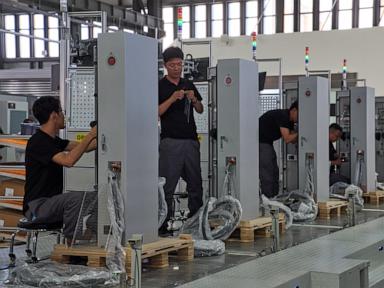
The morning shift at the manufacturing plant begins not with a bell, but with a low, vibrating hum that shakes the coffee in your paper cup. Outside, the fog hangs heavy over sprawling rows of shipping containers, stacked high like children's blocks against a grey sky. Inside, rivers of molten metal glow bright orange, casting long, dancing shadows across the faces of workers who have spent decades watching the world change through the lens of a production log.
They make things. Millions of things. Solar panels that gleam like blue glass mirrors under the fluorescent lights. Electric vehicle batteries packed tightly into grey aluminum casings, charged with the quiet promise of tomorrow. Turbines that spin in the wind miles away.
They make too much.
That is the accusation, anyway. Across the ocean, in glass-walled offices where coffee is sipped from porcelain instead of paper, economists look at spreadsheets and blink at the numbers. Excess capacity. A glut. A tidal wave of cheap goods threatening to crash onto foreign shores and wipe out local factories before they even have a chance to draw breath.
To understand why this matters, you have to step away from the abstract jargon of international trade policy and look at a hypothetical worker named Chen. Chen is forty-two. His hands are calloused from twenty years of welding frames for clean-energy technology. He does not think about macroeconomic theory or supply-side economics. He thinks about his quota. He thinks about the furnace that must stay hot. He thinks about the quiet pride he felt when his city transitioned from pouring cheap, dirty steel for skyscrapers to building the green infrastructure powering the future.
When foreign leaders threaten new tariffs, Chen does not see a diplomatic chess move. He sees a wall rising between his work and the people who need it.
"We are building for the earth," Chen says, wiping soot from his brow during a short break. His voice is drowned out by the roar of a stamping press. "How can building too much clean energy be a crime?"
It is a fair question. And it touches on the raw nerve of modern globalization.
Consider what happens next:
Trade ministers gather in sunlit European courtyards and American legislative halls. They point to falling prices. They point to factories running at fifty percent efficiency elsewhere while domestic plants sit shuttered and rusting. They argue that market forces are being distorted by state support, massive loans, and localized subsidies designed to keep employment high at any cost.
Prices drop. Consumers rejoice. Buyers snap up affordable electric vehicles and solar arrays, accelerating their transition away from fossil fuels. But behind the discount lies a creeping anxiety. What happens when the local factories vanish entirely? What happens when a single nation controls the entire supply chain of the green revolution, holding the keys to the future in a single industrial fist?
This is the paradox of our era. We demand climate action, yet we punish the massive production scale required to achieve it. We want cheap decarbonization, but we fear foreign dominance.
The defense from Beijing is swift and sharp. Officials argue that labeling these manufacturing feats as excess capacity is a mischaracterization born of protectionism. They point out that green technology is not a surplus of cheap plastic trinkets; it is the vital machinery needed to pull humanity back from the brink of ecological disaster. If the world needs millions of solar panels to fight rising temperatures, why criticize the factories brave enough—and big enough—to build them?
The truth, as it usually does, lives in the uncomfortable gray space between two opposing arguments.
Walk through a rust-belt town in the American Midwest, and the ghost of industrial history whispers from every abandoned brick warehouse. Here, workers remember what it feels like to lose an industry. They remember the silence of a parking lot that used to buzz with shift-change traffic. When cheap steel or subsidized technology floods their markets, they feel the chill of obsolescence. Their anger is real. Their fear is justified.
Yet, walk through the gleaming tech hubs of Shenzhen or the sprawling industrial parks of Anhui, and you feel a different kind of urgency. There, the drive is relentless. Stagnation is death. To stop building is to invite economic contraction, lost jobs, and broken momentum.
Tariffs are the blunt instruments chosen to bridge this chasm. Walls of taxes meant to slow the tide, buy time, and level a playing field that feels permanently tilted.
Will they work?
History suggests a complicated answer. Tariffs can protect a domestic industry, but they also raise prices for the everyday consumer trying to buy an electric car or install rooftop solar panels. They can heal a local wound while infecting the broader global economy with friction and distrust. They treat the symptom while leaving the root disease—a fundamental mismatch in industrial strategy and economic philosophy—completely untouched.
The tension between protection and progress is as old as commerce itself. It plays out not just in grand summits, but in the quiet kitchen table conversations of families wondering if their jobs will survive the next trade decree.
The smoke still rises from the chimneys on the horizon. The metal still flows. Across oceans, the arguments grow louder, echoing through halls of power while the simple, heavy work of building the future continues, unabated by the noise.