The air in South Beirut does not just carry the scent of exhaust and roasting coffee. It carries a vibration. It is a low-frequency hum, a collective holding of breath that has lasted for decades. When the television screens in the small, crowded cafes flicker to life and a bearded man in a black turban appears, the world outside the frame ceases to exist. This is not just a broadcast. It is an atmospheric shift.
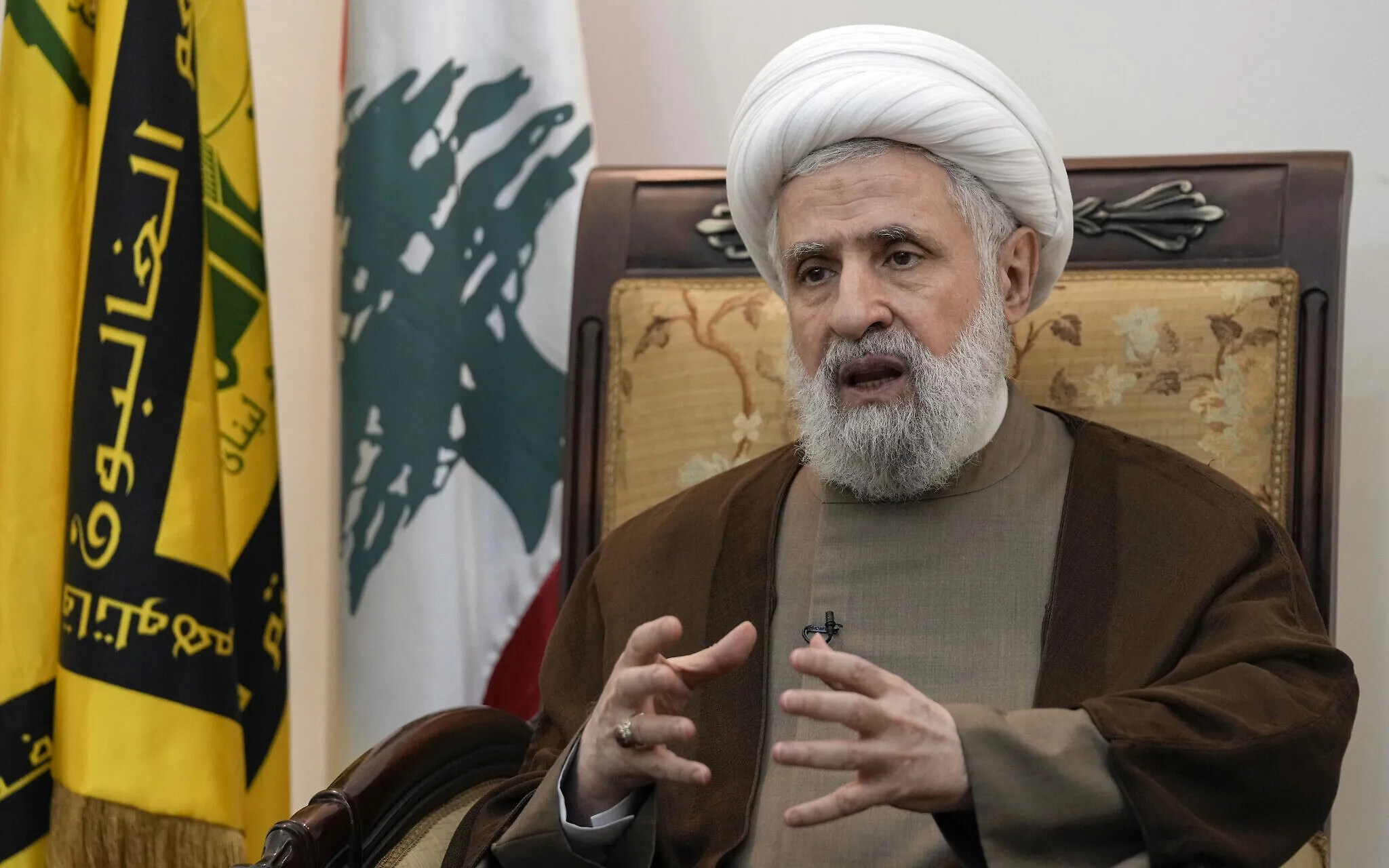
Naim Qassem stands at a podium that has seen the rise and fall of giants. He speaks with a voice that attempts to bridge the gap between the shadow of his predecessor, Hassan Nasrallah, and the brutal, metallic reality of modern warfare. The message remains frozen in time: the weapons will not be laid down.
To the strategist in Washington or Tel Aviv, this is a data point. It is a geopolitical stance to be countered with a specific tonnage of explosives or a new layer of sanctions. But to the family living in a third-story apartment in Dahiyeh, or the farmer watching his olive groves turn to ash near the border, these words are the architecture of their lives. They are the walls of a room they cannot leave.
Consider a man we will call Elias. He is hypothetical, but his exhaustion is real. Elias has spent forty years watching the cycle of defiance and debris. He understands that a "refusal to disarm" is not a bullet point in a press release. It is the reason his son sleeps in his clothes, ready to run. It is the reason the currency in his pocket feels like play money. When the leadership declares that the resistance is eternal, Elias hears the sound of another decade of his life being bartered for a cause that feels increasingly like a ghost.
The core of the matter is not found in the technical specifications of Iranian-made missiles or the range of a drone. It is found in the concept of the "Impossible Surrender."
For the leadership in the bunkers, the weapon is more than a tool of war. It is an identity. To put down the rifle is to cease to exist, not just as a military force, but as a cultural entity. They have painted themselves into a corner where peace is synonymous with erasure. This is the invisible stake that the evening news rarely captures. It is a psychological deadlock where the fear of losing face is more potent than the fear of losing a city.
The logic of the defiant is simple, yet devastating. They argue that the weapons are the only thing standing between Lebanon and total subjugation. It is a narrative of the shield. But shields are heavy. If you hold a shield for forty years, your arm muscles atrophy. Your spine curves. You forget how to use your hands to build, because they are always occupied with the weight of defense.
Look at the statistics of the recent escalations. Thousands of homes leveled. Hundreds of thousands displaced. These are not just numbers; they are the shattered remains of a middle class that was already gasping for air. The refusal to compromise is a high-stakes gamble played with other people's chips. The leadership bets the sovereignty of the nation against the survival of the movement.
The disconnect is staggering.
On one side, there is the soaring rhetoric of "Divine Victory" and "Unyielding Steadfastness." On the other, there is a grandmother in a shelter wondering if she will ever see her wedding photos again. The narrative presented by the competitor—the dry reporting of a warning issued—misses the friction. It misses the heat of the disagreement between those who want to live and those who are prepared to die for a legacy.
Why does it matter to you, reading this from a distance?
Because this is the blueprint for the 21st-century stalemate. It is the realization that in the modern era, military victory is often an illusion. You can decapitate a leadership, as has been done, and the body will continue to thrash, driven by a nervous system of ideology and historical grievance. The refusal to leave the battlefield is a declaration that the war is the destination, not a means to an end.
The silence that follows a speech like Qassem’s is the loudest part of the event. It is the silence of the international community realizing that the old diplomatic levers are disconnected from the machine. It is the silence of the Lebanese state, a ghost ship watching its self-appointed guardians steer it directly into the gale.
We often think of power as the ability to change things. But there is a darker, more stagnant form of power: the ability to prevent change. To keep the status quo frozen in a state of permanent friction. This is the power currently being exercised. It is the power of the "No."
No to disarmament. No to a different future. No to the possibility that the path taken forty years ago might have reached a dead end.
Elias sits on his balcony as the sun dips below the Mediterranean. The sky is a bruised purple. He hears the faint buzz of a drone, a mechanical mosquito that never sleeps. He looks at his hands, calloused and empty. He knows that as long as the ideology of the weapon remains the only currency, his hands will stay that way.
The tragedy of the "Warning" is not that it signals more fighting. The tragedy is that it signals no ending. It is a loop. A record with a deep scratch, playing the same defiant chord over and over while the house burns down around the turntable.
The fist remains clenched. But a clenched fist cannot hold a pen to sign a treaty, nor can it hold the hand of a child to lead them toward a horizon that isn't on fire. It can only strike, or wait to be struck.
Eventually, the arm gets tired.