Water tastes different when you know what is hiding underneath it.
To the casual observer passing through the sun-baked valleys of California, the earth looks solid enough. The soil is a rich, stubborn brown, cracked by heat and dusted with the pale residue of agricultural ambition. Orange groves stretch toward the horizon in military rows, drinking greedily from an invisible reservoir held deep within the subterranean dark.
For generations, we treated that underground world as an infinite basement. You drop a pipe, you turn a valve, and life arrives on the surface, cold and clear.
Until it isn't.
The Slow Invasion
Imagine standing by a well that has served a community for decades. The pump hums with its familiar, mechanical heartbeat, vibrating through the dry soil. The water pours from the spout, glittering in the blinding noon sun. It looks pristine. It smells like nothing.
Now, imagine knowing that every single gallon pouring from that pipe carries a ghost.
Contaminated groundwater does not arrive with a warning siren. It does not turn black or bubble like a witch’s cauldron. It moves in silence, a slow-motion tide of industrial solvents, agricultural runoff, and heavy metals seeping downward through the porous rock and sand. It pools in the ancient aquifers, quietly turning a community's lifeblood into a chemical hazard.
This is the hidden crisis beneath the Golden State. We spent a century learning how to suck the earth dry. We are only now learning how difficult it is to clean up the mess we left behind.
In many parts of California, cleaning up that subterranean poison requires massive diesel generators coughing smoke into the pristine valley air, burning fossil fuels just to clean up the contamination left by past extraction. It is a grim irony. You burn carbon to clean water, trading one environmental catastrophe for another.
Then, something shifted.
A Quiet Revolution in the Dirt
Two years ago, in a corner of the state where the sun is less of a luxury and more of a permanent fixture, an experiment began.
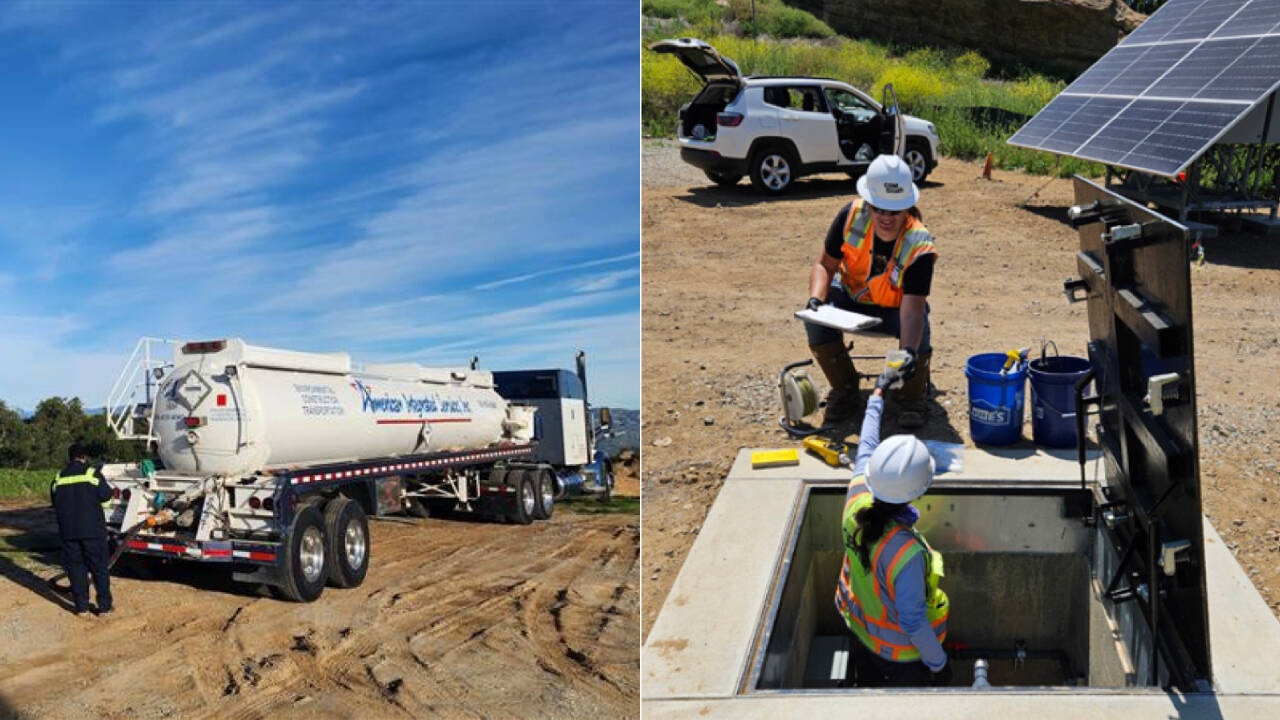
There were no ribbon cuttings. There were no press conferences with politicians holding oversized shovels. Just a group of engineers and hydrologists hauling a strange apparatus out into a field where the groundwater had long since been written off as collateral damage.
They brought a solar pump.
To call it a pump is to call a violin a piece of wood with strings. It is a self-contained ecosystem of extraction and purification, fueled entirely by the blazing canopy overhead. There are no diesel tanks to refill. There are no thick black exhaust plumes fouling the morning air. There is only the silent, unyielding conversion of sunlight into kinetic rescue.
The machine went to work. It began to drink.
Slowly, deliberately, the solar pump lowered its throat into the saturated earth. It did not rush. Water remediation is not a sprint; it is an excavation of time. Day after day, under temperatures that made the air shimmer like a mirage, the solar panels tilted imperceptibly, tracking the arc of the light, feeding their invisible hunger to the motor below.
Drop by drop. Gallon by gallon.
Measuring the Invisible
Sixty-five thousand gallons.
Say the number out loud. It sounds vast, an abstract figure on a spreadsheet, the kind of metric that gets buried in an environmental impact report and forgotten by Tuesday afternoon.
Now, look at it differently.
Sixty-five thousand gallons is enough water to fill three backyard swimming pools to the brim. It is enough to sustain a family of four for over two years. But more than that, every single one of those sixty-five thousand gallons represents a pocket of volatile organic compounds, industrial solvents, or agricultural nitrates that will never find its way into a kitchen tap, an irrigation ditch, or the root system of a local crop.
For two years, the machine worked. It pulled the tainted water up from the dark, routed it through advanced filtration matrices hidden inside unassuming metal housing units, and returned it to the environment cleansed, neutral, and safe.
No grid power. No carbon footprint. Just pure, stubborn engineering staring down a century of ecological neglect.
We often talk about climate resilience as if it requires massive, monolithic infrastructure—giant seawalls, continent-spanning power grids, trillion-dollar federal packages. We look for grand gestures. But the real transformation is happening in the dirt, powered by the most abundant, taken-for-granted resource we possess.
The sun.
What Lies Beneath the Valley Floor
Walk out into that field today and the silence is almost unsettling. The hum of the solar pump is low, easily drowned out by the dry rustle of eucalyptus leaves in the afternoon breeze. The water spilling from the discharge pipe runs clear, cool, and innocent.
You would never know what used to live in it.
That is the quiet triumph of the work. It does not demand applause. It does not trend on social networks. It simply stands under the brutal California sky, absorbing the light, converting the heat, and drinking the poison out of the earth.
We are a species defined by our messes. We dig too deep, we spill too much, we assume the earth is strong enough to absorb our carelessness. And sometimes, miraculously, we build something quiet enough and smart enough to start undoing the damage.
The sun rises tomorrow. The pump will turn. And somewhere deep beneath the cracked earth, another drop of water will finally come home clean.